
Do You Have to Prime Sheetrock Before Painting? A Guide for Property Owners
So, let's get right to it. Do you really have to prime sheetrock before painting? As a professional team that has helped countless homeowners and businesses, our answer is an emphatic yes. Skipping this step is one of the most common and costly mistakes we see, whether it's a home remodel or a new commercial build. It's a fast track to a blotchy, uneven finish that just won't hold up, creating headaches for property owners down the line.
The Short Answer Is Yes—Here's Why
Think of primer as the essential handshake between your new wall and your final paint color. Without it, the paint simply can't do its job correctly.
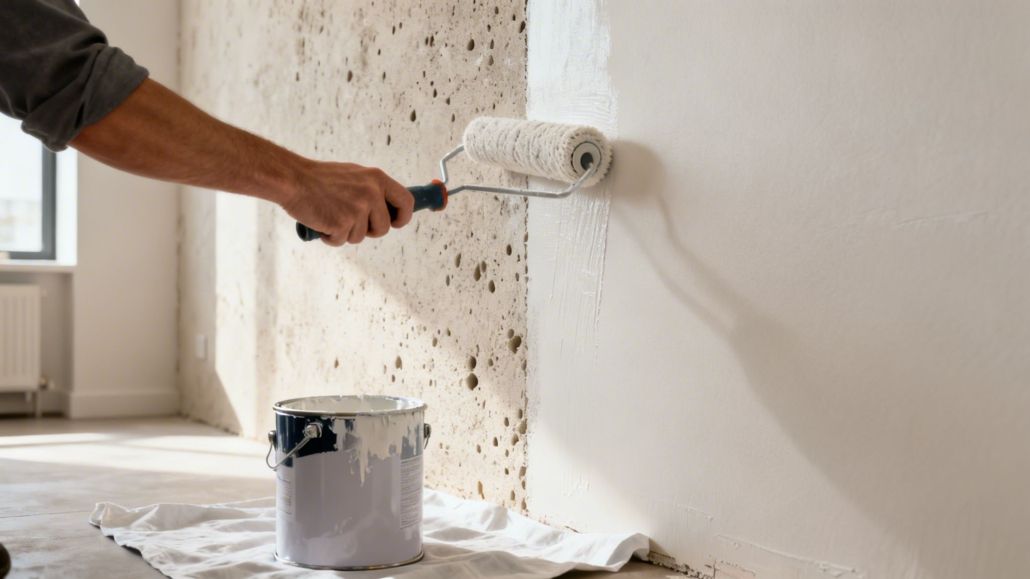
New sheetrock is a tricky surface. You're not dealing with just one material, but two very different ones: the porous paper facing of the drywall and the even more porous joint compound (the "mud") used over seams and screw holes. Each of these absorbs paint at a completely different rate.

Painting directly onto that inconsistent surface is like trying to paint a sponge right next to a piece of cardboard. The joint compound areas will greedily soak up the paint, making them look dull and flat—a frustrating issue we call "flashing." Meanwhile, the paper surface still drinks up a good amount of your expensive topcoat, forcing you to apply more coats than you should need just to get decent coverage.
The table below breaks down exactly why this initial step is so vital for achieving a professional finish for your home or business.
Why Priming Sheetrock Is Non-Negotiable
| Benefit | Impact of Priming | Consequence of Skipping |
|---|---|---|
| Seals Porous Surfaces | Creates a uniform, sealed base so paint dries evenly. | Paint soaks into the wall unevenly, causing blotches and flashing over mudded areas. |
| Ensures True Color | Blocks the dull gray of drywall and white of mud, letting your topcoat color shine. | The underlying surface mutes and distorts the paint color, requiring extra coats. |
| Improves Adhesion | Creates a strong bond between the wall and the paint. | Paint can easily peel, chip, or blister, especially in high-traffic or damp areas. |
| Consistent Sheen | Guarantees your chosen sheen (e.g., eggshell, satin) looks the same everywhere. | The sheen will appear flat over joints and shiny over the paper, creating a striped look. |
Ultimately, priming is what makes the difference between an amateur job and a professional one. It's the key to getting the durable, beautiful results you're paying for.
For business owners and facilities managers, a flawless finish is a direct reflection of your brand's quality. For homeowners, it's about satisfaction and long-term value. Priming is the foundational step that ensures success on any residential or commercial project.
Whether it’s a small residential remodel or a large-scale commercial build-out, priming new sheetrock isn't just best practice—it's the only way to protect your investment and ensure a professional, long-lasting finish. This single step prevents countless headaches and future repairs. At Wheeler Painting, our decades of experience have shown that meticulous preparation is the key to delivering results that stand the test of time for homeowners and businesses in our community.
How Primer Solves the Problem of Porous Drywall
Ever wondered why primer is such a big deal for new drywall? The simplest way to think about unprimed sheetrock is to picture a giant, thirsty sponge. The surface isn't uniform at all; it’s a mix of two very different materials. You have the paper face of the sheetrock and then you have the joint compound—what we call "mud"—spread over the seams and screw holes. That mud is even more absorbent than the paper.

When you try to paint directly onto this mismatched surface, the wall just drinks up the paint unevenly. The joint compound soaks in way more paint than the paper around it, which leads to dull, flat-looking spots. In the painting world, we call this annoying effect flashing or joint banding. It’s the classic tell-tale sign of a rushed or unprofessional job, leaving you with a blotchy finish where every seam and patch stands out.
Creating a Uniform Canvas for Paint
This is exactly where a good primer steps in. A high-quality drywall primer is engineered with a high-solids content and special binders that completely seal the pores on both the paper and the mud. It basically acts as a neutralizing layer, creating a uniform, non-porous canvas that’s ready for paint.
By sealing the surface, primer takes care of several crucial things at once:
- It equalizes absorption: Primer makes sure the entire wall, from the mudded joints to the open fields of paper, drinks in the paint at the exact same rate.
- It prevents flashing: With a properly sealed base, the sheen of your topcoat—whether it’s matte, eggshell, or satin—will look consistent and smooth across the entire wall.
- It improves paint coverage: Since the paint isn’t just getting sucked into thirsty drywall, your topcoat will spread further. This often means you can get the job done with fewer coats.
At the end of the day, primer is what allows the expensive paint you carefully chose for your home or commercial space to do its job. It helps the topcoat dry evenly and stick properly, giving you that smooth, flawless finish you expect in a modern home, a new retail build-out, or a professional office space.
Why "Paint-and-Primer-in-One" Isn't the Answer for New Drywall
We get this question all the time: "Can't I just use a paint-and-primer-in-one?" While those products can be useful for repainting a wall that's already in good shape, they are not a substitute for a dedicated primer on new, unpainted sheetrock. They are essentially just thicker paints and don't have the specific sealing power required to tame the extreme porosity of fresh drywall and joint compound.
For a truly durable and flawless finish on any residential remodeling or commercial construction project, there are no shortcuts. Using a dedicated drywall primer is the only way to correctly seal the surface, guarantee a professional appearance, and prevent common paint failures like peeling and flashing down the road.
When Priming Isn't Just a Good Idea—It's Essential
While we always recommend priming sheetrock, there are a few situations where it's not just a recommendation—it's a requirement. Skipping primer in these scenarios will absolutely guarantee a failed paint job, and we've seen it happen time and time again.
Knowing when primer is non-negotiable is key to protecting your investment, whether you're a homeowner doing a weekend project or a facilities manager overseeing a large renovation.
The clearest example is with brand-new drywall installation. New sheetrock isn't one uniform surface. It's a patchwork of thirsty paper and even thirstier joint compound over the seams and screw holes. If you try to paint directly over this, the paint will absorb unevenly, creating a blotchy, inconsistent finish called "flashing." No amount of extra topcoat will fix it.
The same rule applies after making significant repairs or patches. Even a small patch introduces a new, porous area on an existing wall. Paint over it, and that spot will look dull and flat compared to everything around it. Priming that one little area is the only way to make it truly disappear into the rest of the wall.
Color Changes and Problem Walls
Dramatic color changes are another make-or-break moment for primer. Trying to cover a dark or bold color—like a deep red or navy blue—with a new, light shade is a recipe for frustration. You could end up applying three, four, or even more coats of expensive paint, and the old color might still show through.
A good tinted gray primer acts as a reset button. It neutralizes that strong base color, so your new paint looks true and vibrant in just one or two coats. It's a simple step that saves a lot of time and money for any interior painting project.
At Wheeler Painting, we see the most critical need for primer after water damage. Here in Western Washington, where dampness can be a constant battle for property owners, priming isn't just cosmetic—it’s a crucial step to block lingering moisture, stop stains from reappearing, and prevent mold from coming back.
Finally, walls that have suffered water or smoke damage absolutely must be primed. You need a specialized stain-blocking primer here. These are formulated to permanently seal in ugly water stains, stubborn soot, and persistent odors that would otherwise bleed right through your fresh paint, sometimes for years to come.
In these tough situations, primer isn't just about appearance; it's a functional barrier that restores the wall's integrity. The data backs this up: proper priming can prevent up to 80% of common paint failures like peeling and blistering on challenging surfaces. You can find more great information on how primer creates a lasting bond from the Canadian Painting Contractors Association.
Choosing the Right Primer for Your Sheetrock Project
Okay, so you're on board with priming. That's half the battle. Now comes the important part: picking the right product. Walking into a paint store can be overwhelming, but it really boils down to just a few key types.
Think of primers like tools in a toolbox. You wouldn't use a sledgehammer to hang a picture frame, right? Same idea here. Each primer is engineered for a specific job, and matching the primer to the surface is the secret to a finish that looks truly professional.
Latex-Based (Water-Based) Primers
For the vast majority of interior jobs, especially with fresh sheetrock, a good latex-based drywall primer is your workhorse. These are water-based, which is great news for anyone working inside. They're easy to clean up, dry fast (often ready for paint in just an hour or two), and don't have the heavy, lingering smell you get with other types.
You’ll often see these labeled as “PVA” primers, which stands for polyvinyl acetate. This type of primer is specifically designed to tackle the two different textures on new drywall: the porous paper face and the even more porous joint compound. It seals them both, creating that uniform, non-absorbent canvas your paint needs to look its best and prevent flashing. Plus, its low-VOC (Volatile Organic Compound) formula is a much better option for indoor air quality in homes and commercial spaces.
Primer Type and Best Use-Case
To make it even clearer, here’s a quick guide to help you choose the perfect primer for your specific project needs.
| Primer Type | Best For | Key Feature |
|---|---|---|
| Latex (PVA) | New, unpainted drywall | Evens out porosity, low odor, fast-drying |
| Oil-Based | Water stains, marker, smoke | Excellent stain-blocking power |
| Shellac-Based | Severe stains, heavy odors, wood knots | Ultimate sealing for the toughest jobs |
For most new drywall, sticking with a quality latex PVA primer is your best and most straightforward choice.
Oil-Based and Shellac-Based Primers
While latex handles the everyday stuff, some situations call for the heavy hitters. This is where oil-based and shellac-based primers earn their keep as true problem-solvers.
Oil-Based (Alkyd) Primers: These are your stain-blocking champions. If you’re staring down a stubborn water stain, a wall scribbled with permanent marker, or soot from a fireplace, an oil-based primer is what you need. It creates a seal that water-based primers simply can't, locking the stain away for good. The trade-off? They have a much stronger smell and take longer to dry, sometimes 6-8 hours or more.
Shellac-Based Primers: When you’re dealing with the absolute worst stains and smells, you bring in the shellac. This is the ultimate sealer. It can permanently block severe smoke and nicotine odors from seeping through your new paint job. It's also fantastic for sealing tricky wood knots that love to bleed tannins. Shellac dries incredibly fast, but the alcohol-based odor is intense, so good ventilation is non-negotiable.
For most new drywall installations in home renovations or office space renovations, a quality water-based PVA primer is the most efficient and effective choice. It provides the perfect balance of performance, safety, and convenience, delivering dependable results without the harsh fumes of oil or shellac.
Just as the right exterior primer is critical when you're painting exterior siding, selecting the correct interior primer is the key to a flawless and durable finish inside your property.
The Professional Process for a Flawless Finish
Ask any seasoned painter, and they’ll tell you the secret to an exceptional paint job isn't in the final coat of paint—it’s in the prep work. This isn't just a preliminary step for us; it’s the most crucial phase of the entire project. What we do before a can of paint is even opened determines whether a finish looks good for a few months or stands strong for years.
It all starts with the drywall itself. In most homes and offices, you'll find what’s called a Level 4 finish. This is the industry standard where joints and screw heads get three coats of mud and a good sanding. But for rooms with lots of natural light or where a client wants a truly impeccable look, we aim for a Level 5 finish. This involves skim-coating the entire surface to create a perfectly uniform, glass-smooth canvas ready for paint.
From Sanding to Sealing
With the right drywall finish in place, the real prep work begins. This is a sequence of steps that no professional crew would ever dream of skipping.
- Final Sanding and Inspection: First, we pole-sand every wall to knock down any tiny ridges or tool marks. Then, we use a bright, angled light. This is our secret weapon for spotting subtle flaws that would be invisible under normal lighting but would scream for attention once the final paint goes on.
- Thorough Dust Removal: Next comes the cleanup. Every square inch of the surface gets wiped down with a damp cloth or vacuumed with a soft brush attachment. You have to get rid of all that fine gypsum dust, or the primer simply won't grab hold of the wall properly.
- Application of Primer: Finally, it's time to prime. A skilled painter will roll on the primer with an even, consistent hand, making sure every inch is covered without leaving behind any runs or heavy spots. This single coat seals the thirsty, porous drywall and creates the ideal foundation for the paint to adhere to.
This chart is a great visual shortcut for figuring out which primer to use for different situations, whether you're working with fresh drywall or trying to cover up tough stains.

As the guide shows, a good latex primer is your workhorse for new sheetrock. But for problem-solving—like covering water stains or sealing in odors—oil and shellac primers are absolutely essential tools in our arsenal.
This isn’t just our opinion; it's a standard that's been baked into the industry for decades. For instance, the Gypsum Association’s GA-214-96 standards are very clear: a Level 4 finish requires at least one full coat of primer, while a Level 5 finish calls for a high-quality primer plus two finish coats to achieve that perfect look. The commitment to proper prep work runs deep in our trade.
At Wheeler Painting, this is the standard we bring to every job, from a simple residential repaint to a major commercial renovation. We know from experience that taking the time for meticulous preparation is the only way to deliver a flawless, long-lasting finish our clients will love.
Understanding the whole picture, including the detailed work that goes into things like door and window casings, really shows the value of professional craftsmanship. You can learn more by reading our tips for painting trim.
Common Sheetrock Priming Mistakes to Avoid
Even when you know priming is the right call, a few common slip-ups can derail a project. Getting familiar with these pitfalls is the secret to achieving that professional finish your space deserves, and it highlights why hiring a trusted local provider delivers better results.
One of the biggest mistakes we see is reaching for a "paint-and-primer-in-one" product and expecting it to work on bare, new sheetrock. Think of these products as just thicker paints; they're great for repainting a similar color, but they don't have the right ingredients to seal up porous new drywall and mud. Using them on a fresh wall often leads to a blotchy, uneven finish and poor paint adhesion.
Ignoring the Details of Preparation and Application
Another major misstep is skimping on surface prep. All the primer in the world won't do a bit of good if it's applied over a layer of dust and debris. If you forget to thoroughly wipe down the walls after sanding, the primer just sticks to the dust—not the wall. That’s a surefire recipe for peeling paint down the line.
Beyond the prep work, a few application errors can also sneak in:
- Applying Primer Too Thinly: Trying to stretch a can of primer too far is a classic rookie move. You need a solid, uniform coat to properly seal the surface and even out its porosity. A thin, inconsistent coat is almost as bad as not priming at all.
- Ignoring Drying Times: Patience is a virtue, especially in painting. When you rush and paint over primer before it’s fully cured, you trap solvents and moisture. This can lead to bubbling, peeling, and a weak bond that will fail over time. Always check the can for the recommended recoat time.
- Using the Wrong Type of Primer: Grabbing a standard latex primer to tackle a nasty water stain is setting yourself up for disappointment. That stain will almost certainly bleed right through your topcoat. You have to match the primer to the problem—whether that means a latex, oil-based, or shellac-based product.
By sidestepping these common errors, you can be confident you’re taking the right steps to get the job done correctly. Every part of the process, from cleaning the walls to choosing the right product, adds up to a flawless, long-lasting finish. For larger projects, a clear process is everything, which is why a detailed construction quality control checklist can be an invaluable tool for any commercial construction or renovation project.
Common Questions We Hear About Priming Sheetrock
Even after you understand the 'why' behind priming, some specific 'what ifs' always pop up. We get these questions all the time from homeowners and business owners, so let's tackle them head-on with some quick, practical answers.
Can I Just Use My Regular Wall Paint as a Primer?
This is probably the most common question we get, and the answer is a firm no. It's a shortcut that seems tempting, but it creates more work in the long run.
Your regular topcoat paint just isn't formulated to do a primer's job. It lacks the high concentration of binders needed to seal up porous surfaces like new drywall and joint compound. If you skip the primer, the paint will soak in unevenly, leaving you with a blotchy, inconsistent finish that looks unprofessional. You'll end up needing extra coats of expensive paint to try and fix it, and even then, the adhesion will be weak. Always start with a dedicated primer.
How Long Do I Have to Wait to Paint After Priming?
Patience is key here, but thankfully, you don't usually have to wait too long. The drying time really depends on the type of primer you're using and the humidity in the room.
For most modern latex or acrylic primers, you're typically good to go in about 1-2 hours. On the other hand, if you're using an older-style oil-based primer, you need to give it much more time to cure properly—think 6-8 hours at a minimum, and sometimes it's best to just let it sit overnight. The can is your best friend here; always double-check the manufacturer's specific recoat instructions.
Do I Really Need to Prime Small Drywall Patches?
Yes, absolutely. Don't skip this step, no matter how small the repair is.
That little patch of spackle or joint compound is like a tiny sponge compared to the painted wall around it. If you paint directly over it, the patch will soak up the paint's sheen, creating a dull, flat spot that sticks out like a sore thumb. This visual defect is called "flashing." A quick dab of primer over the patch is the only way to make it disappear and ensure the final finish is perfectly uniform.
What’s the Worst That Can Happen if I Don’t Prime Drywall in a Bathroom?
In a high-moisture area like a bathroom, kitchen, or laundry room, skipping primer is asking for trouble. It's not just about looks; it's about protecting your walls.
An unsealed drywall surface will absorb moisture from steam and splashes. This moisture gets trapped behind the paint, causing it to bubble, peel, and fail prematurely. Worse, it creates the perfect damp environment for mold and mildew to grow within the wall itself. Using a high-quality, moisture-resistant primer is non-negotiable for protecting your investment in these important spaces.
Whether you're finishing a basement or updating a commercial office space, getting the prep work right is what separates an amateur job from a professional one. For a flawless finish that stands the test of time, you need a team that understands the challenges and delivers exceptional results. As a trusted local provider for residential and commercial construction services, we're here to help.
Ready to get it done right? Contact Wheeler Painting today for a transparent, stress-free estimate on your next project. Get your free estimate now.

 “Like” us on Facebook!