

How to Estimate Home Renovation Costs in Puget Sound
A lot of people in Kent, Seattle, and Tacoma start the same way. They stand in a kitchen that no longer works, stare at a bathroom that has seen better days, or walk through a commercial space and think, “We need to do something, but what is this going to cost?”
That question gets harder in Western Washington. Online calculators give quick answers, but quick answers are rarely useful when you are dealing with older housing stock, wet-weather detailing, city permit review, or labor pricing that does not look anything like a national average. If you are trying to figure out how to estimate home renovation costs, the right starting point is not a guess. It is a process.
Your Starting Point for a Realistic Renovation Budget
National averages can help you frame the conversation, but they should not be the number you build your project around. A typical 2,000-square-foot whole-home remodel averages between $100,000 and $200,000 nationally, or about $50 to $100 per square foot, and homeowners in Puget Sound often need to adjust those figures upward by 10-20% because of regional labor and material premiums, according to this renovation cost breakdown for homeowners and investors.
That does not mean every project is expensive. It means the answer depends on scope.
A repaint, drywall repair, and floor replacement is one kind of project. A kitchen remodel with layout changes, permit review, new electrical, and custom cabinets is another. A tenant improvement for an office or retail space is its own category entirely. People get into trouble when they treat all three like they can be estimated the same way.
Start with the decision, not the dream
Before you price anything, decide what kind of project you are planning:
Cosmetic work
Paint, flooring, trim, fixture swaps, and surface updates.System work
Plumbing, electrical, waterproofing, ventilation, or structural repair.Layout work
Removing walls, moving fixtures, reworking circulation, or converting space.Use-change work
Turning a spare room into a bathroom, updating a garage, or reconfiguring a commercial suite.
Each category changes cost in a different way. Cosmetic work is usually easier to estimate early. System and layout work bring more unknowns. Use-change work adds coordination, approvals, and more trade involvement.
Practical rule: If your project changes walls, wiring, plumbing locations, exterior openings, or occupancy use, do not rely on a ballpark number.
Local estimating works better because local conditions matter
A Seattle craftsman, a Tacoma rental, and a newer Kent home may all need “a kitchen remodel,” but they will not estimate the same. In Western Washington, moisture history, previous remodel quality, access for deliveries, parking, permit processes, and existing code conditions all influence cost.
That is why the best estimates are built in layers:
- Define the scope clearly
- Research local material and labor costs
- Build a line-item worksheet
- Add soft costs and contingency
- Compare contractor proposals against that worksheet
That approach gives you control. It also makes contractor conversations more productive, because you are not asking, “What do you think this costs?” You are asking, “How does your proposal line up with the work I want done?”
Scoping Your Project Like a Professional Contractor
The fastest way to get a bad estimate is to ask for pricing before the project is defined. Vague requests produce vague numbers. That is not a contractor problem. It is a scope problem.
A strong estimate starts with a line-item scope of work. The most common pitfall is accepting rough ballpark figures without detailed design documentation. As one estimating guide puts it, “any estimate without a plan is a guesstimate,” and for larger projects a pre-design cost estimate can prevent thousands in wasted design fees, as explained in this article on the best method to estimate renovation cost.

What belongs in your scope of work
Think like a builder for a moment. A contractor has to answer very specific questions before pricing can be reliable.
Write down:
Rooms or areas involved
List every space touched by the project, even if work there feels minor.Existing conditions
Note water staining, cracked drywall, damaged trim, old finishes, uneven floors, or access issues.Demolition items
Be clear about what gets removed and what stays.New work
Cabinets, countertops, siding, flooring, paint, lighting, doors, trim, tile, fixtures, hardware, waterproofing, drywall, and coatings.Trade work
Electrical, plumbing, carpentry, flooring, drywall, painting, siding, roofing, or specialty finishes.Finish level
Stock, mid-range, custom, or premium.Who is supplying what
Owner-supplied fixtures can affect schedule and coordination.
That list sounds basic, but it changes everything. If you ask for “a bathroom remodel,” you may get three totally different proposals. If you ask for “remove tub, install tiled shower, replace vanity, update fan, paint walls and ceiling, new waterproof flooring, keep toilet in place,” you can compare bids with much more confidence.
Split the work into must-haves and nice-to-haves
Achieving smart budgeting requires this step.
Most projects have a core scope and an optional scope. If you separate them early, you can protect the budget without feeling like the whole project failed.
For a Tacoma siding replacement, your must-haves may be damaged panel replacement, weather barrier corrections, caulking, and repainting. Your nice-to-haves may be upgraded trim details or replacing sections that are aging but not yet failing.
For a Seattle office renovation, your must-haves may be wall repairs, paint, lighting changes, flooring, and ADA-related updates. Your nice-to-haves may be a custom feature wall or upgraded millwork in the conference room.
Tip: If you want accurate pricing, separate your wish list from your required scope before you ask for bids.
Measure first, then describe
A lot of estimating mistakes come from bad dimensions. Even if you do not create formal plans, take clean measurements.
For residential work, record wall lengths, ceiling heights, window counts, door swings, fixture sizes, and floor areas. For commercial spaces, include entry widths, ceiling type, rough square footage by area, and any after-hours access constraints.
A short room-by-room worksheet helps:
| Area | Existing condition | Work requested | Notes |
|---|---|---|---|
| Kitchen | Worn cabinets, dated flooring | New cabinets, counters, paint, flooring | Keep sink wall in place |
| Hall bath | Moisture damage near tub | Replace tub surround, vanity, fan, paint | Check subfloor during demo |
| Exterior south wall | Siding wear and failed caulk | Repair siding, seal, repaint | Ladder access limited |
Use photos like part of the estimate file
Take wide shots and close-ups. Label them by room or elevation.
Photos help in two ways. First, they improve early conversations with contractors and designers. Second, they create a record of what you knew before demolition started. That matters when old water damage, patchwork electrical, or hidden framing issues show up later.
Know when pre-design estimating pays off
If your job involves additions, layout changes, custom work, or major structural revision, paying for early estimating can save money. The same estimating source above notes that a pre-design cost estimate can prevent wasted design effort on a project that is not aligned with the available budget.
That is especially useful in Puget Sound, where clients often begin with a rough target number that does not match the finish level or amount of work they have in mind. It is better to learn that before the drawings are complete.
Researching Costs in the Western Washington Market
Many homeowners start with a national average, then wonder why local proposals come back higher. The answer is clear. Western Washington pricing is its own market.
Most online guides are too generic for this region. In 2026, Puget Sound kitchen remodels can range from $250-450 per square foot, professional painting can range from $4-8 per square foot, regional labor rates can run $75-120 per hour, and Washington construction costs saw a 12% year-over-year rise due to labor shortages, according to this Western Washington renovation estimating article.
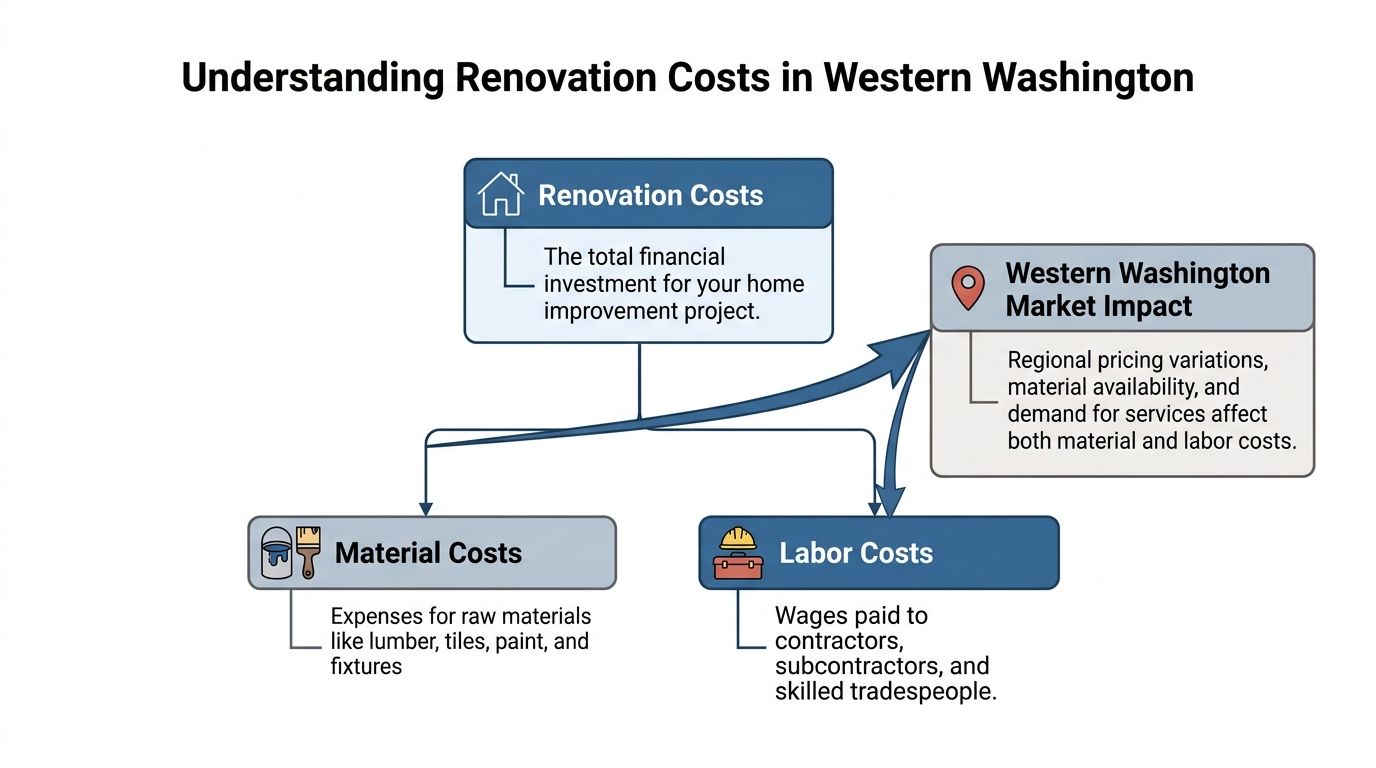
Those numbers explain why a low national estimate can be misleading in Seattle, Kent, or Tacoma. They also explain why labor often drives the conversation as much as material selection.
Material costs are only part of the story
Homeowners often focus on finish costs. Cabinets, tile, flooring, countertops, appliances, and paint are easy to shop.
What is harder to see is the installation burden behind them. A lower-cost tile may still require substantial prep. A beautiful light fixture may still need electrical changes. A cabinet package may look affordable until fillers, trim pieces, panel ends, delivery, and installation details are added.
That is why material shopping should happen in categories:
Base materials
Drywall, framing lumber, backer board, trim stock, primers, sealants.Finish materials
Cabinets, flooring, tile, counters, fixtures, doors, hardware, paint products.Protection and prep items
Waterproofing membranes, moisture barriers, floor protection, masking supplies, patch materials.Exterior weather-related items
Caulks, coatings, siding accessories, flashing components, and waterproofing products.
If you are building a budget worksheet, use supplier quotes where you can. For variable items, use allowances that reflect the quality level you want, not the cheapest placeholder you can find.
Labor is where local knowledge matters most
Labor pricing in Western Washington reflects skill availability, scheduling pressure, travel time, permit coordination, and site complexity.
A house in Seattle with tight access and street parking will estimate differently than a similar job in Kent with easy staging. A commercial repaint in Tacoma that must happen after business hours may also price differently than daytime work in a vacant suite.
Three local realities influence labor cost:
Older homes take longer
Many homes in the region have layers of previous work behind the walls and under the finishes. Surfaces may be out of square. Framing may be inconsistent. Moisture damage may need correction before finish work can begin.
That does not mean the project is a problem. It means labor hours rise when trades have to correct what they uncover.
Wet climate detailing adds tasks
Exterior work in Puget Sound often includes more prep, sealing, repair, and weather planning than a dry-climate estimate would assume. Even interior work can be affected if prior leaks, window failures, or moisture intrusion have damaged adjacent materials.
Commercial projects need coordination
For facility maintenance, tenant improvements, and office space renovation, labor is not just production. It is also scheduling, phasing, occupant protection, noise control, access planning, and cleanup standards.
Key takeaway: In Western Washington, the estimate that looks higher may be the one that includes the work your building requires.
Use local benchmarks carefully
Broad benchmarks can help with early planning, but they are not a substitute for line items.
If you are pricing a kitchen, use regional square-foot numbers only as an early guardrail. Then compare those numbers to the drivers in your project: cabinet count, layout changes, finish level, electrical scope, plumbing scope, drywall repair, flooring type, and paint requirements.
For a more detailed look at kitchen-specific cost drivers, this kitchen remodel cost breakdown is a useful companion when you are sorting out cabinets, finishes, and labor expectations.
A practical way to research without getting buried
Homeowners often over-research finishes and under-research installation. A better method is to split the job into decision groups.
| Cost group | What to verify locally |
|---|---|
| Finish selections | Product pricing, lead times, availability |
| Skilled labor | Current scheduling, access conditions, complexity |
| Site conditions | Parking, staging, protection, occupied vs vacant |
| Code-related work | Permit triggers, inspection requirements, corrections |
This keeps your early estimate grounded in reality. You are not trying to become a contractor. You are trying to create a budget that matches Western Washington conditions instead of a generic online average.
Building Your Preliminary Budget Worksheet
Once you have a clear scope and local pricing research, put everything into one worksheet. This is the point where scattered ideas become a working budget.
A budget worksheet should be plain and readable. If it is too complicated, you will stop using it. If it is too simple, it will hide important costs. The right version sits in the middle.
Build the worksheet by category
Use major categories that mirror how renovation work happens. Separate material and labor columns. That helps you see where costs are moving and where substitutions might help.
Sample Renovation Budget Worksheet
| Category | Estimated Material Cost | Estimated Labor Cost | Total |
|---|---|---|---|
| Demolition | |||
| Carpentry and framing | |||
| Drywall and texture | |||
| Electrical | |||
| Plumbing | |||
| Cabinets and millwork | |||
| Flooring | |||
| Tile and waterproofing | |||
| Interior painting | |||
| Exterior work | |||
| Permits and design | |||
| Contingency |
Fill in what you know. For unknowns, use allowances.
Use allowances the right way
An allowance is a placeholder for something you have not selected yet. This is common for tile, light fixtures, plumbing fixtures, hardware, or appliances.
Bad allowances are artificially low and make a proposal look cheaper than it will be. Good allowances reflect the level of finish you intend to buy.
For example, if you know you do not want builder-grade fixtures, do not use bargain placeholders in the worksheet. That only moves the cost surprise to later in the project.
Keep resale in mind, but do not budget by resale alone
Budgeting should match how you use the space first. Resale still matters, especially for kitchens and baths, but it should not be the only filter.
The 2025 Cost vs. Value Report notes that a mid-range kitchen remodel can cost over $50,000 and still recoup a significant portion of its cost at resale. That same source also stresses the need for a 10-20% contingency fund for unforeseen issues, as summarized in this remodeling cost and value discussion.
That gives you a practical budgeting principle. Spend intentionally on items that affect function, durability, and daily use. Be more selective on the pieces that are easy to upgrade later.
Contingency is not optional
A contingency fund is not extra padding for poor planning. It is protection against normal renovation uncertainty.
In Western Washington, contingency matters because older homes, moisture exposure, and prior remodel work can conceal conditions that are not visible during an initial walk-through. Once walls or finishes open up, the job may need corrections before the visible finish work can continue.
Tip: Put contingency in its own line in the worksheet. Do not scatter it across other categories where it becomes invisible.
Add one owner worksheet and one contractor worksheet
This helps avoid confusion.
Your owner worksheet should include everything you will spend, including design services, permit costs, finish purchases, temporary disruptions, and contingency. A contractor worksheet may only include the contracted construction scope.
When those two versions are separate, you can compare proposals more accurately and still track the full financial picture of the project.
Use a planning tool for larger additions
For larger residential remodeling projects, especially additions or space conversions, it helps to compare your own worksheet against a structured planning resource like this home addition cost estimator. The point is not to replace a site visit. It is to check whether your assumptions are in the right range before you move deeper into design.
Uncovering Permits and Other Hidden Renovation Costs
Most budget misses do not come from paint color or cabinet style. They come from the work people forget to include.
Permits are a big part of that. So are design fees, engineering input, debris handling, access limitations, and correction work uncovered after demolition. In Seattle and Tacoma, the permit process can also affect timing, which in turn affects scheduling and labor.

Permits change more than paperwork
A permit does not just add an application. It can change drawings, sequencing, inspections, and the order in which trades work.
That matters for projects involving:
- Electrical updates
- Plumbing relocation
- Structural modification
- Siding replacement tied to envelope corrections
- Additions and conversions
- Commercial tenant improvement work
In practical terms, permit-related work can reshape a budget because code-required corrections often appear once the city reviews the scope or once existing conditions are exposed.
Hidden costs usually come in clusters
Homeowners often think in single line items. Renovation costs tend to arrive in groups.
A bathroom example is common. You remove a damaged surround and expect finish replacement. Then the crew finds wet framing, damaged sheathing, old venting, and code-related updates. The “extra cost” is not one surprise. It is a chain of connected tasks.
Typical hidden-cost groups include:
| Hidden cost area | What often triggers it |
|---|---|
| Design and documentation | Layout changes, permit submittal, structural review |
| Protection and cleanup | Occupied homes, dust containment, debris hauling |
| Envelope corrections | Siding failure, flashing issues, water entry |
| Code compliance | Electrical, ventilation, guardrails, life-safety updates |
Post-damage repair estimates need special caution
Storm, flood, and other catastrophic repairs are where standard estimating formulas break down fastest. The visible damage is often only part of the scope.
Estimates for post-catastrophic event repairs often overrun by 25-40%, and in Puget Sound, water damage restoration can average $10,000-$50,000, with up to 30% of cost tied to unseen mold remediation and mandatory code upgrades, according to this renovation estimating guide focused on hidden costs.
That is exactly why disaster repair budgets should be built differently from elective remodel budgets. Insurance scope, demolition findings, drying requirements, contamination concerns, and code corrections all need to be reviewed together.
Practical rule: If your project starts with damage, do not estimate from finishes backward. Start with investigation, drying, safety, and code-related corrections first.
Western Washington adds its own soft-cost pressure
The region’s climate and building patterns create extra planning work. Exterior envelope repairs may require more scrutiny. Waterproofing details matter. Older properties may have a history of patch repairs that look acceptable on the surface but do not hold up once adjacent materials are removed.
Commercial spaces add another layer. If your office renovation or tenant improvement must happen around business operations, temporary protections, access controls, and schedule phasing become part of the project cost even if they are not obvious in the first sketch of the job.
How to Compare Contractor Bids and Reduce Costs
A low number can be expensive if the scope is thin. A higher number can be the better value if it includes the work required to finish the job properly.
That is why comparing contractor bids is less about price alone and more about clarity. You are not shopping for a single number. You are evaluating how each contractor understands the project.

Compare bids line by line
Put proposals next to your scope of work and look for gaps.
Check these items first:
Scope completeness
Does the proposal include demolition, prep, protection, cleanup, and finish work?Material specificity
Are products named clearly, or are they described vaguely?Allowance realism
Do fixture and finish allowances match the quality level you expect?Exclusions
What is not included? This section often explains why one bid is lower.Schedule assumptions
Does the price assume vacancy, clear access, or owner-supplied materials?
If one contractor includes drywall repair, moisture correction, primer, finish coats, and trim touch-up, while another says “paint bathroom,” those are not equal bids.
Red flags that deserve a second look
Some proposals signal trouble before a project even begins.
A few examples:
Too much ambiguity
Words like “as needed” or “standard prep” without detail can hide major differences in scope.Large categories with no breakdown
A single lump sum for a complex remodel makes it hard to understand what you are buying.Missing site conditions
If the estimate ignores access, protection, occupancy, or permit coordination, the job may not be fully priced.No discussion of change handling
Renovation projects change. Good proposals explain how changes are documented and approved.
If you want help evaluating contractor qualifications beyond price, this guide on how to choose a general contractor gives a useful checklist for comparing experience, communication, and proposal quality.
Cost reduction that does not weaken the project
Reducing cost is possible. The key is cutting the right things.
Here are the moves that tend to work:
Phase the project
If the full scope stretches the budget, split the project into logical phases. Do the work that protects the building or improves function first. Save lower-priority upgrades for later.
Keep the layout where possible
Moving plumbing, reworking electrical paths, or shifting walls adds complexity quickly. If the existing layout works reasonably well, improving finishes within that layout often creates a better cost-to-value outcome.
Standardize where it makes sense
Custom work has its place. So do straightforward materials and repeatable details. A clean, durable, well-installed standard finish usually performs better than a complicated premium feature installed under budget pressure.
Spend where failure is expensive
Do not cut corners on prep, waterproofing, surface correction, or substrate repair. In painting and renovation work, hidden prep often determines whether the visible finish lasts.
Key takeaway: Save on selections if needed. Be careful about saving on prep, waterproofing, or trade quality.
A short video can also help you think through the decision-making side of renovation planning before signing a contract.
Why a detailed proposal is worth more than a fast answer
Clients usually feel more comfortable once they can see the project broken into understandable parts. That is not just about trust. It improves decision-making.
A detailed proposal lets you revise the job intelligently. Maybe you keep the waterproofing scope and reduce tile complexity. Maybe you hold the office layout steady and postpone custom millwork. Maybe you repaint now and phase flooring into a later schedule window.
That flexibility is what good estimating creates. It gives you choices without losing control of the job.
Start Your Renovation with Confidence
A reliable renovation estimate is built, not guessed. It starts with a clear scope. It gets stronger when you use Western Washington pricing instead of generic national numbers. It becomes useful when you organize it into a line-item budget, account for hidden costs, and compare contractor bids carefully.
That process works for a kitchen remodel in Kent, a siding and exterior painting project in Tacoma, or a tenant improvement in Seattle. Different project types need different details, but the discipline is the same. Define the work clearly, price it locally, and leave room for what you cannot see yet.
If you approach the project that way, you can make decisions calmly instead of reacting to surprises.
If you are planning a remodel, repair, tenant improvement, or painting project in Kent, Seattle, Tacoma, or the towns in between, Wheeler Painting & Restoration Services can help you start with an on-site consultation and a clear, detailed proposal. Whether you need residential remodeling, commercial construction, facility maintenance, interior painting, exterior painting, drywall, waterproofing, or a smaller to mid-size build-out, Wheeler provides a single accountable team to help you price the work realistically and move forward with confidence.

 “Like” us on Facebook!