

How to Choose a General Contractor in Puget Sound
Your project’s success hinges on one key decision: choosing the right general contractor. This isn’t just about finding someone to swing a hammer; it’s about partnering with a professional who can bring your vision to life, on time and on budget. For homeowners, business owners, and facilities managers feeling overwhelmed by a construction or renovation project, this choice is paramount.
The selection process can be broken down into three crucial steps: verify their local experience, confirm they are fully licensed and insured, and review a portfolio of projects similar to yours. Getting these three things right is the foundation of a smooth, successful project.
Starting Your Project with the Right Partner
Choosing a general contractor in the Puget Sound region is arguably the single most important decision you’ll make for your project. Whether you’re a homeowner gearing up for a major kitchen remodel or a business owner managing a new retail build-out, this choice sets the tone for everything—from staying on budget to the final quality of the work.
A great contractor makes a complex process feel manageable and reassuring. The wrong one can lead to stress, unexpected costs, and frustrating delays. You’re not just hiring a builder; you’re looking for a professional with deep roots here in Western Washington who understands the unique challenges of our area and can guide you with clarity and expertise.
A contractor with years of experience right here in our community knows the ins and outs of local building codes, which materials hold up to our damp climate, and who the most reliable local subcontractors are. That kind of local, community-focused knowledge is invaluable.
Key Pillars of a Trustworthy Contractor
Before interviewing contractors or comparing bids, it helps to have a clear picture of what a qualified professional looks like. Focusing on these non-negotiables from the start will help you filter out the wrong fits and concentrate on the best candidates for your residential or commercial project.
- Proven Local Experience: A contractor who has been serving the Puget Sound area for decades has seen it all. They know how to navigate permitting with the City of Seattle versus Tacoma and have built solid relationships with the best local suppliers.
- Proper Credentials: This is a firm rule. A legitimate contractor will readily provide their Washington state license, liability insurance, and bonding. This is your safety net, protecting you from liability and financial issues if something goes wrong.
- Relevant Project Portfolio: Their past work is the best preview of what they’ll do for you. Look for a portfolio with projects that mirror yours in scope and style, whether it’s a detailed home restoration or a large-scale commercial construction project.
Following this simple vetting framework ensures you’re only spending time on truly qualified, trusted local providers.
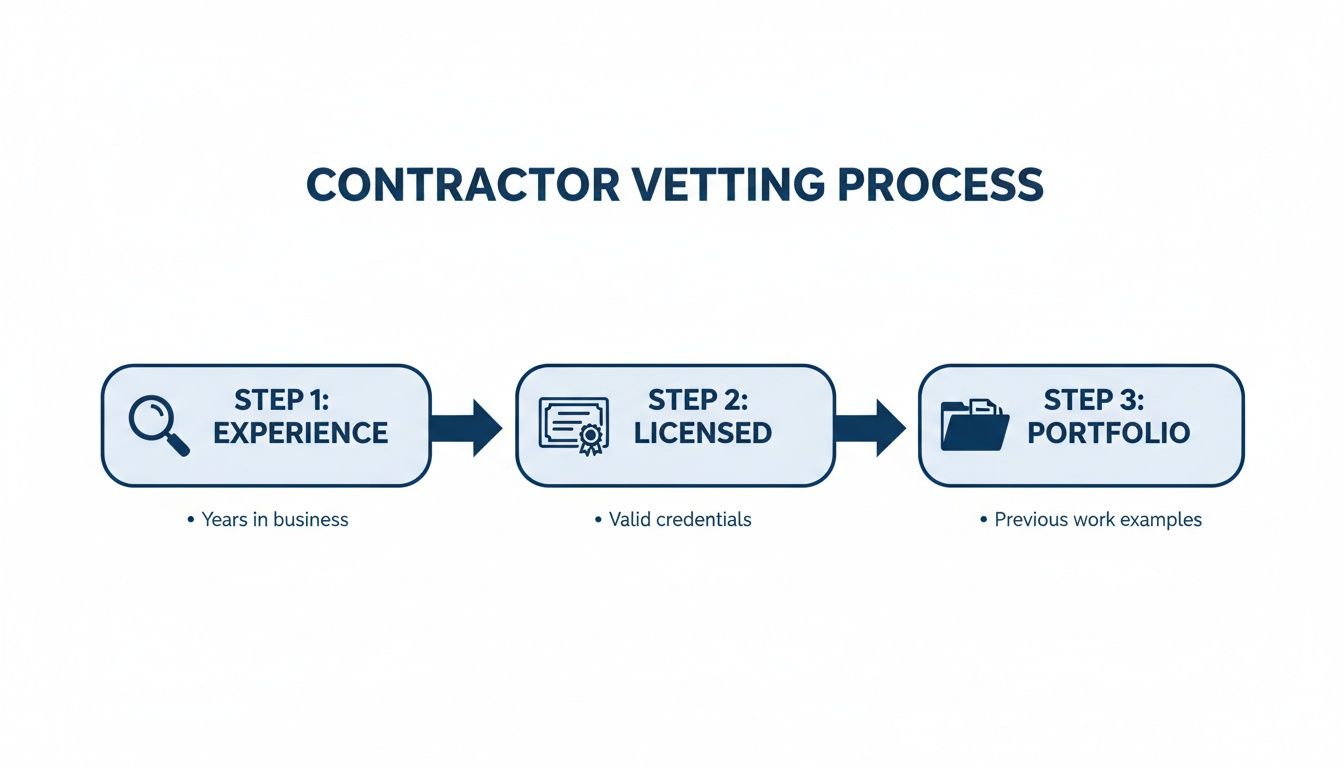
To make this initial screening process even easier, here is a quick checklist. Think of it as your first step to quickly qualify or disqualify potential contractors.
Quick Vetting Checklist for Your General Contractor Search
| Vetting Category | What to Look For | Why It Matters |
|---|---|---|
| Experience & Reputation | 10+ years in Puget Sound, positive online reviews, local references. | Deep local experience means they understand regional codes, climate challenges, and the best local subcontractors. |
| Licensing & Insurance | A valid WA State contractor license, general liability insurance, and proof of bonding. | This is non-negotiable. It protects you from financial risk, worksite accidents, and unfinished work. |
| Portfolio & Specialization | A gallery of completed projects similar to yours in size, style, and complexity. | You need a contractor who has successfully done this kind of work before, not one learning on your dime. |
Using this table as a guide helps you stay organized and objective as you begin your search. By systematically checking these boxes for every potential candidate, you build a strong foundation for a successful partnership and a project you can be proud of.
Verifying Licenses, Insurance, and Bonding

Before you begin discussing project details, there’s a crucial first step you cannot skip: verifying a contractor’s credentials. This isn’t just paperwork; it’s the single most important thing you can do to protect your property and investment.
You’ve likely heard the phrase “licensed, insured, and bonded.” It’s more than a slogan—it’s a three-part shield for your home, business, and peace of mind.
Here in Washington state, these are not optional; they are the absolute minimum standard for a professional. A contractor who has gone through the process of getting properly licensed, insured, and bonded demonstrates that they are a legitimate business committed to doing things correctly. It signals professionalism and protects you.
What Does “Licensed, Insured, and Bonded” Actually Mean?
It’s easy for these terms to blur together, but each one protects you in a specific way. Understanding the difference empowers you to ask the right questions and spot any red flags.
Let’s break it down in simple terms:
- Licensed: This is the state’s official approval. A contractor license from Washington’s Department of Labor & Industries (L&I) proves they’ve registered their business and are legally allowed to perform construction work. It’s the baseline for legitimacy.
- Insured: This refers to general liability insurance. If a worker accidentally damages your property, a neighbor’s fence, or causes an injury to a visitor on the job site, this insurance provides coverage. Without it, that liability could fall on you.
- Bonded: Think of a contractor’s bond as a financial safety net. It’s a type of surety bond that protects you if the contractor fails to complete the job, doesn’t pay their suppliers (who could then place a lien on your property), or otherwise defaults on their financial duties.
These protections are not just theoretical. In fact, research covering the U.S. construction industry landscape shows a clear trend: bonded and insured contractors successfully complete 35% more commercial expansions without claims. It’s a real-world risk reducer.
How to Verify a Contractor in Washington State
Don’t just take their word for it. Any reputable contractor will expect you to do your homework and will gladly provide their license number. Thankfully, Washington makes this incredibly easy.
The L&I has an excellent online Verify a Contractor tool. Just enter the company’s name or license number, and in seconds, you can see if their license is active, their insurance is up to date, and their bond is in good standing.
Consider this scenario: A painter working on your office building falls from a ladder and is injured. If the contractor isn’t properly insured, you, as the property owner, could be sued for their medical bills and lost wages. It’s a messy, expensive, and completely avoidable situation.
What to Look for on an Insurance Certificate
When a contractor provides their certificate of insurance, don’t just glance at it. You need to look for two specific things:
- Coverage Amount: For most residential or light commercial work, you should see at least $1 million in general liability coverage. For larger or more complex projects, that number should be higher.
- “Certificate Holder” Section: Ask your contractor to have you listed as a “certificate holder” on their policy for the duration of your project. It’s a simple request, and it means you’ll be automatically notified if their policy is canceled for any reason.
Taking a few minutes to verify everything might feel like a hassle, but it’s an investment that pays huge dividends in security and peace of mind. It’s how you separate the pros from the pretenders right from the start.
Matching a Contractor’s Experience to Your Project

It’s a common mistake to assume that any good general contractor can handle any project. The reality is that construction is a world of specialists. The skills needed for a custom home build are very different from what’s required for a fast-paced commercial office renovation.
Ensuring a contractor’s specific expertise aligns with your project’s demands is one of the most critical steps. It’s about more than looking at a photo gallery; you need to confirm that their hands-on experience matches what you need.
Looking Beyond a Polished Portfolio
When you’re reviewing a contractor’s past work, look for relevance in three specific areas: scope, style, and complexity. A beautiful picture of a finished kitchen doesn’t tell you if they had to move load-bearing walls, re-route plumbing, or navigate a tough permitting process.
Think like an investigator. If you’re a facility manager planning a retail build-out, seeing a portfolio full of residential bathroom remodels should be a red flag. Commercial projects run on different timelines, use different materials, and require a different communication style with stakeholders.
A proven track record in your specific project type is more than a confidence booster. It’s a direct indicator that they have refined processes, strong subcontractor relationships, and a deep understanding of potential roadblocks before they happen.
This is especially true for specialized work. For instance, if your property has suffered fire or water damage, a standard remodeler may not be the right fit. You need a restoration specialist who understands insurance claims, mold remediation, and structural drying.
Getting Real Answers From Relevant References
Asking for references is a standard step, but asking for the right kind of references is what separates a good choice from a great one. Don’t just accept a pre-approved list. Be specific.
If you’re a business owner planning an office space renovation, ask to speak with other business owners or property managers they’ve worked for. Then, ask targeted questions:
- Communication: How did they handle updates or unexpected issues? Was there a single point of contact?
- Budgeting: How close was the final invoice to the initial bid? Were change orders explained clearly and priced fairly?
- Scheduling: Did they finish on time? How did they manage delays from subcontractors or supplies?
Hearing from someone who has been in your exact shoes provides invaluable insight that a curated portfolio cannot offer. You can learn more about how a professional team manages these details by exploring our approach to residential construction services.
Why Decades of Local Experience Matter
Here in the Puget Sound, experience isn’t just a number—it’s a powerful tool for managing risk. A residential or commercial contractor who has been in business for decades has weathered economic downturns, material shortages, and countless updates to local building codes. That kind of adaptability is earned one project at a time.
This experience has a tangible impact. In regions like ours, seasoned contractors deliver 20-30% fewer delays on average. A recent 2025 construction market trends report highlighted a concerning trend: the Project Surety Index (PSI) jumped 19% year-over-year, driven by a shocking 88.2% surge in project abandonments, often tied to newer, less experienced firms. Choosing a contractor with a long history in Western Washington drastically lowers that risk.
A firm with thousands of completed projects, from small home improvements to large commercial build-outs, brings institutional knowledge that can’t be faked. They don’t just build things; they anticipate problems, find creative solutions, and ensure your project is built to last in our unique Pacific Northwest climate.
Asking the Right Questions: The Contractor Interview
You’ve done your research, checked credentials, and narrowed your list. Now comes the most important part: the interview. This is your chance to get a real feel for the person and company you’ll be trusting with your home or business.
Think of this as a conversation to see if you genuinely connect. You’re not just hiring a builder; you’re starting a partnership that could last for months. Their portfolio shows what they can do, but this conversation will tell you how they do it. Pay close attention to how they listen and explain things. Your gut feeling is often a good indicator of the future working relationship.
Questions About Their Day-to-Day Operations
These questions help you understand their process, their team, and how they manage the logistics of a construction site.
- Who is my main point of contact? This is essential. Will you speak directly with the owner, or will they assign a dedicated project manager? A single, consistent contact is key to clear communication.
- Tell me about your subcontractors. A contractor is only as good as their team. You want to hear that they work with a trusted, regular crew of plumbers, electricians, and other trades. Long-term relationships usually mean better craftsmanship and more reliable scheduling.
- How often will a supervisor be on-site? An absent contractor can lead to problems. Someone in a leadership role should be checking in frequently to ensure quality work and steady progress.
Gauging Their Communication Style
Every project can encounter a snag—a surprise pipe, a delayed material shipment. What separates pros from amateurs is how they communicate and handle those challenges.
You’re looking for a partner, not just a service provider. A great contractor is transparent and solution-oriented. They’ll bring you a problem, but they’ll also bring you well-thought-out solutions.
- How will we stay updated on progress? Be specific. Do they send weekly emails, use a project management app, or schedule regular calls? Having an agreed-upon system is what matters.
- What is your process for change orders? Changes can happen. A professional will have a formal, written process. Any deviation from the original plan should be documented in a change order detailing the new work, cost, and schedule impact. Crucially, you should approve this before the new work begins.
- Tell me about a time a project had a problem. What happened and how did you fix it? This question reveals a lot. If a contractor claims they’ve never had a problem, they are either inexperienced or not being honest. A seasoned pro will have a story and will focus on how they communicated with the client and solved the issue. You can see how an experienced team tackles a wide range of challenges by looking at our project portfolio.
Red Flags to Watch For
Sometimes, the most important information comes from what isn’t said. During your conversation, keep an eye out for these warning signs.
Be wary of any contractor who:
- Gives vague answers. A professional knows their process and should be able to explain it clearly and simply.
- Uses high-pressure sales tactics. A good contractor’s reputation speaks for itself. If they push you to sign immediately, it’s a red flag.
- Speaks poorly of former clients or their own crew. This points to a lack of professionalism and a tendency to shift blame.
- Seems disorganized. If they show up late or unprepared, imagine how they’ll manage a complex project with many moving parts.
How to Compare Bids and Understand Contracts
You’ve done your research and now have a few solid bids in hand. This is the moment where you move from interviews to hard numbers. It’s tempting to just look at the total and pick the lowest price, but that can be a costly mistake.
Learning how to compare bids is a skill. It’s about looking past the final number to understand what you’re actually getting for your money. A professional, detailed bid is a roadmap for your project. A vague one is a major red flag.
Beyond the Bottom Line: An Apples-to-Apples Comparison
The golden rule is to make sure you’re comparing identical scopes of work. If one contractor’s bid is significantly lower than the others, your first question shouldn’t be, “Why are they so cheap?” but rather, “What are they leaving out?”
An unusually low bid often signals trouble. It could mean they plan to use cheap materials, uninsured labor, or will hit you with expensive “change orders” later to make up for their lowball offer.
To do this right, break down each proposal line by line. Any professional contractor will provide this level of detail.
- Material Specs: Are they specific? Look for brand names, model numbers, and quality grades. A bid that says “siding replacement” is not the same as one that specifies “James Hardie Cedarmill Lap Siding.”
- Labor Costs: The bid should provide a clear picture of the labor involved. Vague descriptions can hide corner-cutting.
- Allowances: An “allowance” is a placeholder budget for items you haven’t selected yet, like countertops or light fixtures. Be wary of unrealistically low allowances meant to make the initial bid look more attractive.
- The “Extras”: Does the bid account for permits, daily site cleanup, and final debris removal? These details can add thousands to your final bill if not included upfront.
Why a Contractor’s Team Matters More Than You Think
When looking at labor costs, consider the crew. The skilled labor shortage is a real challenge in the construction industry. While the sector is expected to see modest growth into 2025, some areas like commercial and multifamily projects might plateau.
For homeowners and businesses in Puget Sound, a contractor’s ability to retain a skilled team is more critical than ever. Research shows that contractors with low employee turnover deliver projects 15-25% under budget more often. That’s a huge saving on a residential remodeling project or commercial renovation. You can learn more about how construction employment trends affect projects and see why a stable team is a sign of a well-run company.
Decoding the Construction Contract
Once you’ve selected the winning bid, it’s time to review the contract. This legal document protects everyone by laying out all expectations in black and white. A good contract should be written in plain language and feel fair and transparent.
Never sign a contract you don’t fully understand.
Your construction contract is the single source of truth for your project. It should eliminate ambiguity and provide a clear, agreed-upon plan for handling every aspect of the project, from payments to problem-solving.
Before you sign, make sure your contract includes these essential components:
- A Detailed Scope of Work: This is the heart of the document. It should list every task and material, referencing the bid and any plans. The more detail, the better.
- A Clear Payment Schedule: The contract must spell out how much is due and when. Payments should be tied to project milestones (e.g., foundation poured, framing complete), not just arbitrary dates.
- Project Milestones and Timeline: Look for a projected start date, key milestones, and an estimated completion date. It should also explain how potential delays will be handled.
- The Change Order Process: A formal process for any changes is non-negotiable. The contract must explain how changes will be priced and approved in writing by both you and the contractor.
- Warranty Information: The contract must clearly state what is covered by the contractor’s workmanship warranty, for how long, and how to file a claim if needed.
Signing a solid contract provides the peace of mind to move forward, knowing you have a fair agreement that sets your project up for success.
Answering Your Lingering Questions About Hiring a Contractor

Even after doing your homework, a few questions often remain. Choosing a general contractor is a big commitment, and it’s normal to want every detail clarified before you sign a contract.
Let’s walk through some of the most common questions we hear from clients in the Puget Sound. Our goal is to provide clear, straightforward answers so you can move forward with total confidence.
How Many Bids Should I Get for My Project?
You’ll hear different opinions, but the ideal number is usually three. Getting three detailed bids from contractors you’ve already vetted gives you a solid benchmark for what your project should cost. It’s enough to establish a clear market rate without becoming overwhelming.
The quality of the contractors you invite to bid matters far more than the quantity of bids. Three proposals from reputable, well-matched companies are infinitely more valuable than ten from a random list. To get a true apples-to-apples comparison, make sure every contractor is bidding on the exact same scope of work, materials, and plans.
What Is the Difference Between an Estimate and a Bid?
These terms are often used interchangeably, but in construction, they are very different. Understanding this distinction is critical for protecting your budget.
An estimate is a ballpark figure. It’s a rough approximation of cost, usually given early in the process before all project details are finalized. Think of it as an educated guess—it can, and often does, change.
A fixed-price bid, on the other hand, is a formal, binding offer. It is a document where the contractor promises to complete a very specific scope of work for a set total price. This provides you with budget certainty. Unless you approve a formal change order, that price is locked in.
For any project with a clear scope—from a siding replacement to a commercial tenant improvement—you should always insist on a detailed, fixed-price bid. It protects you and ensures everyone is on the same page about the total cost from day one.
What Are Some Red Flags to Watch Out For?
Knowing what to avoid is just as important as knowing what to look for. Your gut feeling is a great guide, but there are also concrete warning signs that should give you pause.
Be on high alert for any contractor who:
- Asks for a large down payment. A reasonable deposit is standard, but demanding 30%, 40%, or 50% upfront is a massive red flag. It often signals cash flow problems.
- Provides a vague proposal. A professional bid is detailed and transparent. A single page with a bottom-line number is a sign of unprofessionalism or a plan to add surprise costs later.
- Pressures you to sign immediately. A good contractor respects your process and gives you the time you need to review everything and make a smart decision.
- Cannot produce proof of licensing and insurance. This is non-negotiable. If they hesitate or make excuses when you ask, walk away immediately.
Perhaps the biggest red flag is a bid that seems too good to be true. An unusually low price often means they’ve missed something, plan to use cheap materials, or intend to recover their profit through a barrage of expensive change orders.
How Important Is Local Experience in Western Washington?
It is absolutely essential. A contractor who has spent decades working right here in Western Washington brings specialized knowledge you just can’t get from an out-of-towner. Our climate is beautiful, but it’s also tough on buildings.
A seasoned local pro knows this area inside and out.
- Climate-Specific Materials: They know which siding holds up to our rain, which paint formulas resist moss, and the right way to waterproof a foundation for our soggy winters.
- Permitting Nuances: They have experience with the permitting processes in King County, Pierce County, and other local municipalities, which can save you months of headaches.
- Subcontractor Relationships: They have a trusted network of local electricians, plumbers, and roofers they’ve worked with for years, leading to better quality work and a more reliable schedule.
Hiring a residential or commercial contractor with deep roots in the Puget Sound means you’re getting a partner who is invested in our community and knows how to build things that last here.
Ready to partner with a general contractor who brings decades of local experience and a commitment to quality? Wheeler Painting & Restoration Services has been serving homeowners and businesses across Western Washington since 1991. We’re ready to make your project straightforward and successful.








 “Like” us on Facebook!