Tag Archive for: interior painting Seattle

Sherwin Williams Kitchen Cabinet Colors: A Puget Sound Guide

A lot of homeowners in Seattle, Kent, and Tacoma stand in their kitchen and have the same reaction. The layout still works. The cabinets are solid. But the room feels tired, darker than it should, and harder to update than expected.

A full remodel isn’t always necessary to change that feeling. Cabinet painting can shift the whole room, especially when the color is chosen for Pacific Northwest light instead of copied from a bright, sun-heavy kitchen in another part of the country. In this region, overcast skies, common wood tones, and moisture from daily cooking all affect how cabinet paint looks and how long it lasts.

That’s why sherwin williams kitchen cabinet colors deserve more thought than a quick trip to the paint store. The right white can soften a dim kitchen and make it feel larger. The wrong greige can go flat. A dramatic navy or black can look polished in one home and heavy in another.

Your Guide to a Kitchen Transformation

A dated kitchen usually doesn’t fail all at once. It happens in layers. Yellowed cabinet finishes, busy wood grain, older hardware, and a color that absorbs more light than you realized. Before long, the whole room feels older than the rest of the house.

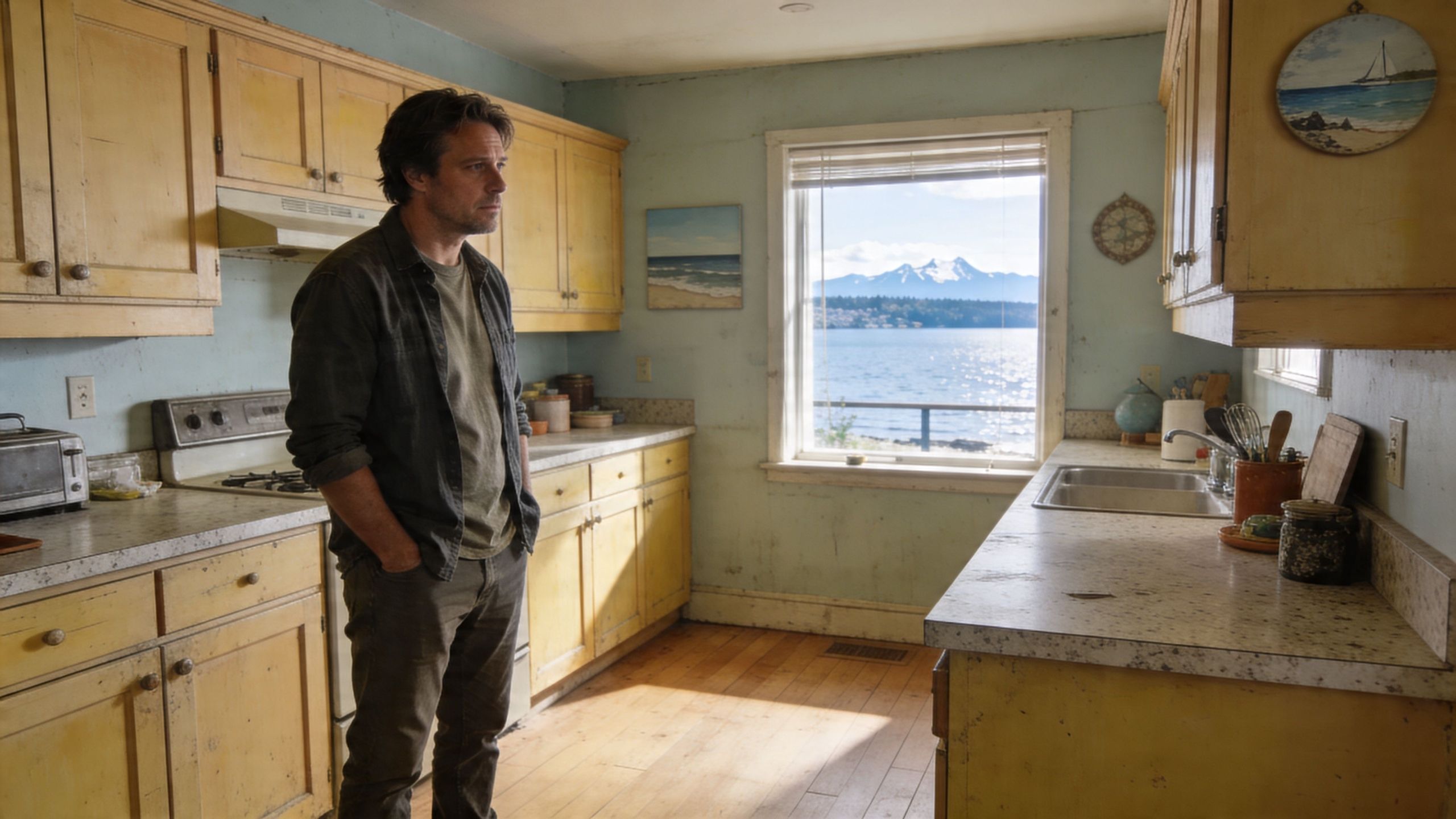
A man stands in a vintage kitchen with worn yellow cabinets, looking out a window at a scenic mountain landscape.

Cabinet painting is often the point where a kitchen starts feeling manageable again. You keep the footprint, avoid the disruption of a full tear-out, and put your budget where it changes the room most. For many properties between Seattle and Tacoma, that’s the practical middle ground between living with a dated kitchen and committing to a full renovation.

The part that overwhelms people isn’t usually the painting itself. It’s the color decision. White sounds simple until you see ten whites. Beige sounds safe until it turns pink or muddy. Black looks sharp online, then feels too heavy in a kitchen that doesn’t get much daylight.

A cabinet color never lives by itself. It always shows up next to countertops, flooring, backsplash tile, lighting, and the weather outside your window.

A smart starting point is to separate the visual change from the storage problem. If your kitchen also feels cluttered, this guide on how to organize kitchen cabinets helps homeowners think through function before they repaint around a layout that still isn’t working.

The payoff is real when the color is chosen well. Cabinets become the clean backdrop the room was missing, and the kitchen starts to feel brighter, calmer, and easier to maintain day to day.

Fundamentals of Choosing the Right Cabinet Color

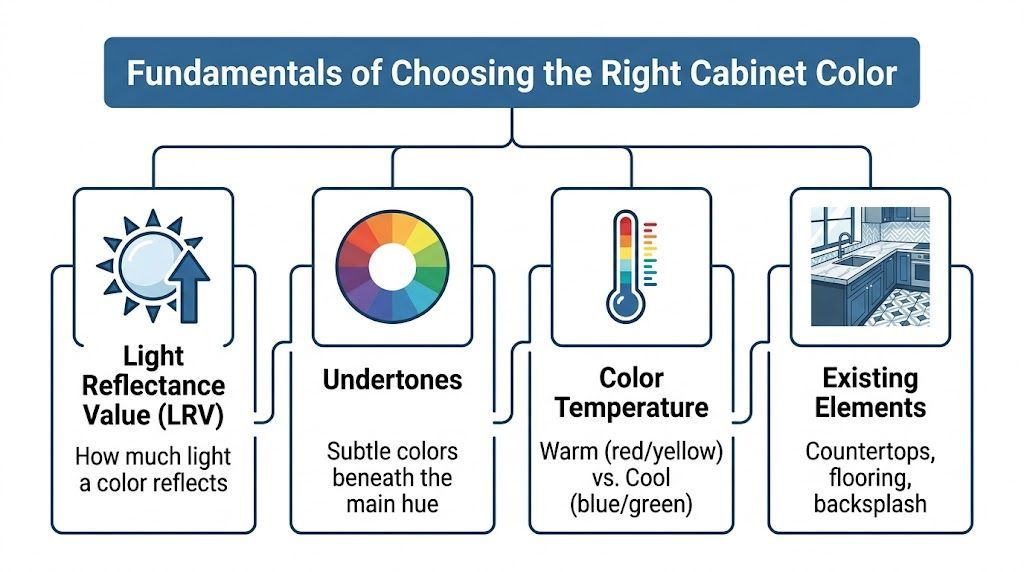
Most cabinet color mistakes come from choosing by name instead of performance. "White," "greige," and "navy" don’t tell you enough. The better approach is to judge each color by how it handles light, what undertone sits under it, and what sheen will look right after real daily use.

A helpful infographic showing four key factors to consider when choosing the right kitchen cabinet color.

Light reflectance matters more than most people think

LRV, or Light Reflectance Value, tells you how much light a paint color reflects. Visualize the difference between wearing a black jacket and a white shirt on a cloudy day. One holds onto light. The other throws it back into the room.

In Puget Sound kitchens, that matters. A higher-LRV cabinet color can help a room feel more open and less compressed during darker parts of the year. A lower-LRV color can look rich and grounded, but it needs the right setting.

Sherwin-Williams trends have also shifted away from cool grays toward warmer greige neutrals, bleached blondes, and bold matte navies, according to Sherwin-Williams Industrial Wood’s look at kitchen cabinetry trends. That move makes sense locally because warmer cabinet colors usually read more comfortably under overcast skies than sharp, icy grays.

Undertones decide whether a color works or fights the room

A cabinet color can look white at the store and still lean yellow, gray, green, or beige once it’s installed. That hidden bias is the undertone, and it’s often what creates the "something feels off" reaction.

Here’s what to check before committing:

  • Countertops first: If the counters have warm veining or creamy tones, a stark cool cabinet color can feel disconnected.
  • Flooring second: Orange-toned wood floors and some older fir trim can make cool cabinet colors look harsher.
  • Backsplash and wall color last: These can support the cabinet color, but they rarely fix a mismatch created by the larger fixed finishes.

For a broader comparison of common cabinet tones, this article on good colors for kitchen cabinets is useful as a secondary reference point when clients are trying to narrow down style direction before sampling.

If your existing cabinets are wood and you're trying to predict how paint and undertones will behave over the substrate, it also helps to understand the species you're working with. Wheeler has a practical overview of types of kitchen cabinet woods that can help you identify what’s already in the room.

Practical rule: Never judge a cabinet color from a tiny chip alone. Sample it beside the countertop, floor, and backsplash in both morning and evening light.

Sheen changes both the look and the maintenance

Color gets most of the attention, but sheen changes how cabinets wear. For most kitchens, satin and semi-gloss are the finishes worth considering.

Semi-gloss is easier to wipe down and usually gives you a crisper, more reflective look. Satin is slightly softer and can be more forgiving on older cabinet doors that have minor texture, grain telegraphing, or repair marks.

There’s also a trade-off with darker colors. Sherwin-Williams notes that matte and low-sheen finishes on darker cabinet colors can hide fingerprints up to 40% better than gloss finishes in high-traffic kitchens, based on its industrial cabinetry trend guidance linked above. That can be helpful on islands or lower cabinets where hands constantly hit the surface.

What usually works and what usually doesn’t

A few patterns show up again and again in the field:

  • What works: Warm whites in dim kitchens, balanced greiges with mixed metal finishes, and darker accent colors used with restraint.
  • What struggles: Cool gray cabinets in already gray rooms, very glossy dark finishes on busy family kitchens, and trendy colors chosen without testing them in local light.
  • What deserves patience: Two-tone kitchens. They can look excellent, but they need stronger coordination between counters, wall color, and hardware.

People don’t need hundreds of paint names. They need a filter for making fewer, better choices.

Top Sherwin-Williams Cabinet Color Palettes

Not every kitchen needs the same answer. Some need light. Some need warmth. Some need contrast so the room stops looking flat. The strongest sherwin williams kitchen cabinet colors usually fall into three practical groups: bright whites, softer neutrals, and bold statement colors.

A useful gallery of ideas for side-by-side comparison is Wheeler’s collection of kitchen cabinets paint color ideas. It helps clients narrow the conversation before moving into physical samples.

Timeless and airy whites

Pure White (SW 7005) is one of the safest recommendations for cabinet painting when the goal is to brighten the room without making it feel sterile. It has an LRV of 84 and reflects substantial light, which is part of why it remains a top cabinet choice in design roundups focused on Sherwin-Williams whites, as noted by Designing Vibes. It also sits warmer than many people expect, which helps it avoid that hard, clinical look.

Alabaster (SW 7008) is another strong option when a kitchen needs softness. Verified trend guidance for Sherwin-Williams cabinetry notes Alabaster (LRV 82) as a brightening choice that reflects 80%+ light and works well in smaller kitchens where space feels compressed. It tends to be easier with warmer counters and wood floors than a cooler white would be.

These whites work well with:

  • Quartz with soft veining
  • Subway tile or handmade-look backsplash
  • Brushed nickel, polished nickel, or unlacquered brass
  • Natural wood accents on shelves, stools, or flooring

Sophisticated neutrals and greiges

Not every kitchen wants white cabinets. In many Seattle-area homes, a white cabinet can feel too sharp against warmer flooring, natural wood trim, or existing stone surfaces.

Accessible Beige (SW 7036) is a dependable direction when the room needs warmth more than brightness. It sits in that neutral zone where it can work with both black and brass hardware and usually feels more grounded than off-white. In homes with alder or fir tones, that warmth often reads more intentional than a cool gray.

Evergreen Fog (SW 9130) fits homeowners who want a color but don’t want the kitchen to feel loud. Sherwin-Williams trend guidance places it in the warmer cabinet movement and describes it in the LRV 30-40 range, which gives it enough body to read as a muted statement without going dark. It can work nicely on islands or full cabinetry when the kitchen has decent natural light and simple counters.

Neutrals and greiges pair best with:

Cabinet direction Best supporting finishes
Warm greige Creamy quartz, stone-look backsplash, aged brass
Beige-neutral White counters, warm wood flooring, matte black hardware
Muted green-greige White oak accents, simple tile, mixed metals

If a kitchen has a lot of fixed warm material already, a slightly warmer cabinet color usually looks more expensive than forcing in a cooler trend color.

Bold and dramatic statements

Dark cabinets can look outstanding, but they’re less forgiving. They need enough light, enough contrast, and enough restraint.

Tricorn Black (SW 6258) is the cleanest black in this group. It was featured in Sherwin-Williams’ 2021 Colormix® Tapestry palette and has grown into a major statement option. Verified data notes that it now makes up 25% of top designer picks in inspiration galleries after that palette feature, making it one of the better-established dark cabinet choices rather than a short-lived novelty. Its strength is that it reads as a true black without obvious brown or gray drag.

Dark cabinet colors often work best in one of these layouts:

  • Island only: Strong contrast without taking over the room
  • Lower cabinets only: Keeps weight low and preserves brightness above
  • Full set in larger kitchens: Works when the space has strong lighting, lighter counters, and enough visual breathing room

For navy-leaning kitchens, Sherwin-Williams industrial trend guidance also points to colors such as In the Navy SW 9178 and Needlepoint Navy SW 0032 in the broader move toward bold matte navies. These are good candidates for people who want depth without going all the way to black.

Sherwin-Williams recommended cabinet colors

Color Name (SW #) LRV Undertone/Family Pairs Well With
Pure White (SW 7005) 84 Warm white Quartz counters, brass, nickel, light backsplash
Alabaster (SW 7008) 82 Soft warm white Warm woods, creamy counters, classic tile
Shoji White (SW 7042) 74 Off-white, warmer neutral Stone counters, softer backsplashes, warmer flooring
Accessible Beige (SW 7036) Qualitatively warm neutral Beige-greige Alder tones, black hardware, mixed metals
Evergreen Fog (SW 9130) 30-40 Warm green-greige White oak, simple tile, understated stone
Tricorn Black (SW 6258) Qualitatively very dark True black White counters, brass, concrete, wood accents

One note on color codes: Sherwin-Williams identifies cabinet colors by SW numbers, and that’s the most reliable way to specify them on a project. Because no verified HEX or RGB values were provided in the approved source material, it’s better not to rely on unofficial digital color conversions when making a final paint decision.

Color Strategies for Pacific Northwest Homes

National cabinet advice often misses what happens in a Seattle or Tacoma kitchen in February. Light is flatter. Shadows stay longer. Colors that looked balanced online can feel cooler, heavier, or duller once they’re installed in a real Puget Sound home.

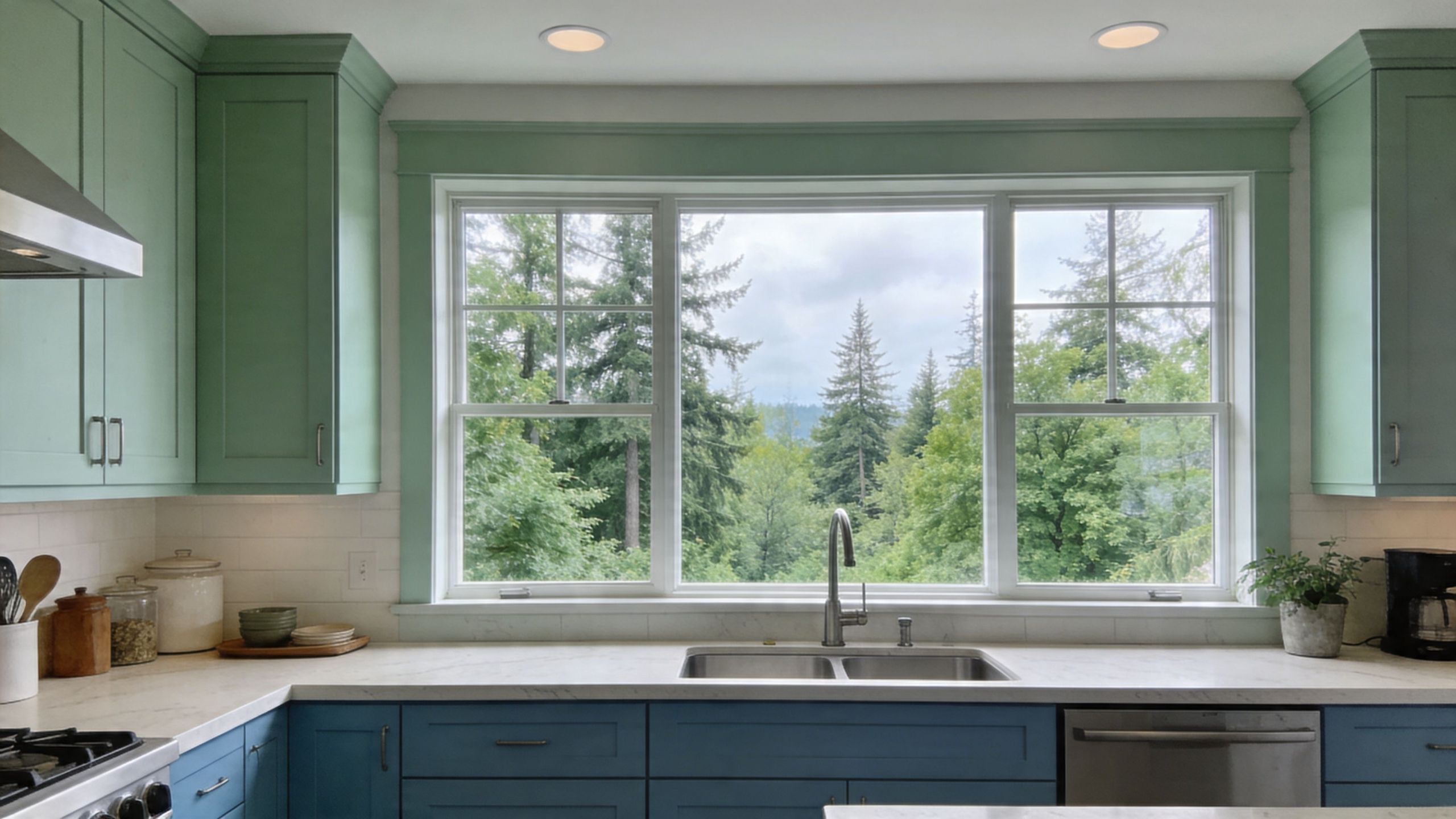
A modern kitchen featuring two-tone cabinetry with green upper cabinets and blue lower cabinets under a window.

The region averages 40% less sunlight than national norms, and one survey cited a 62% regret rate for non-neutral cabinets in dim climates, which is why warmer beiges and higher-LRV whites are often the safer long-term choice in local homes, according to this Studio McGee discussion of neutral kitchen cabinet color. That doesn’t mean bold colors are a mistake. It means they need better planning here than they might in a brighter market.

Use brightness deliberately, not automatically

A brighter cabinet color can help in kitchens with limited daylight, but brightness alone isn’t the goal. The goal is balance.

In north-facing kitchens or rooms blocked by neighboring homes, warm whites and soft neutrals usually hold up better than sharp cool whites. They bounce light without making the room feel washed out. In open-concept homes, they also tend to transition more naturally into adjacent living spaces.

Work with local wood tones instead of fighting them

A lot of homes between Kent and Tacoma still have natural wood floors, fir trim, alder cabinetry in nearby rooms, or wood accents that aren’t changing with the kitchen project. That matters.

Cabinet paint should support those materials, not argue with them. In practice, that usually means:

  • Warm whites for homes with honey or amber wood notes
  • Greige or beige-leaning neutrals when flooring has visible warmth
  • Muted greens or navies only when there’s enough contrast from counters and wall color

If the kitchen includes prominent wood elements, bring those samples into the color decision early. A paint color that looks calm on a sample board can go muddy next to warm fir or turn colder than expected against stone with gray veining.

Most PNW kitchens look better when the cabinet color relates to the wood tone somewhere in the house, even if it doesn't match it exactly.

Moisture changes the paint conversation

Puget Sound kitchens also deal with moisture differently. Daily cooking, cooler outdoor weather, and seasonal dampness create conditions where lower-quality products show their weaknesses faster.

That affects both color and finish. Dark colors can reveal failure sooner if the coating wasn’t built correctly. Lighter colors can yellow or get blotchy if the wrong product was used. A proper cabinet system matters more here because the environment is less forgiving.

For homeowners and facility managers, that means thinking beyond the paint chip. The right sherwin williams kitchen cabinet colors still need the right prep, primer, and topcoat system to stay attractive in a kitchen that sees steady use.

The Professional Process for a Flawless Finish

A cabinet finish earns its keep after the kitchen goes back to normal. Doors open and close hundreds of times. Pulls get grabbed with wet hands. Steam hangs in the room on dark winter mornings. In Seattle, Tacoma, and Kent, that daily moisture exposure is part of the job, so the process has to be built for wear from the start.

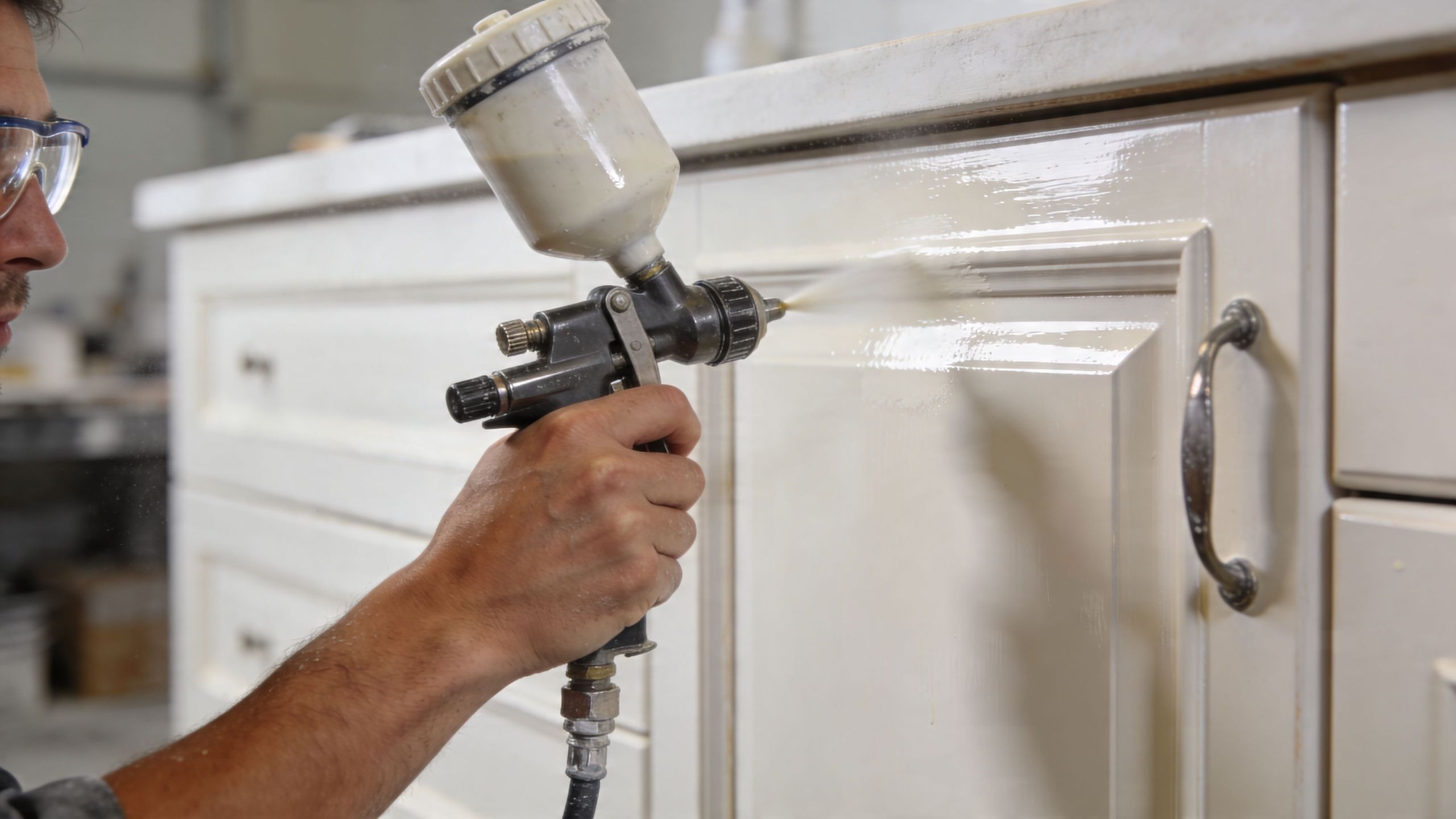
A professional painter uses a spray gun to apply fresh off-white paint to a kitchen cabinet door.

Prep does most of the hard work

Cabinets carry layers of contamination that homeowners rarely see. Grease near the range, polish residue on rail profiles, hand oils around pulls, and old cleaners all interfere with adhesion. If those contaminants stay in place, the new finish is more likely to chip at corners, fisheye during application, or wear prematurely around high-touch areas.

A proper prep sequence usually includes:

  1. Removing doors, drawers, and hardware so each piece can be coated cleanly.
  2. Labeling every part to keep reinstallation accurate.
  3. Cleaning and degreasing with extra attention near cooking zones and handles.
  4. Sanding or scuffing to create mechanical adhesion.
  5. Priming repaired areas and slick surfaces so the topcoat bonds evenly.

This is also the stage where old cabinet problems show up. Swollen MDF edges, failed caulk lines, hinge wear, and grain that needs filling are easier to correct before finish coats go on than after the color is applied.

Product choice matters more on cabinets than on walls

Cabinets need an enamel made for repeated contact and routine cleaning. Standard wall paint can look acceptable for a short time, but it usually does not hold up well on doors, drawer fronts, and face frames that get touched all day.

Sherwin-Williams Emerald Urethane Trim Enamel is a common choice for cabinet work because it levels well and cures to a harder finish than typical wall coatings. That matters in PNW kitchens, where moisture, cooking residue, and cooler indoor conditions can expose weak coating systems faster.

For homeowners weighing a full repaint against a more limited scope, Wheeler has a useful page on painting kitchen cabinet doors and drawer fronts. That decision affects labor, downtime, and how uniform the final result looks across the whole kitchen.

Field note: If a painter treats cabinet work like wall work, expect callbacks.

Application quality decides whether the finish looks factory-made or obviously repainted

Good spraying is only part of the job. Film thickness has to stay consistent. Dust has to be controlled. Recoat timing matters. So does temperature and humidity, especially during damp stretches common around Puget Sound. If the schedule gets rushed, the finish may dry unevenly, block when doors close, or show texture differences between frames and doors.

Cure time is where patience pays off. Cabinets can feel dry well before they are ready for full service, and that gap matters. I tell clients the same thing on nearly every project. A coating that gets handled too hard in the first few days can dent, print, or lose sheen before it fully hardens.

A general contractor with cabinet painting capability, such as Wheeler Painting & Restoration Services, can also be useful on broader kitchen projects because cabinet work often overlaps with drywall repair, trim updates, flooring protection, and schedule coordination with other trades.

Why Hire a Local Pro for Your Cabinet Project

Cabinet painting looks simple from a distance. Once the doors come off, the project becomes a finish-control job. Color selection, prep, dust management, dry time, hardware reinstallation, and protection of the rest of the home all have to line up.

That’s where DIY projects usually get expensive. The paint itself isn’t the only risk. The bigger risk is choosing a color that doesn’t work in local light, then applying it over a surface that wasn’t properly cleaned or primed. By the time those mistakes show up, the kitchen is already disrupted and the fix is rarely quick.

Local experience changes the recommendation

A contractor who works regularly in Seattle, Kent, Tacoma, and the communities in between sees the same recurring conditions:

  • Overcast light that cools colors down
  • Warm existing wood tones that affect undertones
  • Daily moisture and cooking residue that stress coatings
  • Older cabinet boxes and doors that need repair before paint

A local pro can spot these issues early and steer the project toward a practical result instead of a trendy one that won’t wear well.

Accountability matters on cabinet work

Cabinet painting is detailed work done in one of the busiest rooms in the property. Homeowners want the kitchen back. Facility managers want predictable scheduling. Property owners want the finish to hold up without constant touch-ups.

That’s why local accountability matters. If something needs adjustment, you’re not dealing with an out-of-area crew that has already moved on. You’re working with a contractor who serves this market and understands the expectations here.

The right hire doesn’t just apply paint. They protect the schedule, the surrounding finishes, and the long-term look of the kitchen.

It also helps on larger renovation projects

Some cabinet jobs stay small. Others turn into broader updates once the homeowner sees the opportunity. New flooring, drywall repair, backsplash replacement, tenant improvements, small retail refreshes, or office breakroom updates often tie into cabinet refinishing decisions.

Working with a contractor that handles both painting and broader residential or commercial construction can simplify those moving parts. Instead of coordinating several separate vendors, you have one point of contact who can keep the sequence organized.

For many property owners, that reduction in friction is just as valuable as the paint color itself.

Frequently Asked Questions About Cabinet Painting

How much does it cost to have kitchen cabinets professionally painted in the Seattle area

The exact price depends on the number of doors and drawers, the condition of the existing finish, how much prep is required, whether the boxes and interiors are included, and whether the project is part of a larger remodel. A small, straightforward repaint is very different from a kitchen with heavy grease, damaged doors, or layout-related carpentry work.

The most reliable way to price it is with an on-site estimate. That lets the contractor inspect the surface condition and confirm the scope before anyone promises a number that won’t hold.

How long does the cabinet painting process take

Most cabinet projects take several days from prep through reinstallation, and some take longer depending on drying conditions, complexity, and whether other work is happening in the kitchen at the same time. The timeline is driven less by how fast paint can be sprayed and more by how carefully the surfaces are prepared and how much cure protection is built into the schedule.

If someone promises an unusually fast turnaround, ask what they’re skipping.

Can I still use my kitchen during the project

Usually, yes, but not normally. Expect disruption. Doors and drawers may be removed, access may be limited, and parts of the kitchen may be off-limits during prep, spraying, or curing.

Most homeowners do best when they set up a temporary kitchen zone in another room with coffee supplies, a microwave, and a few everyday dishes. That takes the pressure off the main kitchen while the work is underway.

How durable are painted cabinets over the long term

Painted cabinets can be very durable when the project uses the right prep, primer, and cabinet-grade enamel. Long-term durability depends on the system, not just the color. Cabinets painted with a product designed for trim and cabinetry, and allowed to cure properly, will hold up much better than cabinets coated with ordinary wall paint.

Daily care matters too. Use gentle cleaners, avoid slamming doors, and give fresh paint time to harden before treating it like a fully cured factory finish.


If you're planning cabinet painting, a kitchen refresh, or a larger residential or commercial improvement project in Seattle, Kent, Tacoma, or the communities in between, Wheeler Painting & Restoration Services can help you sort through color selection, surface prep, and project scope with a clear on-site consultation and estimate.

10 Modern Paint Ideas for Wood Paneling

That dark paneling is still doing what it was built to do. It adds texture, warmth, and a little insulation. The problem is that in a lot of Seattle, Kent, and Tacoma homes, it also makes a room feel heavy. In offices and tenant improvement spaces, it can read more dated than intentional. Many people stand in front of it and assume the only real fix is demolition.

Usually, it isn’t.

Wood paneling became a major part of American interiors in the 1950s, peaked in the 1970s, and then fell hard out of favor as tastes moved toward cleaner, lighter spaces, according to Hunker’s overview of paint colors that go with wood paneling. That’s why so many Puget Sound properties still have solid wood, veneer, MDF, or laminate panels that are structurally fine but visually tired.

Painting is often the smarter move. The same source notes average professional painting costs of $1,500 to $3,000 for a 12×12 room, compared with $5,000 to $10,000 for removal and drywall replacement. For homeowners and property managers, that difference matters.

At Wheeler Painting, we see this all the time. A living room in Kent needs light. A paneled office in Seattle needs to look current. A commercial space between Tacoma and Seattle needs a finish that can handle daily wear without turning into a maintenance problem. Good prep, the right primer, and a finish that suits the space make the difference between a clean update and a peeling mess.

If you're collecting paint ideas for wood paneling, start with looks that work in real buildings, not just in design photos. If you want broader inspiration for lighter, breezier interiors, these coastal home decor ideas can help you think through the overall room. Below are ten approaches we recommend most often, along with the trade-offs that people should know before they open a paint can.

1. Matte or Eggshell Finish Over Wood Paneling

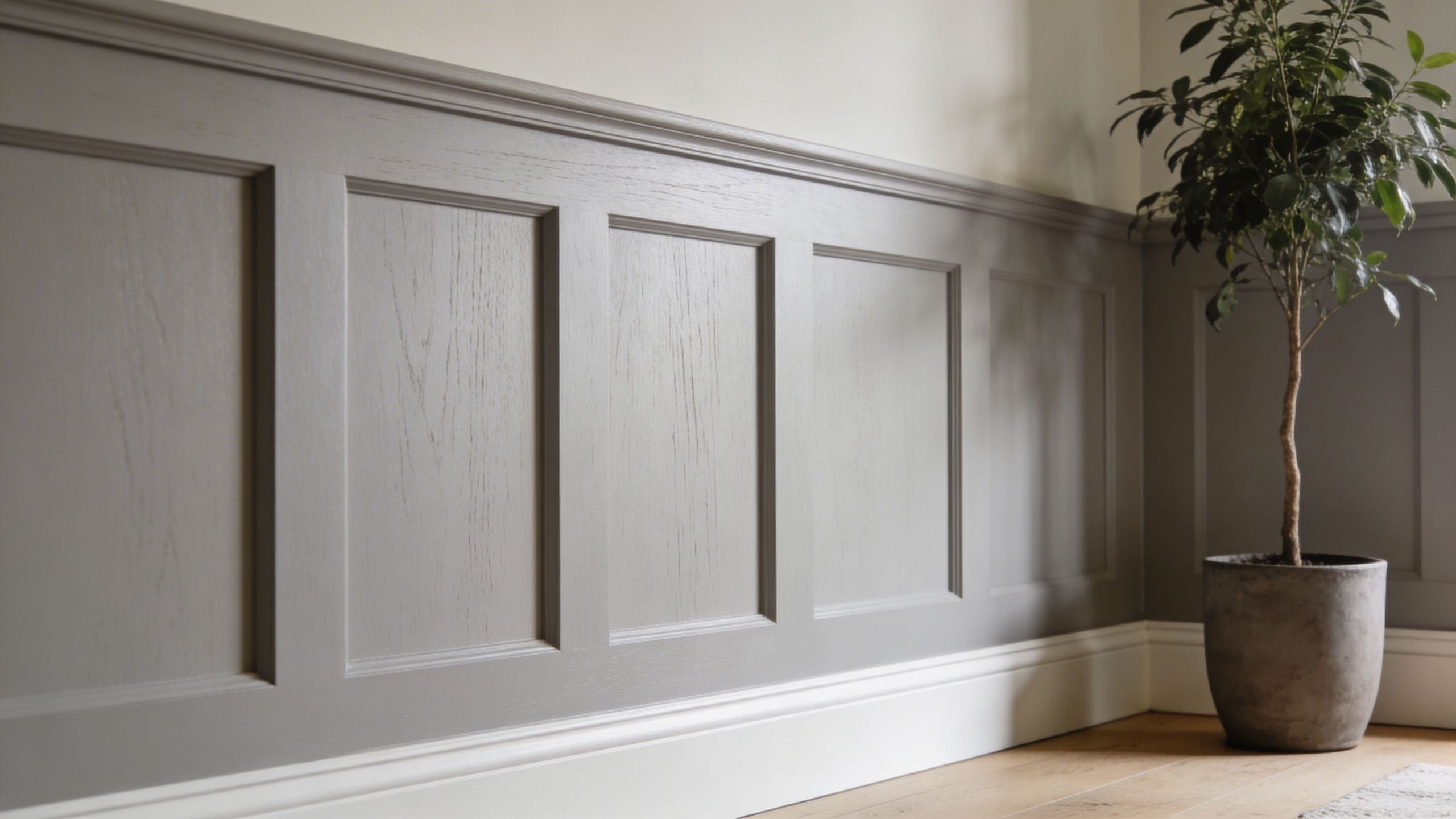
A minimalist room corner featuring grey wood paneling, white baseboards, and a small potted houseplant.

A simple solid-color paint job in matte or eggshell is still the safest update for most paneled rooms. It keeps the panel profile, hides a lot of age, and doesn’t try too hard. In Seattle living rooms and Kent bedrooms, this is often the finish that gives old paneling a clean reset without making the wall look plastic.

Matte looks softer. It cuts glare and helps grooves and seams recede. Eggshell reflects a little more light and is easier to wipe down. In houses with kids, pets, or busy hallways, eggshell usually holds up better.

Where this works best

This approach fits spaces where the paneling itself isn’t special enough to preserve as wood, but still adds useful texture. I’d use it in:

  • Living rooms and dens: Soft whites, warm grays, and muted greige tones calm down dark paneling fast.
  • Home offices: Eggshell gives a more finished look without the shine of satin.
  • Commercial offices: Matte can look sharp in conference rooms, but only if the walls won’t be touched often.

CertaPro states that interior latex paint in a satin finish is the top recommendation for painted wood paneling and cites 98% coverage efficiency on properly prepped surfaces. Even when clients choose matte or eggshell for appearance, that durability benchmark is a good reminder that prep is doing the heavy lifting.

Practical rule: If the paneling is glossy, fake wood, or old veneer, primer matters more than color.

What works and what doesn’t

Light sanding helps. For slick surfaces, the verified data points to products like Insl-X Stix Primer for difficult adhesion, with 95% adhesion success on challenging glossy veneers. After that, use thin coats. Thick paint builds up in grooves and can make paneling look muddy.

If your paneling has stain bleed, smoke residue, or old waxy polish, don’t skip cleaning and testing. The best finish in the world won’t save a bad substrate. If you’re dealing with stained wood and wondering how the prep changes, Wheeler’s guide on painting over wood stain is a useful starting point.

2. Accent Wall or Color Blocking

Not every paneled room needs all four walls painted the same way. Sometimes the smartest move is restraint. One paneled accent wall can keep the room’s character while letting the rest of the space breathe.

This is one of the better paint ideas for wood paneling when the room already has good natural light. In Tacoma dens, Seattle studies, and commercial reception areas, a darker feature wall can feel intentional instead of outdated.

Strong color without a heavy room

Deep navy, muted forest green, charcoal, and warm clay tones all work well on paneling because the grooves add shadow and depth. A flat drywall wall in the same color can feel plain. Paneled texture gives it more presence.

For open-plan homes, color blocking can also help separate uses. A paneled dining nook in a warmer tone can feel distinct from an adjacent living room painted in a soft neutral. In offices, one brand-color wall often does more than painting everything bold.

The verified data notes that in today’s paneling projects, 75% opt for lighter hues to brighten spaces by reflecting up to 80% more light. That tracks with what we see locally. If a room is already dark, keep the bold color limited to one wall.

Clean lines matter here

With color blocking, sloppy edge work ruins the effect. Tape carefully, test samples on the actual paneling, and watch how the color changes from morning to evening. Grooves can throw shadows that make a color feel deeper than it looked on a swatch.

A couple of combinations that tend to work:

  • Soft white with charcoal: Good for family rooms and modern farmhouse updates.
  • Warm beige-gray with deep green: Strong in libraries, dens, and office spaces.
  • Light greige with muted blue: Safer for commercial interiors where you want personality but not drama.

If you want more combinations before choosing a feature wall, Wheeler has a helpful page on accent wall color ideas.

Bold paneling works when the rest of the room gives it room to breathe. If every surface is shouting, the paneling usually loses.

3. Whitewashing or Limewash Finish

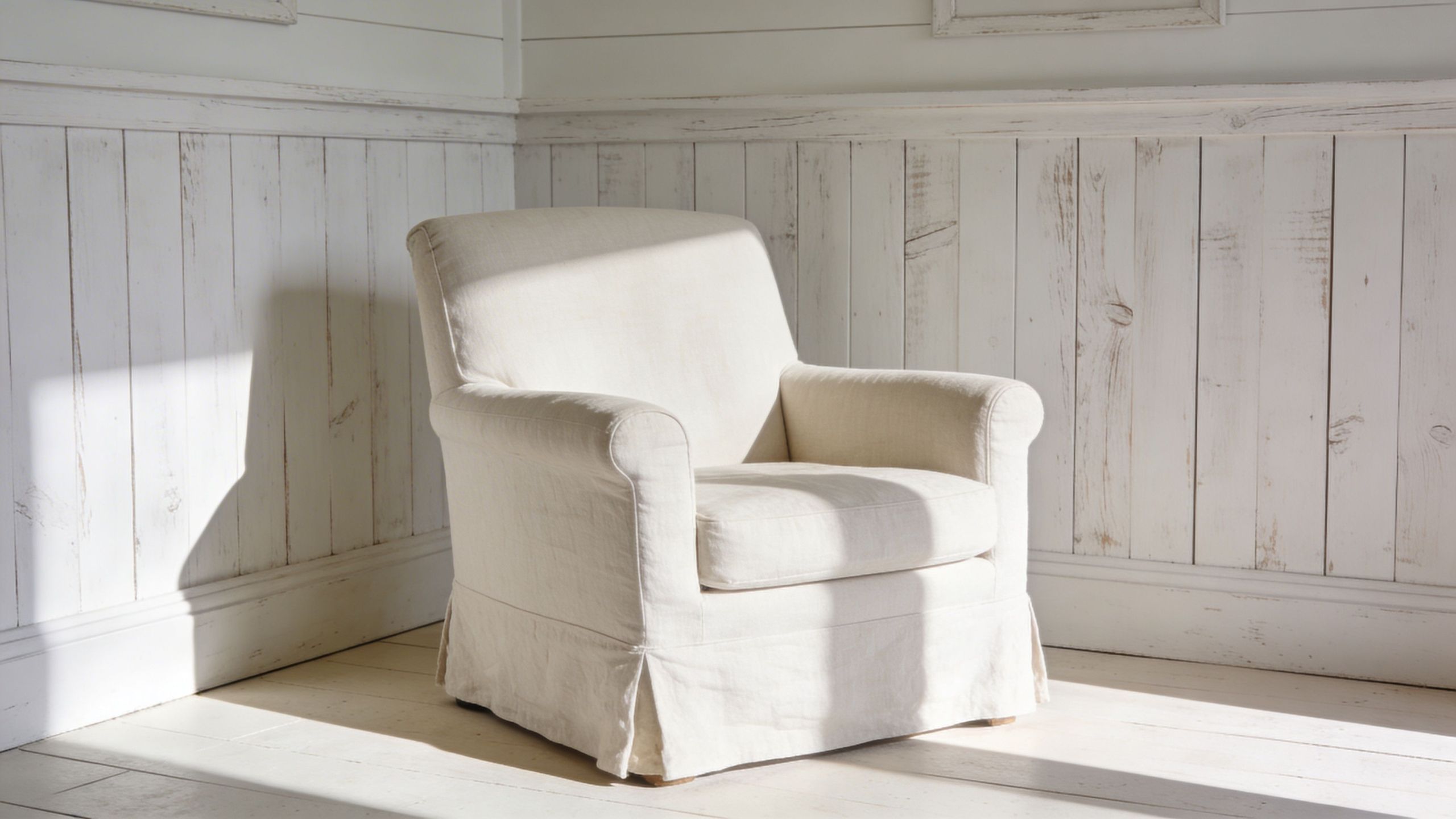
A cozy, slipcovered armchair sits in a sunlit room against rustic white wood paneled walls.

Whitewash is for people who don’t hate the wood. They hate the darkness. That’s an important difference.

Instead of burying the grain under a full solid coat, whitewashing softens the brown or orange tone and lets some of the wood character stay visible. In Puget Sound homes that lean farmhouse, coastal, cottage, or rustic-modern, it can look honest and relaxed.

Best fit for real wood character

This technique looks best when the paneling has actual grain worth seeing. On cheap printed laminate, it rarely looks convincing. On solid wood or decent veneer, it can be a beautiful compromise.

Use it in:

  • Bedrooms and sunrooms: It keeps the walls light without making them sterile.
  • Cottages and older homes: It preserves age and texture.
  • Spaces with natural fibers and soft textiles: Linen, oak, and matte black accents all pair well with it.

The global wood-based panel market reached USD 217.9 billion in 2024 and is projected to grow at a CAGR of 4.8% from 2025 to 2034. That matters because engineered panel products remain common, and not every surface is a good candidate for a translucent finish. Know what’s on your wall before you commit.

The trade-off

Whitewash is more forgiving stylistically, but less forgiving technically. Lap marks, uneven wiping, and inconsistent transparency show up fast. You need to work in manageable sections and keep a wet edge.

For higher-wear rooms, a protective topcoat may be worth discussing. That’s especially true if the paneling sits in a hallway, commercial common area, or kids’ space where hands are constantly on the wall.

What doesn’t work is trying to force a limewash look onto paneling with heavy stain bleed, slick laminate, or water damage. In that case, a solid paint system gives a cleaner result and fewer surprises.

4. Staining Over Paneling Toning or Glazing

Some paneling doesn’t need to be painted at all. It needs to be corrected.

That’s where toning and glazing come in. If the wood feels too orange, too red, or too shiny, a translucent stain or glaze can shift the color while keeping the grain visible. This is a better move than opaque paint when the architecture still benefits from a wood finish.

When preserving the wood makes sense

I’d look at this in executive offices, studies, libraries, and higher-end homes where the paneling has some substance. It can also work in commercial interiors that want warmth without the full 1970s look.

A glaze can mute yellow undertones. A darker toner can pull washed-out wood toward walnut or espresso. The result is quieter and provides a more custom appearance than a full repaint.

This is also the point where people realize paneling can support a broader design style. If you’re after a warmer, more natural room, a rustic kitchen palette often translates well to paneled dens, offices, and built-ins too.

Why DIY gets risky fast

This is one of the least DIY-friendly options on the list. Uneven absorption, streaking, and lap marks are common. Old clear coats, wax, smoke residue, and sun fading all affect how a toner sits on the wall.

A few realities worth knowing:

  • Gel stains give more control: They tend to sit more evenly than very thin liquid products.
  • Sample areas are mandatory: What looks good on one board can shift on the next.
  • Protection matters: A clear topcoat is often needed once the color is right.

If your paneling ties into cabinetry, built-ins, or trim, consistency gets even harder. That’s why cabinet stain work is usually a good reference point. Wheeler’s guide on how to stain wood cabinets shows the level of prep and finish control this kind of work takes.

What doesn’t work is rushing cure time. Toning systems can look dry on the surface while still being vulnerable underneath.

5. Ombré or Gradient Painting

Ombré on wood paneling isn’t for every property, but in the right setting it can be memorable. Restaurants, boutique offices, creative studios, and statement walls in modern homes are the usual candidates.

Panel grooves help this effect. They break up the transition and give the gradient more rhythm. On a flat wall, ombré can sometimes feel like a mural experiment. On paneling, it can read more architectural.

Where a gradient earns its keep

This is strongest when the wall is meant to be noticed. Think a reception area in Seattle, a café wall, or a single media-room feature in a Tacoma home. It’s not the choice for every bedroom or every leased office suite.

The best gradients stay in one family. A smoky blue fading into a pale blue-gray works. A clay tone fading into sand can work. Hard contrast usually looks accidental unless the painter is very experienced.

Projected design reporting for 2026 says modern slat designs are seeing 35% to 50% higher adoption in urban lofts and minimalist interiors. That’s a projection, not a current universal rule, but it points to the same broader trend: people are treating wall paneling as a design feature again, not just background.

What has to go right

The challenge isn’t choosing colors. The challenge is blending them before edges flash off. Humidity helps open time a bit in our region, but it can also slow curing and expose poor technique.

This kind of finish usually works best when:

  • The wall is simple: Fewer windows, outlets, and interruptions.
  • The palette is tight: Neighboring tones blend better than opposites.
  • The room supports it: Minimal furnishings help the wall stand out.

If you want ombré to look refined, use fewer colors than you think you need.

On rental turnovers and standard resale prep, I’d skip it. On the right feature wall with the right client, it can look excellent.

6. Decorative Glazing or Faux Finishes

Decorative finishes live or die on execution. There’s no middle ground. A good faux finish can make paneled walls feel custom. A bad one can make the whole room look themed.

This is why I rarely recommend it for full rooms. For one statement wall, a restaurant niche, a reception backdrop, or a high-end powder room, it can be a smart move.

Good uses for specialty finishes

Glazes can soften a base color and add depth. Metallic washes can bring movement to a paneled wall without full sparkle. Leathered, stone-inspired, or brushed effects can help old paneling feel more like an intentional surface treatment than a leftover finish.

In Seattle commercial interiors, this can work well in hospitality and retail. In homes, it usually fits one of two approaches: either very refined and muted, or intentionally dramatic.

If you want a quick visual reference for decorative technique, this type of application helps show why hand skill matters:

Why this is usually a contractor job

The verified data notes an underserved issue in humid climates like Puget Sound. High moisture contributes to tannin bleed, mold growth, and paint peeling, and 70% of paint failures in damp areas stem from inadequate vapor barriers. A decorative finish layered over unstable prep just fails in a fancier way.

That is the primary trade-off. Specialty finishes look premium, but they’re less forgiving of substrate problems.

Before approving a faux finish, I’d want to know:

  • What is the paneling made of
  • Has it been painted or sealed before
  • Is there moisture or movement in the wall
  • Will the wall take frequent cleaning

If the answer to that last point is yes, especially in commercial spaces, choose a simpler finish with a more serviceable topcoat.

7. Two-Tone or Color Split Painting

Two-tone paneling is one of the most practical updates on this list. It gives old paneling a custom look without requiring a specialty artist. It also solves a common problem. Full-height dark paneling can make a room feel squat.

Paint the lower section darker and the upper section lighter, and the wall usually feels better proportioned right away.

Why this works so well on paneling

Panel grooves already divide the wall visually, so a horizontal color split feels natural. In dining rooms, offices, and hallways, it can mimic the effect of wainscoting even when the original paneling wasn’t installed for that purpose.

This can be especially effective in Seattle and Tacoma homes with lower ceilings. Verified data notes that two-tone methods can enhance room height perception by up to 20%. That lines up with what clients react to. The room feels taller because the upper wall reads lighter and less heavy.

Smart pairings

A few combinations that work consistently:

  • Warm white over charcoal: Crisp but not cold.
  • Greige over muted navy: Good in offices and dining areas.
  • Soft gray over deep green: Nice in studies, libraries, and bedrooms.

For lower walls, I prefer a finish that can take more abuse. Satin or a durable eggshell is usually a safer choice there than dead-flat paint.

What doesn’t work is placing the split at an awkward height. If it cuts through window trim, built-ins, or furniture lines badly, the wall looks accidental. Snap a level line and step back before you paint.

The lower half should ground the room. The upper half should lighten it.

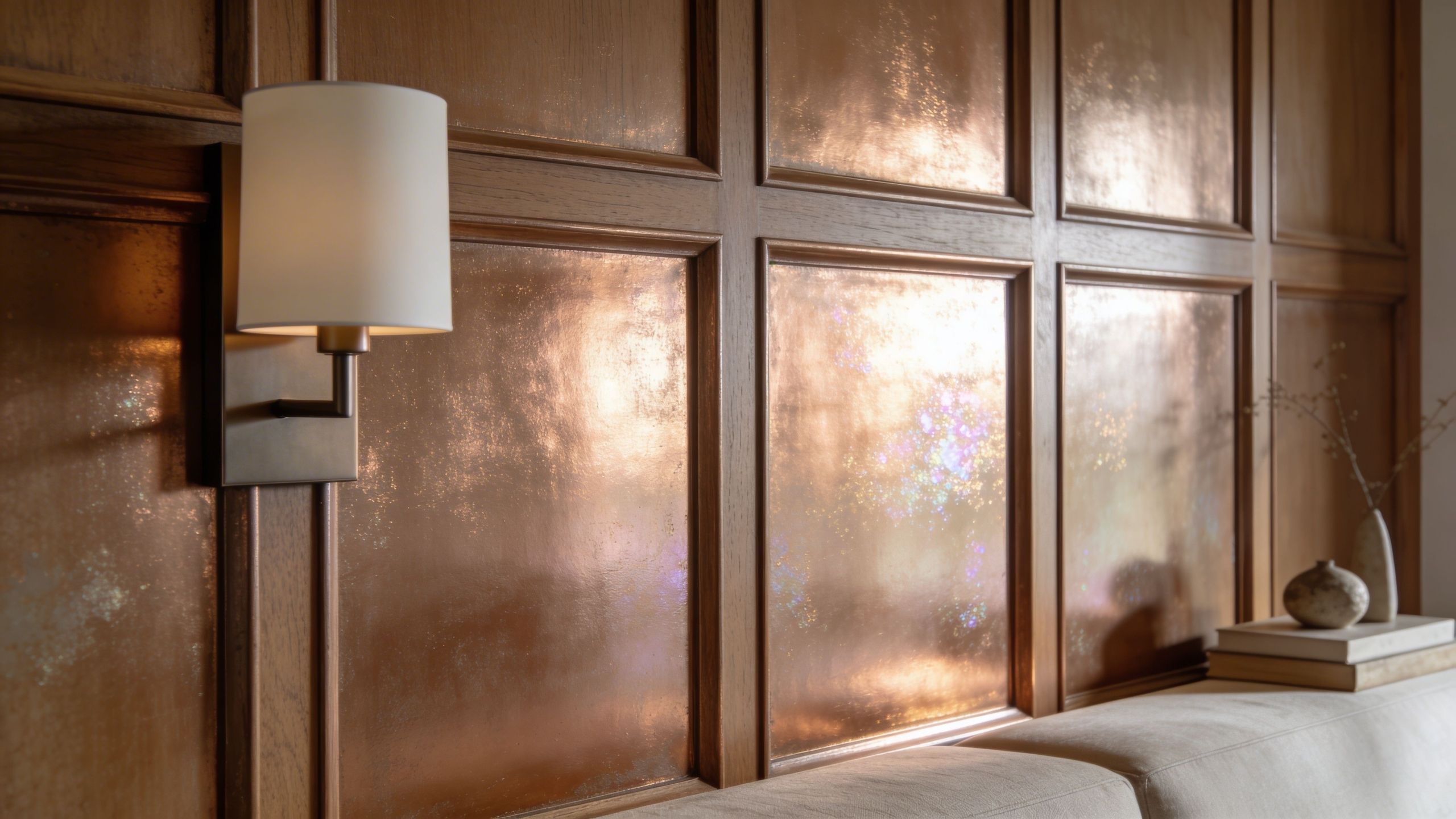
8. Metallic or Pearl Paint Finishes

A modern interior wall featuring elegant wood paneling with decorative metallic copper accents and a wall sconce.

Metallic and pearl finishes can make paneling feel expensive fast. They can also make it feel overdone fast. The difference usually comes down to restraint, lighting, and surface prep.

On grooves and raised details, metallic pigments catch light in a way flat paint can’t. That can be beautiful in a powder room, bar area, boutique retail space, or hospitality setting. It’s less useful on every wall of a family room.

Best applications

I like metallics most when they stay secondary. Bronze, pewter, champagne, and soft pearl tones usually work better than bright gold or silver. They should shift with the light, not shout at you from across the room.

This kind of finish can complement:

  • Feature walls with good sconce or pendant lighting
  • Commercial reception areas
  • Small residential spaces where drama is welcome

The key is smooth prep. Metallic products magnify roller lines, patched seams, and groove buildup. Any flaw in the paneling tends to show more, not less.

Durability and maintenance considerations

For commercial settings, finish selection matters as much as color. Verified data notes that commercial spaces see 2x paint wear from abrasion and that epoxy topcoats over latex can deliver 5x scratch resistance. That’s a real consideration for paneled feature walls in tenant improvements, lobbies, and common areas.

At the same time, not every metallic wall needs a heavy topcoat. In a low-touch residential room, the extra layer may be unnecessary and may alter the sheen.

What doesn’t work is forcing a metallic finish into a room that already has busy flooring, heavy grain, bold countertops, and reflective furniture. Paneling should add depth. It shouldn’t compete with every other finish in the room.

9. Textured Paint or Specialty Surface Treatments

Textured coatings are usually a last resort or a deliberate design choice. Sometimes they help old paneling disappear. Sometimes they create a fresh architectural finish. Sometimes they just make future repairs harder.

That’s why I’d only recommend texture when there’s a clear reason for it.

When texture earns the extra work

If the paneling is extensively grooved, uneven, or visually cheap, texture can help break the pattern and move the wall away from “wood paneling” altogether. In commercial settings, certain textured systems can also soften sound and hide wear better than a perfectly smooth finish.

Projected trend data for 2026 says ultra-matte, low-VOC water-based finishes with scrub resistance above 200 cycles per ASTM D2486 are gaining favor in panel applications. That’s a projection source, but the practical takeaway is useful. If you texture a wall, choose a finish system that can still be cleaned.

What people underestimate

Texture is messy. Overspray gets everywhere. Repairs are never invisible unless the original application was documented and matched carefully.

Before using any specialty surface treatment, think through the long term:

  • Can this wall be patched later without obvious flashing
  • Will the owner repaint in a few years
  • Does the room need easy wipe-down maintenance
  • Is the paneling stable enough to support added material

For leased commercial spaces, I usually lean toward simpler systems unless the tenant specifically wants texture as part of the build-out design. For residential remodels, subtle texture can work, but heavy faux stucco over old paneling often feels like a workaround, not a finish choice.

If the main goal is modernizing the wall, smooth paint usually ages better.

10. Modern Minimalist or Monochromatic Approach

This is the finish approach I recommend most often when clients want the paneling to feel current and not trendy. Paint the whole room, or most of it, in a related family of warm whites, soft grays, beige-grays, or muted earth neutrals. Let the grooves read as texture, not contrast.

It’s simple, but simple doesn’t mean basic.

Why it works in Puget Sound spaces

Light quality in the Seattle-Tacoma corridor changes all day. A stark white that looked clean at noon can feel cold and flat by late afternoon. Warmer neutrals tend to stay livable across changing cloud cover and lower winter light.

Verified data says neutrals such as soft whites and light grays are used in 60% of professional paneling applications for timeless appeal. That makes sense. They don’t date the room quickly, and they support everything from Scandinavian-inspired homes to clean office remodels.

The maintenance side matters too

In our climate, finish selection can’t be separated from durability. The verified data notes that satin latex offers mildew resistance lasting 5 to 7 years in humid climates like Western Washington. Even if a minimalist look leans softer in sheen, this is why I still look closely at room use before defaulting to dead-flat paint.

For a monochromatic result that lasts, keep these priorities in order:

  • Choose the right undertone: Warm whites and soft greiges are easier to live with than stark bright whites.
  • Prime for the material: MDF, veneer, and laminate don’t all behave the same.
  • Match sheen to use: Lower-sheen for low-touch rooms, more washable finishes where hands and scuffs are constant.

A minimalist paneling update isn’t trying to hide the wall. It’s treating paneling as architecture.

10 Wood-Paneling Paint Ideas: Comparison

Option Implementation complexity Resource requirements Expected outcomes Ideal use cases Key advantages
Matte or Eggshell Finish Over Wood Paneling Low–Moderate (prep and priming) Primer, interior paint, basic tools Modern low-sheen look; hides minor flaws Budget renovations, general residential rooms Cost-effective, easy touch-ups, extends paneling life
Accent Wall or Color Blocking Moderate (precise edge work) Paints, painter's tape, samples High visual impact; defined focal areas Defining zones, highlighting features, creative updates Low-cost transformation, flexible design choices
Whitewashing or Limewash Finish Moderate (technique-sensitive) Diluted paint or limewash, brushes/rags, optional sealer Bright, airy semi-transparent finish; visible grain Farmhouse/coastal styles, heritage restorations Preserves wood character, forgiving on imperfections
Staining Over Paneling (Toning/Glazing) Moderate–High (skill for even application) Semi-transparent stains/glazes, sealer, ventilation Natural wood tone update; upscale, unified appearance High-end homes, unifying varied panel tones Maintains natural grain, professional refined finish
Ombré or Gradient Painting High (advanced blending skills) Multiple paints, blending tools or sprayer, skilled labor Refined gradient depth; strong focal statement Artistic feature walls in residential or commercial spaces Highly distinctive, hides imperfections through variation
Decorative Glazing or Faux Finishes Very High (artisan technique) Specialty glazes, experienced decorative painter, sealant Custom surfaces that mimic marble/stone/metal Luxury projects, showrooms, statement walls Designer-quality look, unique and customizable results
Two-Tone or Color Split Painting Moderate (precise dividing line) Two paints, tape, level or laser Balanced, proportioned visual effect Transitional homes, dining rooms, children's rooms Timeless approach, creates cohesion and balance
Metallic or Pearl Paint Finishes Moderate–High (consistent application needed) Metallic/pearlescent paints, specialty rollers/brushes Shimmering, light-reflective focal surfaces Accent walls, luxury interiors, hospitality venues Luxurious, brightens space, contemporary appeal
Textured Paint or Specialty Surface Treatments Moderate–High (equipment and skill) Texture compounds, spray equipment, masking materials Three-dimensional surfaces; hides joints and flaws Concealing damage, adding dimension, acoustic uses Effectively hides imperfections; adds depth and interest
Modern Minimalist or Monochromatic Approach Low–Moderate (color selection critical) High-quality neutral paints, good lighting Timeless, calm surfaces that emphasize texture Contemporary homes, corporate interiors, galleries Timeless and versatile; highlights architectural details

Your Next Step Choosing the Right Finish for Your Puget Sound Property

Painting old paneling is one of the few interior updates that can change a room quickly without tearing the space apart. That’s why it keeps coming up in both residential remodeling and commercial renovation work. The paneling is already there. The question is whether you fight it, hide it, or use it well.

Some of these paint ideas for wood paneling are straightforward. Matte neutrals, monochromatic schemes, and simple accent walls are usually accessible for a handy homeowner with patience. If the paneling is in decent shape, the room is dry, and you’re using the right primer and finish, a DIY project can succeed.

Others are much less forgiving.

Whitewashing has to be controlled. Toning and glazing can go sideways fast if the existing clear coat, stain, or wood species isn’t behaving the way you expected. Metallic finishes show every flaw. Faux finishes depend heavily on technique. Two-tone work sounds simple until the split line lands in the wrong place or the darker lower section starts showing every scuff because the wrong sheen was used.

That’s where a contractor earns their keep.

In the Puget Sound area, paneling projects come with a few local realities. Humidity changes dry times. Older homes can have smoke residue, waxes, or hidden moisture issues. Commercial spaces need finishes that can be cleaned and maintained. Tenant improvements often need a finish system that looks sharp without creating a headache for the next turnover. A paint idea that works in a photo online may not be the right move for a living room in Kent or a property manager’s office update in Seattle.

The biggest mistake people make is choosing color first and surface system second. It should be the other way around. Start with the substrate. Is it solid wood, veneer, MDF, or laminate? Is there tannin bleed? Is there sheen? Does the room stay dry? Will people touch the wall every day? Once those answers are clear, color and style become much easier decisions.

That’s also why hiring a trusted local residential contractor or commercial construction partner often saves time and money even when painting seems simple on the surface. Good prep isn’t glamorous, but it’s the part that determines whether the finish still looks good down the road. In homes, that means fewer callbacks and fewer repaints. In businesses, that means less disruption and a cleaner result that supports the rest of the renovation.

At Wheeler Painting, we help homeowners, property managers, and business owners across Seattle, Tacoma, Kent, and the communities in between sort through those decisions without overcomplicating the job. Sometimes the answer is a bright neutral eggshell. Sometimes it’s a durable satin system for a commercial wall. Sometimes the best move is to preserve the wood with toning instead of covering it.

If you’re comparing house painting near me, residential contractor near me, commercial painting services near me, or commercial construction near me, look for a team that can do more than just put paint on the wall. You want clear prep standards, realistic guidance, and a finish plan that fits the space, the schedule, and the budget.

If your paneling is making a room feel stuck in another decade, you probably don’t need demolition. You need the right finish and the right process.


If you're ready to update wood paneling in a home, office, retail suite, or tenant improvement project, Wheeler Painting & Restoration Services can help you plan it properly from the start. We serve Seattle, Kent, Tacoma, and the surrounding communities with residential remodeling, commercial renovations, interior painting, specialty finishes, and practical color guidance that fits the space, the schedule, and the budget. Reach out for a detailed proposal and a straightforward conversation about what will work best for your property.