

A Guide to the Design Build Project Delivery Method
Taking on a construction project can feel overwhelming. You have a vision, a budget, and a lot of questions. The design build project delivery method simplifies the entire process by bringing everyone together under one contract, one team, and one shared goal. Instead of you, the property owner, acting as the middleman between an architect and a builder, this unified approach turns potential adversaries into trusted collaborators.
Understanding the Design-Build Method
Let’s imagine you’re planning a new office space or a major home renovation. In a traditional project, you’d hire a designer to create blueprints. Then, you’d take those plans to various contractors for bids. The problem? The contractor might look at the plans and say, “This is beautiful, but it’s going to cost way more than you think,” or “This won’t work with the building’s existing structure.” Suddenly, you’re stuck in a frustrating blame game, shuttling messages back and forth.
Design-build flips that entire process on its head.
It’s a more straightforward, reassuring approach. You sign a single contract with one firm. That firm is responsible for everything, from the initial sketches and engineering to permitting and the final coat of paint. For property owners, business owners, and facilities managers in our community, this means you have a single, trusted partner guiding you from start to finish. There’s no disconnect between the vision and the execution because it’s all handled by one expert team.
A Unified Team from Day One
The real magic of the design-build method happens right at the beginning. The builders, designers, and engineers are all in the same room from day one. This isn’t just a minor detail—it’s the secret sauce to a successful project.
When the construction team is involved during the design phase, they provide immediate, practical feedback. They can flag potential issues, suggest more cost-effective materials, and ensure the design is actually buildable within your budget.
This integration delivers clear benefits:
- No More Finger-Pointing: You have a single point of contact. If a problem arises, there’s no debate about whose fault it is; the team is collectively responsible for finding a solution.
- Designing to a Budget: Cost isn’t an unpleasant surprise at the end. It’s a foundational piece of the design conversation, ensuring the final plans align with your financial reality.
- A Faster Path to Completion: Design and construction can overlap. The team can start ordering long-lead-time materials or begin site prep while final design details are being finalized, shaving weeks or even months off the timeline.
The design-build model creates a true partnership. The adversarial tension that can poison a traditional project is replaced by a shared commitment to getting the job done right, on time, and on budget.
A Growing Trend in Construction
This isn’t just a niche idea; it’s rapidly becoming the go-to method for savvy property owners. What was once considered an “alternative” is now a dominant force in the industry.
In fact, research predicts that design-build will account for 47% of all U.S. construction spending by 2025. Why the massive shift? Because it consistently delivers better outcomes with less stress, especially on complex projects. You can dive into the details by reading the findings on design-build utilization from FMI Corp.
For local businesses and homeowners, this trend means you’re not a guinea pig. You’re choosing a proven, modern approach trusted to deliver great results for your residential or commercial project.
How a Design-Build Project Unfolds, Step by Step
Knowing the definition of design-build is helpful, but what does it actually look like day-to-day? To really understand it, you have to see the process in action. Unlike the classic construction model where steps are siloed and often conflicting, a design-build project is a much more logical, collaborative journey from start to finish.
For property owners, this difference is night and day. It translates to a more predictable, less stressful experience. Instead of acting as the go-between for a separate architect and builder, you have one unified team—a single partner—guiding you through every phase. Your vision for that commercial renovation or home remodel stays intact without all the usual headaches.
This simple chart shows you exactly what I mean. It cuts right to the core of the design-build advantage: the direct, uncluttered path from owner to the integrated team to the finished project.
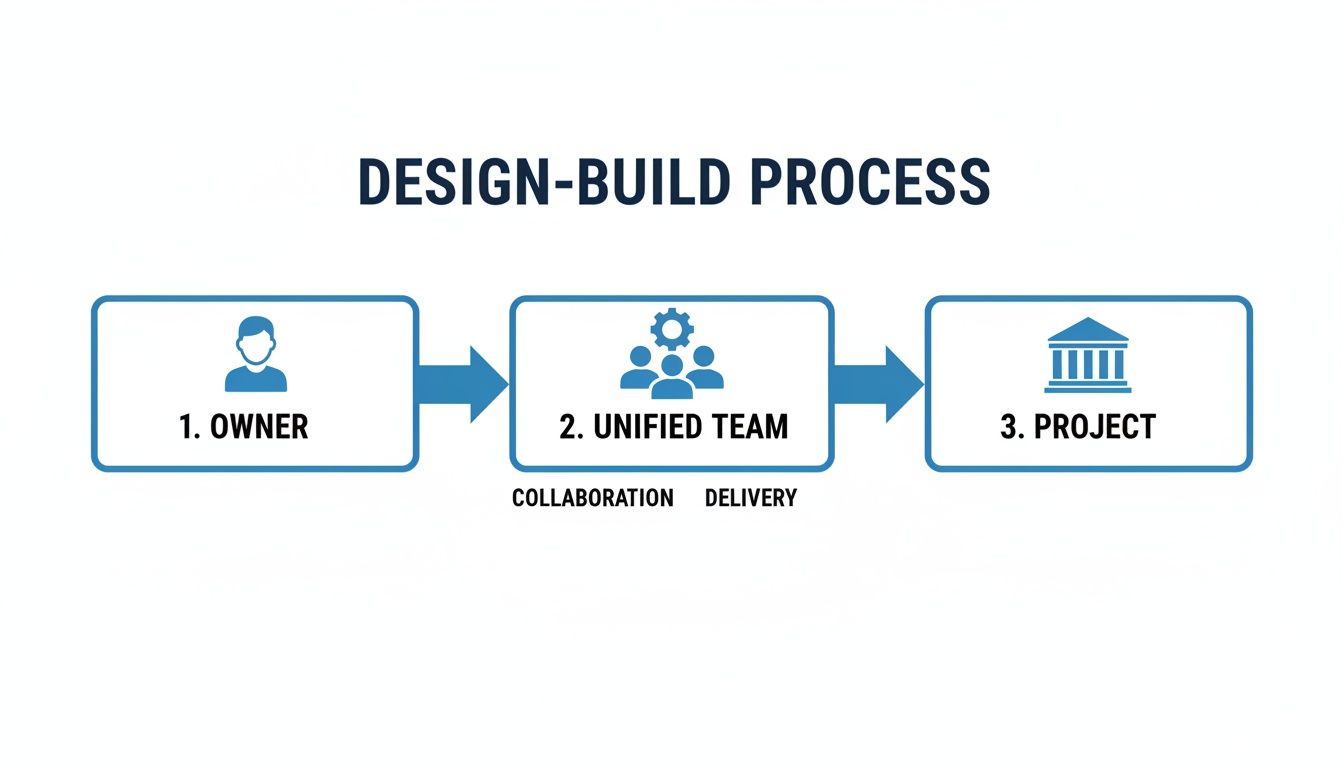
As you can see, the owner and the unified team work as one. This single entity handles everything, which is how you get to the finish line without the frustrating detours and disputes that plague other methods.
Phase 1: The Initial Consultation & Vision Setting
Every great project starts with a simple conversation. This first meeting is all about your vision, your goals, and what you need the space to do. Whether you’re planning an office space renovation or a major kitchen expansion, this is your chance to lay it all on the table.
Right away, we start talking about the budget. It’s a crucial part of the conversation. Your design-build partner will listen to your ideas and give you honest, early feedback on costs. This helps align your dreams with financial reality from the very beginning, avoiding that all-too-common heartbreak of designing a project you can’t actually afford to build.
Phase 2: Collaborative Design & Feasibility Checks
This is where the magic of the integrated model really comes alive. The architects, designers, and construction experts are all in the same room, turning your vision into a real, buildable plan. As creative ideas take shape, the construction pros are right there to provide immediate input on buildability, material costs, and potential roadblocks.
This constant feedback loop ensures the design isn’t just stunning, but also practical and affordable.
- Constructability Reviews: The builders are looking over the designer’s shoulder, catching potential construction headaches on paper before they can become expensive problems in the field.
- Value Engineering: The team actively looks for smarter ways to build. They might suggest alternative materials or different construction methods that deliver the same quality and look for less money.
- Accurate Costing: Because the people pricing the job are the same ones who will build it, the cost estimates are grounded in reality, not just theory.
Phase 3: Pre-Construction & Permitting
Once you’ve signed off on the final design, the project shifts into the pre-construction phase. This is where your design-build firm manages all the critical behind-the-scenes logistics to get everything teed up for construction.
Your single point of contact will be busy finalizing the schedule, ordering materials, and navigating the permitting process with local municipalities. Having an experienced local team handle this is a massive benefit—they know the specific codes, the people at the permit office, and how to get things approved efficiently, whether it’s for a retail build-out or siding replacement.
With a unified team, pre-construction is a smooth, overlapping process. While designers put the final touches on the drawings, the construction crew is already lining up subcontractors and materials. This overlap is a key reason design-build projects can move so much faster.
Phase 4: Unified Construction & Project Management
With plans approved and permits secured, it’s time to break ground. The transition from paper to reality is incredibly smooth because the people building the project are the same ones who helped design it. The lead designer and project manager stay deeply involved, making sure the final product is a perfect match for the original vision.
Throughout the build, you still have that single point of contact providing you with regular updates and answering your questions. This clear line of communication gets rid of the confusion and delays that happen when an owner is stuck playing telephone between a separate designer and contractor.
Phase 5: Project Completion & The Final Walkthrough
As the work winds down, the team performs detailed quality checks on every last detail to make sure it meets their—and your—high standards. The final step is the walkthrough, where you and the project lead go through the finished space together.
This is your moment to inspect the work, learn how your new systems operate, and confirm that everything is exactly as you expected. A design-build project isn’t done until you are 100% satisfied with the outcome. From the first handshake to the final handover, the entire process is built around your peace of mind.
Comparing Different Project Delivery Methods
To really get a handle on the design-build method, it helps to see how it stacks up against the other ways projects get built. Whether you’re a homeowner planning a residential remodel or a business owner managing a commercial build-out, the project delivery method you choose sets the tone for everything that follows. It defines how everyone communicates, who’s responsible for what, and ultimately, it shapes the final result.
In the construction world, you’ll generally run into three main models: Design-Build (DB), the traditional Design-Bid-Build (DBB), and Construction Manager at Risk (CMAR). Each one is structured differently, and understanding those differences can save you a world of headaches down the road.
Let’s break down how these methods really play out for local property owners.
The Traditional Route: Design-Bid-Build
Design-Bid-Build (DBB) is the classic approach most people picture. It’s a straight line, two-step process where you, the owner, are juggling two separate contracts. First, you hire an architect to draw up a full set of plans. Once those plans are 100% finished, you send them out for contractors to bid on, typically picking the lowest price.
The most important thing to grasp here is that the designer and the builder are in separate worlds. They have no contract with each other, and one’s job ends before the other’s begins. This fundamental separation is where most of the problems start.
Because the builder has zero input during the design phase, it’s common to get a beautiful design that’s way over budget or surprisingly complicated to actually build. When a problem pops up on-site—and they always do—it can quickly turn into a finger-pointing match between the designer and the contractor. You’re left stuck in the middle, trying to solve a problem you didn’t create.
A Hybrid Approach: Construction Manager at Risk
Construction Manager at Risk (CMAR) tries to find a middle ground. In this setup, you still hold separate contracts with the designer and a construction manager (CM). The key difference is that the CM joins the team early in the design process to provide input on costs, scheduling, and whether the design is even buildable within the budget.
The “at-risk” part is crucial. The CMAR gives you a Guaranteed Maximum Price (GMP) and is on the hook for any costs that go over that number. This gives them a powerful incentive to keep the budget under control.
While CMAR brings some much-needed collaboration to the table, it doesn’t create a truly unified team. You’re still managing two contracts and acting as the mediator if disagreements arise. It’s an improvement over the old way, but it stops just short of the single-source accountability you get with design-build. If you’re managing facility construction services or a renovation, you can see more about our integrated process for commercial construction.
A Side-by-Side Comparison
Choosing the right path for your project can feel overwhelming, but seeing the methods compared directly can make the decision much clearer. This table breaks down the key differences from a property owner’s perspective.
Project Delivery Methods at a Glance
| Factor | Design-Build (DB) | Design-Bid-Build (DBB) | Construction Manager at Risk (CMAR) |
|---|---|---|---|
| Contracts | One Contract with a single design-build entity. | Two Separate Contracts held by the owner (one with designer, one with builder). | Two Separate Contracts held by the owner (one with designer, one with CMAR). |
| Accountability | Single Point of Responsibility. The DB firm is accountable for everything. | Divided Responsibility. The owner must manage disputes between the designer and builder. | Shared Responsibility. Owner still manages two contracts, but CMAR takes on budget risk. |
| Timeline | Faster. Design and construction phases overlap, speeding up delivery. | Slower. A linear, sequential process; construction can’t start until design is fully complete. | Moderate. Faster than DBB due to early CM input, but not as integrated as DB. |
| Cost Control | Budget set early. The team designs to the budget from day one, reducing cost overruns. | Cost is an unknown until the bidding phase. Designs are often over budget. | Good. CM provides early cost feedback and a Guaranteed Maximum Price. |
| Owner’s Risk | Low. The design-build firm assumes the risk for both design and construction. | High. Owner is exposed to change orders, delays, and disputes between parties. | Moderate. GMP transfers cost risk to the CMAR, but owner still manages two prime contracts. |
Ultimately, the best choice depends on how much risk you are willing to carry and how involved you want to be in managing different players.
The most significant distinction comes down to risk and responsibility. In the Design-Bid-Build model, the owner carries the risk of the plans and specifications. In Design-Build, that risk is transferred to the unified team, giving the owner a much more predictable and secure project experience.
The Real-World Payoff of Going Design-Build
It’s one thing to understand the blueprint of the design-build project delivery method, but it’s another to see how it actually makes a difference on the ground. For homeowners and commercial property managers in our community, this unified approach isn’t just a different way of doing things—it delivers real, tangible benefits to your wallet, your schedule, and your sanity.
These advantages are the natural outcome of putting everyone on the same team, with the same goal, right from the start. Let’s break down the four biggest reasons this model works so well for everything from a major kitchen overhaul to a full commercial renovation.
A Single Point of Accountability
We’ve all heard the horror stories. In a traditional project, when something goes wrong, the blame game begins. The builder points to the architect’s plans, the architect blames the builder’s crew, and you, the owner, are stuck playing referee in a costly dispute.
The design-build model cuts through all that noise. With one contract and one unified team, the buck stops in one place. Your design-build firm is on the hook for everything: the design’s quality, the budget’s accuracy, and the final construction. This means problems get solved quickly and collaboratively, not debated endlessly while the project stalls.
Faster Project Completion
In construction, time is money. The old-school Design-Bid-Build method is notoriously slow and rigid. First, the design has to be 100% complete. Only then can you start the long process of finding and vetting contractors. It’s a purely sequential approach with built-in delays that can easily tack months onto your timeline.
Design-build flips that script by letting key phases overlap—a process known as fast-tracking.
- Early Procurement: The team can order materials with long lead times, like custom windows or specialized fixtures, while the finer design details are still being worked out.
- Site Preparation: As soon as the initial plans are solid, work on the foundation and site can kick off, shaving off valuable weeks.
- Streamlined Permitting: The integrated team can navigate local permitting offices with a single, clear voice, preparing applications far more efficiently.
This simple overlap gets you from concept to completion much faster than the old way of doing things.
By bringing design and construction under one roof, the design-build project delivery method compresses the entire schedule. That’s a massive advantage for a business trying to open its doors or a family just wanting to get their home back.
Tighter and More Realistic Cost Control
For any property owner, the biggest fear is a budget that spirals out of control. In the traditional model, the budget is often treated as an afterthought. You get a design you love, send it out for bids, and then get hit with sticker shock when the numbers come back way over what you expected. The only solution? Costly and frustrating redesigns.
Design-build puts cost at the center of the conversation from day one. Your budget isn’t just a goal; it’s treated as a core design parameter, just like the square footage or the number of rooms. The builder’s real-world cost knowledge informs every decision the designer makes, grounding the entire project in financial reality. This collaboration means fewer surprises and a dramatic reduction in the kind of expensive change orders that blow up budgets.
Higher Quality and Innovation
When builders have a seat at the design table, the final product is almost always better. They bring a practical, hands-on perspective that a designer working alone simply can’t replicate. This early collaboration is a breeding ground for smart ideas and a higher-quality result.
Imagine this: during the design for an office renovation, the contractor suggests a new type of durable flooring that has the same look as the specified product but costs less and lasts longer. Or maybe they see a more efficient way to route the HVAC, gaining you an extra foot of ceiling height. That’s the kind of practical, invaluable insight that makes a project smarter, not just bigger.
Is the Design-Build Method Right for Your Project?
Picking a project delivery method can feel like a huge decision, but it really boils down to what matters most to you. The best approach is simply the one that aligns with your specific goals for the timeline, budget, and how hands-on you want to be. While the design-build project delivery method isn’t a silver bullet for every situation, it truly shines in a few common scenarios that many homeowners and business owners face.
Let’s walk through these key situations. By the end, you’ll have a much clearer idea of whether a unified team is the right move for your next commercial renovation or residential build.
When Speed Is a Top Priority
Got a tight deadline? Maybe you’re a business owner needing to open a new retail build-out before the holiday rush, or a homeowner trying to finish an addition before a new baby arrives. In these time-sensitive cases, the traditional, step-by-step Design-Bid-Build process can feel agonizingly slow.
This is where design-build really pulls ahead. It’s built for speed. By overlapping the design and construction phases—a strategy called “fast-tracking”—the team can get started on site prep or order materials with long lead times while the final design details are still being ironed out. This parallel workflow can easily trim weeks, sometimes even months, off the project schedule.
For Projects Demanding Close Collaboration
Some projects are just plain complicated. They have a ton of moving parts and benefit enormously from having the builder and designer in the same room from day one.
Think about projects like these:
- Historic Restorations: You never know what you’ll find behind a 100-year-old wall. A design-build team can pivot on a dime when surprises pop up, with the builder offering practical fixes that still honor the architect’s vision.
- Highly Custom Builds: If you have a one-of-a-kind vision, that direct line of communication is everything. The builder can give immediate feedback on whether a designer’s creative idea is actually buildable (and affordable), making sure the final plan is both incredible and practical.
- Technically Challenging Renovations: Any job involving major structural work or complex mechanical systems needs flawless coordination. A unified team helps prevent the miscommunications between separate firms that often lead to expensive mistakes.
If You Prefer a Single Point of Contact
Look, most property owners are busy. You’re running a business or a household, and you probably don’t have the time or the desire to play mediator between a separate architect and contractor. If you value simplicity and clear accountability, design-build is a perfect fit.
With a single contract, you have one dedicated partner responsible for everything. This completely sidesteps the stressful “he said, she said” arguments that can derail a project. You have one number to call for updates, questions, and solutions.
This streamlined management keeps you in the loop and in control, but without dragging you into the day-to-day weeds. You can see how this unified approach delivers outstanding results by exploring our portfolio of completed projects.
When Budget Certainty Is Non-Negotiable
For most people, the biggest source of stress in any construction project is the budget. The traditional process can feel like a guessing game, where you don’t get a firm price until late in the game—often leading to sticker shock and having to go back to the drawing board.
The design-build model tackles this problem from the very beginning. The budget isn’t an afterthought; it’s a foundational piece of the design process itself. The entire team, from the designer to the builder, is working together to create a plan that fits your financial targets. This “designing to budget” approach gives you cost certainty early on, dramatically cutting the risk of surprise overruns and making sure your investment is handled with care.
Partnering With a Local Design-Build Expert
It’s one thing to understand the theory of the design-build project delivery method, but it’s another thing entirely to bring a vision to life. For homeowners and commercial property managers, that means finding a local partner who doesn’t just get the process but is also deeply rooted in the community they serve.
That’s where Wheeler Painting & Restoration Services comes in. We’re not just another contractor; we act as your single point of responsibility, dedicated to turning even the most complex projects into a reality.
Our whole approach is founded on the key design-build principles: accountability and communication. From the first rough sketch to the final coat of paint, our team is on top of every detail. We make sure your vision comes to life on schedule, on budget, and with the kind of craftsmanship our neighbors have trusted since 1991.
Your Single Source for Residential & Commercial Projects
Whether you’re looking for a residential contractor near you for a major home remodel, or commercial construction services for a retail build-out, our process is consistent. We build a partnership based on straightforward communication and a solid understanding of local building codes and what people in this area really need. This completely removes the headache of juggling different contracts and trying to get multiple companies on the same page.
- For Commercial Clients: We handle everything from tenant improvements and office space renovation to full facility construction. Our goal is to make sure your business space is functional, looks incredible, and is ready for business with as little disruption as possible.
- For Homeowners: We’re here to guide you through residential remodeling, additions, and restorations with a steady, reassuring hand. You can count on a transparent process and results that go well beyond what you hoped for.
At Wheeler Painting & Restoration, we shoulder the risk and complexity so you don’t have to. Our integrated team of designers, project managers, and builders works in lockstep, transforming the often-adversarial nature of construction into a shared mission for success.
Let’s Build Your Vision Together
Picking a contractor is a huge decision, and we believe in earning your trust long before a hammer ever swings. Our long history serving our community speaks for itself—it’s a direct result of our commitment to quality and making sure our clients are happy. You can learn more about our team and what drives us by exploring our company’s story and values.
If you’re ready for a smoother, more collaborative way to build, we’d love to talk. Contact Wheeler Painting & Restoration Services today for a consultation. Let us show you how our design-build approach delivers better results with far less stress, turning your project from an idea into a beautiful reality.
Common Questions About Design-Build
Thinking about using the design-build method for your project? It’s a different way of doing things, and it’s natural to have questions. Here are some of the most common ones we get from clients, with straightforward answers to help you understand how it all works.
How Is the Budget Handled in a Design-Build Project?
This is one of the biggest and best differences. Instead of designing first and then finding out the cost later, the budget is a core part of the conversation from day one.
You, the designer, and the builder all sit down together to establish a realistic target budget. The entire project is then designed to that number. This integrated approach practically eliminates the painful and costly surprise of getting bids back that are way over what you wanted to spend, which often forces you to go back to the drawing board.
Do I Have Less Control Over the Design in This Model?
It might seem that way, but it’s actually the opposite. In a design-build setup, the owner is a crucial part of a single, unified team. You’re not just a client handing off a vision; you’re an active participant.
You’ll be working directly with the designers and builders at the same time. When you have an idea, you get instant feedback on not just the aesthetics, but also the cost and construction timeline. This gives you more meaningful control to shape a final product that truly aligns with your vision and your budget.
Is Design-Build More Expensive Than Other Methods?
While every project is unique, design-build is often more cost-effective when you look at the total picture. By bringing everyone together under one roof, it slashes the expensive change orders and delays that come from designers and builders not being on the same page.
Think of it this way: a shorter project timeline means lower costs. Fewer disputes between separate firms means fewer budget-busting surprises.
Because the designer and builder are working as a team from the start, they’re both motivated to find smart, efficient solutions that deliver the best value. This collaborative spirit helps prevent the cost overruns that are all too common in other project models.
Ready to see how a more streamlined construction process can benefit your project? The team at Wheeler Painting & Restoration Services has been delivering dependable craftsmanship and serving businesses and homeowners in our community since 1991. Contact us to learn more about how we can support your vision.







 “Like” us on Facebook!