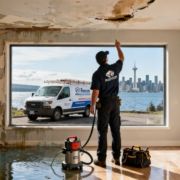
Tag Archive for: puget sound restoration

Water Damage Restoration Process: Your 2026 Guide

A leak behind the wall. A ceiling stain that suddenly spreads. A toilet supply line that lets go while you're at work. By the time you notice water damage, stress usually arrives first and answers come second.

That's normal.

In Tacoma, Seattle, Bellevue, and across the Puget Sound, water damage often moves farther than people expect because moisture doesn't stay put. It follows framing, drops into insulation, settles under flooring, and lingers in older assemblies long after the visible puddle is gone. In this climate, that hidden moisture matters.

What to Do When You First Discover Water Damage

If you've just found water in your home or building, the first job is simple. Protect people, stop the source if you safely can, and avoid making the damage worse.

A worried woman holding a smartphone and looking up at a large water stain on her ceiling.

A common call starts with something small. A homeowner in Seattle notices bubbling paint in a hallway. Another in Tacoma sees a brown ring on the ceiling below an upstairs bath. A business manager in West Seattle walks into a retail space and finds warped planks near an exterior wall after heavy weather. What looks minor at first can turn into a larger repair if water has been sitting inside drywall, trim, or subfloor.

Water damage is also more common than many people realize. About 1 in 60 insured homes files a water-damage claim each year, and a typical home can take up to five days to dry fully before reconstruction begins, which is why fast response matters so much for mold prevention and limiting secondary damage, according to water damage statistics for homeowners.

Your first moves on site

  • Shut off the water source: If the leak is coming from a supply line, appliance, or fixture and it's safe to reach, close the nearest valve or the main.
  • Cut power to affected areas if needed: Don't step into standing water near outlets, appliances, or electrical equipment.
  • Take photos before cleanup: Capture ceilings, walls, flooring, furniture, and the suspected source.
  • Move contents out of harm's way: Rugs, boxes, electronics, and furniture legs can absorb moisture fast.
  • Call for professional help early: The sooner the inspection starts, the more options you usually have to salvage materials.

Practical rule: Don't judge the scope by the visible stain. The visible area is often smaller than the wet area.

If you're still deciding whether what you're seeing is active damage or old staining, this guide to signs of water damage in walls can help you recognize the warning signs before finishes start failing.

The water damage restoration process follows a clear sequence. Inspection first. Then extraction and drying. Then cleaning, repairs, and final finishes. When that sequence is handled correctly, the project becomes much more manageable.

The Professional Inspection and Damage Assessment

The first site visit sets the direction for the whole job. If the inspection is rushed, the rest of the project usually suffers.

A six-step professional inspection and damage assessment process flowchart for home water damage restoration services.

Professional restoration starts with classification, not with fans. Technicians identify the water source, contamination category, and damage class before deciding what can be dried in place and what has to be removed, because moisture often spreads beyond the visible impact area, as explained in this overview of professional water damage restoration classification.

What classification means in plain language

There are two separate questions on day one.

First, what kind of water is involved? Clean supply-line water is treated differently from dishwasher discharge, sewer backup, or outside flooding. The contamination level affects safety procedures, demolition decisions, and what can realistically be saved.

Second, to what extent has the structure absorbed moisture? A small ceiling stain in a newer home may involve a focused repair. The same stain in an older Puget Sound home with plaster, layered flooring, or previous remodels can hide a much larger wet zone.

Here's the practical difference:

Assessment point Why it matters
Water source Tells the crew how hazardous the loss may be
Contamination category Helps determine cleaning vs removal
Material type Drywall, hardwood, insulation, tile backing, and trim all react differently
Moisture spread Hidden migration changes demolition and drying strategy
Occupancy needs A home, office, or tenant space may need a phased plan

Tools crews use to map hidden moisture

A solid inspection includes more than a visual walk-through. Crews use moisture meters to check material moisture content, thermal imaging to spot temperature differences that may indicate concealed moisture, and physical probing where needed to confirm what the instruments suggest.

In Bellevue, Kirkland, and New Castle, older construction can complicate this step. Water may move behind original trim, under multiple flooring layers, or into wall cavities that were insulated or patched over time. That's why experienced crews document room by room instead of making assumptions from one wet patch.

Water follows the path of least resistance, not the path that makes the damage easy to see.

Some property owners like to do a first pass themselves before the crew arrives. That can be useful if it helps you identify shutoff points and likely leak areas. For a practical homeowner resource, these water leak detection tips are worth reviewing, especially when the source isn't obvious.

What a good assessment should produce

By the end of inspection, you should have clear answers on:

  • Affected areas: Which rooms, cavities, and assemblies are involved
  • Salvage decisions: What can stay, what needs removal, and what needs further testing
  • Immediate containment steps: How the crew will protect clean areas and contents
  • Drying plan: Equipment type, likely placement, and monitoring approach
  • Rebuild considerations: What repairs may follow once dry standards are met

That plan is what keeps the water damage restoration process disciplined instead of reactive.

Water Extraction and Advanced Structural Drying

Drying works best when it's treated as a controlled mechanical process, not a race to make surfaces feel dry.

A technically sound drying phase combines bulk water extraction, air movement, and dehumidification. Removing standing water first shortens the drying cycle and reduces the risk of secondary damage like mold, and crews typically use pumps and vacuums before placing industrial air movers and dehumidifiers, according to this guide to the water repair process and structural drying.

Extraction first, always

If water is still sitting on the floor, that's the first target. Submersible pumps, extraction units, and commercial wet vacuums remove what can be physically lifted out of the structure before evaporation even begins.

You don't want equipment spending days trying to evaporate water that should've been extracted in the first hour. On wood floors, carpet pad, and lower drywall, fast extraction can also improve salvage options.

Air movement and dehumidification do different jobs

Air movers and dehumidifiers are often mentioned together, but they're not interchangeable.

  • Air movers: Push air across wet surfaces to increase evaporation
  • Dehumidifiers: Pull moisture from the air so the room doesn't stay saturated
  • Daily adjustments: Equipment gets moved as moisture patterns change

Think of it as a loop. Water leaves the material, enters the air, and then the dehumidifier removes it from the environment. If one part of that loop is missing, drying slows down.

Why Puget Sound homes need careful monitoring

In North Bend, Snoqualmie, and other damp Western Washington areas, outside weather can work against the drying plan. Opening windows isn't always helpful. In many cases, it adds humidity instead of removing it.

That's one reason crews monitor progress every day. They aren't just checking whether the carpet feels better underfoot. They're measuring subfloors, sill plates, drywall edges, trim, and wall cavities to verify that the structure is moving toward dry standards.

On the job: The loud equipment isn't the proof the job is working. The moisture readings are.

A disciplined dry-out usually includes:

  1. Initial extraction and setup based on the wet materials and room layout.
  2. Containment if needed so unaffected areas don't absorb added moisture.
  3. Repeated moisture checks to confirm hidden materials are drying, not just exposed surfaces.
  4. Equipment changes if one room dries faster than another or if trapped moisture shows up in a cavity.

For homeowners, the biggest mistake is shutting off equipment too early because the space looks better. For commercial properties, the common mistake is trying to reopen too quickly without confirming the structure is dry. Both create the same problem later. Odors, swelling, finish failure, and hidden mold risk.

Thorough Cleaning Sanitizing and Mold Prevention

Dry doesn't automatically mean clean.

After the structure reaches the right condition for the next phase, crews still need to address contamination, residues, odors, and the conditions that let mold take hold. This part is especially important in Issaquah, Seattle, and other Puget Sound locations where moisture can linger in enclosed spaces and older assemblies.

Cleaning depends on the water source

A clean-water pipe break and a sewer backup are not the same job. Neither are a roof leak over drywall and standing water that sat against cabinetry and base trim. The cleaning approach changes based on what the water touched and how long it was there.

That can include surface cleaning, removal of unsalvageable porous materials, HEPA vacuuming where needed, and targeted antimicrobial treatment in affected zones. The goal isn't to fog the whole building and hope for the best. The goal is to remove what's contaminated, clean what can be restored, and leave the space safe for reconstruction.

Mold prevention starts before you see mold

In Western Washington, clients often ask the same question: “If I don't see mold yet, do I still need treatment?” In many cases, yes. Waiting for visible growth misses the point. Good restoration work reduces the conditions mold needs by drying thoroughly, removing compromised materials, and treating areas that were exposed.

Here's where shortcuts usually fail:

  • Spraying over damp materials: That doesn't solve trapped moisture.
  • Painting too soon: Coatings can hide a problem, not fix it.
  • Keeping damaged porous materials in place: Drywall, insulation, and trim may still hold contamination or odor.
  • Skipping cavity cleaning: Wall and floor voids need attention when water migrated beyond the finish layer.

If a room smells musty after the dry-out, something still needs attention. Odor is a clue, not a cosmetic issue.

If you want a plain-language outside perspective on cleanup concerns, this roundup of expert mold removal advice gives a useful overview of why proper removal and prevention matter after a moisture event.

What property owners should expect

A careful sanitizing phase should leave you with clear answers about:

Question What you need to know
What was removed Damaged materials, contaminated contents, or both
What was cleaned Which surfaces were restored rather than replaced
What was treated Areas that received antimicrobial or odor-control work
What still needs rebuild Drywall, flooring, cabinets, trim, or paint finishes

That clarity matters because the next phase is reconstruction, and clean documentation helps everyone make better decisions.

Repairs Reconstruction and Final Finishes

Reconstruction is the point where many homeowners finally feel the job turning back toward normal use of the space.

A professional contractor in a company shirt hangs a framed landscape painting on a living room wall.

In Puget Sound homes, that phase needs more care than people expect. Older plaster and drywall assemblies, layered remodels, fir trim, uneven textures, and persistent ambient moisture all make rebuild work less forgiving. A wall that looks dry can still move differently than the surrounding surfaces. A floor patch can stand out if the installer ignores age, light exposure, or species variation. Good reconstruction work accounts for those conditions before the first new board or sheet goes in.

Rebuild should not start until dry verification is complete. Meter readings, cavity checks, and jobsite documentation confirm the structure is ready for closure. That protects the new work from finish failure, recurring odor, and hidden moisture problems that show up weeks later as swollen trim, peeling paint, or flooring movement.

Why rebuild quality matters after dry-out

The repair phase is where a project can either come back cleanly or turn into a string of callbacks.

On paper, replacing drywall, trim, paint, and flooring sounds straightforward. In practice, the details matter. Wall cuts need to land in places that allow strong patches and better texture transitions. Replacement materials need to match the age and profile of what stayed. Paint often needs to run corner to corner on an entire wall, not just over the patched area, if you want the room to read as finished instead of repaired.

That is especially true in Tacoma and Seattle homes, where older construction rarely gives you perfectly flat walls or standard material dimensions. A contractor who only handles dry-out may stop once the moisture is gone. The owner is then left coordinating multiple trades, finish decisions, and schedule gaps. A single point of contact helps keep the work organized from demolition through final coating.

Common repair paths after water damage

The exact scope depends on what was removed and what can be matched well enough to restore the room properly.

  • Drywall and insulation replacement: Common after flood cuts, ceiling damage, or wet wall cavities
  • Subfloor and finish floor repair: Hardwood, LVP, tile, and underlayment all have different tolerance for moisture and patching
  • Cabinet and millwork replacement: Sink bases, vanity cabinets, toe kicks, fillers, and trim often take the brunt of a leak
  • Trim carpentry and fixture reset: Baseboard, casing, doors, and plumbing or electrical trim need to go back in the right sequence
  • Texture, primer, and paint: Matching existing surfaces takes planning, especially in homes with older orange peel, hand textures, or multiple prior paint jobs

For interior wall assemblies, this guide on how to repair water-damaged drywall explains why some sections can be repaired cleanly while others should be removed and rebuilt.

Sometimes the best answer is a true like-for-like repair. Sometimes the smarter choice is a limited upgrade while the area is already open, especially in kitchens, baths, and laundry rooms where waterproofing details and material transitions matter. The right decision depends on budget, insurance scope, and how visible the repaired area will be once the room is back in use.

Rebuilding should leave you with a room that feels finished, stable, and consistent with the rest of the property.

Wheeler Painting & Restoration Services handles both restoration and reconstruction work, including drywall, flooring, cabinets, waterproofing, and painting. That continuity helps with scheduling, accountability, and finish coordination, which matters even more in occupied Puget Sound homes where delays and handoff mistakes add stress fast.

Managing Your Insurance Claim and Project Costs

The financial side of water damage is often as stressful as the damage itself. Most property owners aren't dealing with a planned remodel. They're dealing with an interruption, a claim, and a stack of decisions they didn't expect to make this week.

The contractor's role here is partly technical and partly administrative. Good documentation supports the work on site and helps the adjuster understand what happened, what was affected, and what was required to restore the space.

What to document early

If you're filing a claim, keep the record clean and organized from the start.

  • Photos and video: Capture affected rooms, damaged contents, and the apparent source before major cleanup
  • Timeline notes: Record when you discovered the loss, what emergency steps were taken, and who was contacted
  • Material list: Note flooring types, cabinetry, trim, paint areas, and built-in features
  • Communication log: Keep adjuster, contractor, and mitigation updates in one place

That information helps reduce confusion later, especially if hidden moisture expands the scope after demolition or meter testing.

What usually affects cost

Water damage projects don't price out from one factor alone. Cost usually changes based on a mix of conditions:

Cost driver Why it changes the project
Source of water Cleaner losses are different from contaminated ones
Area affected A single room is different from multi-room spread
Material type Hardwood, tile, cabinets, drywall, and insulation all require different labor
Hidden moisture Wet subfloors and wall cavities add drying and repair work
Access and occupancy Furnished homes, businesses, and active tenant spaces require more protection and coordination

A good estimate should separate mitigation from reconstruction when needed, identify what's included, and note where final pricing depends on material selections or concealed conditions.

How contractors help with claims

A professional contractor can help by providing:

  1. Scope documentation that ties visible damage to the affected assemblies.
  2. Moisture findings that support why certain materials needed drying or removal.
  3. Line-item repair estimates for reconstruction after mitigation is complete.
  4. Updated revisions if additional damage appears once finishes are opened.

That doesn't remove every insurance challenge, but it does make the claim easier to understand. It also gives you a clearer basis for deciding whether to restore in kind or combine repairs with planned upgrades such as a bath remodel, kitchen refresh, or flooring change.

Choosing a Restoration Partner in the Puget Sound

Water restoration isn't a niche service anymore. The U.S. damage-restoration industry included 60,020 businesses in 2025, and one market study reports that water damage restoration held 38.56% of disaster-restoration revenue that year, which is why choosing an experienced restoration firm matters more than hiring a general handyman, according to this damage-restoration market overview.

That scale cuts both ways. You have options, but not all options are structured the same.

What local owners usually need most

In the Puget Sound, the right partner needs to understand more than extraction equipment. They need to know how moisture behaves in this region, how older homes and mixed-construction buildings complicate dry-outs, and how to move from emergency work into quality reconstruction without losing control of the schedule.

For many property owners, the greatest pain isn't just the leak. It's coordinating multiple companies. One team for emergency service. Another for drywall. Another for flooring. Another for painting. Then someone has to decide who owns the gaps between those scopes.

A better way to compare firms

When you're evaluating who to hire in Tacoma, Seattle, Kirkland, Bellevue, or Snoqualmie, ask direct questions:

  • Who is your day-to-day point of contact?
  • How do you document moisture and verify dry conditions?
  • Do you handle reconstruction after mitigation, or do I need a separate contractor?
  • How do you protect occupied homes or active commercial spaces?
  • Can you match finishes, not just replace damaged material?

Those answers tell you more than a broad promise ever will.

A local, full-service firm usually gives you tighter communication and clearer accountability. One project manager. One scope. One schedule. That matters for homeowners, and it matters just as much for facility managers handling tenant improvements, office space renovation, or smaller commercial rebuilds after a loss.

If you're comparing options, this page on choosing a water damage repair contractor is a practical starting point for what to look for in a restoration partner.


If you need help with a leak, flood, or hidden moisture issue in Tacoma, Seattle, New Castle, Issaquah, Bellevue, Kirkland, North Bend, West Seattle, or Snoqualmie, contact Wheeler Painting & Restoration Services. You'll get a single point of contact for the full water damage restoration process, from inspection and dry-out through reconstruction and final painting, with clear communication the whole way.

Your Puget Sound Guide to Finding a Water Damage Repair Contractor in 2026

That sinking feeling when you spot a dark stain spreading on your ceiling or step into a puddle in your kitchen is something no property owner wants to experience. Whether you’re a homeowner in West Seattle or a facility manager in Bellevue, your mind starts racing. But the very first thing to do is take a breath, focus on safety, and then call a professional water damage repair contractor. In these situations, acting fast is everything.

What to Do Immediately After Finding Water Damage

The first hour after you find water damage is absolutely critical. What you do right away can make a huge difference in the final repair bill and the amount of disruption to your life or business. This is especially true here in Western Washington, where our damp climate means mold can start growing in as little as 24 to 48 hours.

A person using a smartphone to document a leaking water faucet and water damage on the floor.

Before you even think about cleanup, you have to secure the area. The checklist below outlines the immediate priorities for homeowners and property managers alike.

Immediate Water Damage Response Checklist

Follow these steps the moment you discover a water issue to protect your property and yourself.

Priority Action Why It's Critical Pro Tip
Shut Off the Water Source The first priority is to stop more water from entering your property. If you can't find the specific valve, turn off the main water supply. Know where your main water shut-off valve is before an emergency happens. It's often in a garage, basement, or utility closet.
Turn Off the Electricity Water and electricity are a deadly combination. If water is near outlets, lights, or appliances, go to your breaker box and shut off power to that area. If you have to step in standing water to get to the breaker box, don't do it. Call an electrician or your emergency contractor immediately.
Document Everything Your insurance company will need proof of the damage. Use your phone to take extensive photos and videos of the leak, the damaged areas, and any affected belongings. Get wide shots of the room and close-ups of the damage. Narrate your videos, explaining what you're seeing and when you discovered it.
Call a Professional Contact a certified water damage restoration company. They have the equipment and expertise to handle the situation safely and effectively. Look for a trusted local provider like Wheeler Painting, who serves your community and understands the full scope of repairs, from drywall to floor repairs.

Once you've run through this initial safety and documentation checklist, it's time to get a professional on the line.

A quick response isn't just about convenience—it's about stopping a small problem from becoming a catastrophe. Delay gives water time to soak into drywall, subfloors, and framing, which can lead to structural rot and widespread mold.

If you're having trouble locating the source of the water, especially if it's hidden behind walls or in the ceiling, getting specialized help is key. Some companies offer services for expert water leak discovery from Four Seasons that can pinpoint the issue without unnecessary demolition.

This kind of emergency is more common than you might realize. Across the country, about 14,000 people deal with water damage every single day, and it makes up nearly a quarter of all property damage claims. Here in the Puget Sound, our relentless rain and high humidity make homes and commercial buildings from Tacoma to Bellevue particularly susceptible. That's why having a contractor who understands the full process—from the initial water damage cleanup to the final repairs—is so important.

When the water stops and the initial panic wears off, you’re left with a critical decision: who do you trust to fix this? It's a choice that can feel overwhelming, but getting it right is the difference between a successful restoration and a nightmare of lingering moisture, mold, and shoddy repairs.

Hiring the right water damage repair contractor isn't about a quick Google search and hoping for the best. It’s about doing a little homework to find a true professional who can confidently manage the chaos—whether that's a burst pipe in a Tacoma basement or a failed roof on a Seattle commercial property.

First Things First: Verify Their Credentials and Insurance

Before you talk about a single scope of work, you need to confirm the contractor is legitimate. This is a non-negotiable first step that protects you from enormous financial and legal risks.

  • Washington State License: They must have a current contractor license. This is your proof that they've met the state's minimum requirements for registration, bonding, and insurance.
  • General Liability Insurance: This is what covers any accidental damage to your property while they’re working. Ask to see the certificate of insurance—don't just take their word for it.
  • Workers' Compensation: If one of their crew gets hurt on your property, this insurance protects you from being held liable. Without it, you could be on the hook for their medical bills.

A contractor who acts cagey or hesitates when you ask for these documents is a huge red flag. A true pro expects these questions and will have their paperwork ready to show you. It’s a basic sign of transparency and professionalism.

Do They Have the Right Experience and Offer the Right Services?

Not all contractors are created equal, especially when it comes to water damage. This isn't a job for a handyman; it’s a specialized field that demands a deep understanding of moisture dynamics, drying science, and mold prevention. Water damage restoration is a massive part of the property services industry, and for good reason—it requires real expertise. You can see the scale of this market in this in-depth industry report.

So, ask them pointed questions about their experience. Have they handled projects like yours before? A kitchen flood in a Bellevue condo is very different from a sprinkler system failure in a Kirkland retail space. A seasoned contractor should easily be able to provide examples and references. For more ideas on what to ask, check out our guide on important questions to ask any contractor.

This is where a full-service general contractor can be a lifesaver. Think about it: instead of you playing project manager—hiring one company for water extraction, another for drywall, and yet another for painting—a company like Wheeler Painting handles it all. We’re perfect for building owners, facility managers, and homeowners looking for a trusted partner to handle everything from drywall and flooring to custom cabinets. Having that single point of contact saves you an incredible amount of time and stress, turning a complicated disaster into a smooth, managed process.

The Water Damage Restoration Process from Start to Finish

Walking into your property after a flood or major leak is a gut-wrenching experience. It's chaos. But for a professional water damage repair contractor, it's a familiar problem with a clear, step-by-step solution. Knowing what to expect can bring a sense of order to the chaos, whether you're dealing with a flooded basement in your Issaquah home or a soaked commercial space in Bellevue.

The first thing we do is attack the standing water. This isn't a job for a shop vac; we bring in powerful, truck-mounted pumps for emergency water extraction. The goal is to get the bulk water out as fast as possible to stop it from seeping deeper into walls, flooring, and the structure itself.

Assessment and Strategic Removal

With the standing water gone, the real investigation begins. We use specialized tools like moisture meters and thermal imaging cameras to find every last pocket of dampness. Water is sneaky—it hides behind drywall and under floorboards—and our gear tells us exactly what’s wet and what’s not. This detailed inspection is how we build an accurate scope of work.

From there, we start the careful process of removing materials that are too damaged to save. This is more of a surgical removal than a messy demolition.

Commonly removed items include:

  • Waterlogged drywall and insulation
  • Warped baseboards and ruined flooring, like wood and tile floors
  • Sagging or stained ceiling tiles

By taking these materials out, we open up the structure. This lets us get drying equipment aimed directly at the wet wood framing and subfloors, which is essential for a truly dry and stable building.

Drying, Cleaning, and Final Reconstruction

Now for the drying phase. We strategically place a whole fleet of industrial-grade air movers and dehumidifiers. It might look and sound like a wind tunnel, but this setup creates the perfect environment to pull every last bit of moisture out of the building's skeleton. This structural drying and dehumidification process isn't rushed; it can take several days, and we'll be back to monitor moisture levels until everything is back to normal.

Once completely dry, we thoroughly clean and sanitize every affected surface. This is a critical step to kill off any bacteria and prevent mold from getting a foothold down the road.

The infographic below shows how to find the right team to handle this complex job from start to finish.

An infographic showing three steps to vet a water damage contractor including verifying credentials and assessing services.

As you can see, finding a single, full-service contractor who manages the entire project is always the best way to go.

Finally, we get to the best part: reconstruction. This is where your property comes back to life. At Wheeler Painting, our crews handle every detail of the rebuild, from hanging and finishing new drywall to laying flooring, painting, and installing trim. For business owners in places like Kirkland or North Bend, our integrated approach means you get back to business faster. Our comprehensive water damage remediation services are designed to make the journey from disaster to fully restored as seamless as possible.

Navigating Your Water Damage Insurance Claim

Let's be honest, dealing with the insurance company after a flood or leak can feel just as overwhelming as discovering the damage itself. Between the endless phone calls, the mountain of paperwork, and the adjuster visits, it's a full-time job you never asked for.

This is where having an experienced water damage repair contractor in your corner makes all the difference. They aren’t just there to fix the walls; they’re your most important ally in getting your claim approved and paid fairly. They provide the detailed estimates, moisture readings, photos, and a clear, professional scope of work that adjusters require. Simply put, a well-documented claim is a claim that moves forward.

Your Right to Choose Your Contractor

It’s almost a guarantee your insurance company will suggest one of their "preferred vendors." While it might seem easier to just go with their recommendation, it's critical to know that you have the right to choose your own licensed contractor.

Think about it: an insurer's preferred partner has a relationship with the insurance company. A contractor you hire independently works for you. At Wheeler Painting, our loyalty is to you and your property. We're your advocate, ensuring repairs restore your home or business to its pre-damage condition without the corner-cutting that can sometimes pad an insurance company’s bottom line.

We see this all the time with property managers in places like Issaquah or New Castle who are handling a claim for a multi-tenant building. An experienced local contractor knows how to navigate those complexities, from isolating the damage to keeping multiple stakeholders in the loop.

For a facility manager in Bellevue or a business owner in West Seattle, having a contractor who speaks the same language as insurance adjusters is priceless. We handle the back-and-forth, presenting clear, indisputable evidence to justify every part of the restoration. This kind of proactive partnership prevents frustrating delays and disputes, getting you back to normal that much faster. Our goal is to lift that burden off your shoulders so you can focus on what matters most.

Why a Local Puget Sound Contractor Is Your Best Bet

When you're staring at a spreading water stain, the temptation might be to call the first big, recognizable name you find. But when it comes to water damage in Western Washington, going local isn't just a preference—it's your most powerful move.

A national chain might have a slick commercial, but a contractor with deep roots in the Puget Sound region brings a level of understanding that a faceless corporation just can't replicate. It's an expertise born from dealing with our unique climate, year after year.

A repair contractor shakes hands with a homeowner on a porch with a mountain landscape in view.

Think about it. A company right here in our area knows our weather patterns inside and out—from the relentless winter drizzle to the atmospheric river events that can catch homeowners off guard. This local knowledge means they know precisely how moisture attacks the specific building materials used in our homes and are already familiar with the building codes in cities from Tacoma all the way up to Bellevue.

The Advantage of Local Knowledge and Speed

In a water damage emergency, every single minute counts. The difference between a minor cleanup and a full-blown gut job can come down to how quickly a team gets on site. A local crew can be at your door in Seattle or Kirkland in a fraction of the time it takes for a company dispatching from a distant regional hub. That rapid response is what stops the damage from spreading, and it can save you a staggering amount of money on the final bill.

It's not just about speed, either. Local contractors are woven into the fabric of the community. They know which supplier in Issaquah has the perfect match for your decade-old flooring, and they know exactly who to talk to at the permitting office in West Seattle. These aren't small details; these are the things that keep a project from getting bogged down in frustrating delays.

When you hire a local contractor, you’re hiring a neighbor. Their reputation isn't built on a national marketing budget, but on the work they've done in communities like North Bend and Snoqualmie. Their business thrives on your satisfaction, and that kind of direct accountability is priceless. You're not going to get that from a 1-800 number.

Building Trust Through Community Focus

At the end of the day, working with a team that lives here means you're getting a partner who is genuinely invested in seeing your home or property put back together correctly. We understand the worries of homeowners and facility managers in the area because we're right here living and working alongside you.

A local water damage repair contractor brings so much more to the table:

  • Faster Emergency Response: We're just down the road, not hours away, so we can start mitigation almost immediately.
  • Regional Expertise: We've seen how our wet climate affects local construction and know exactly how to handle it.
  • Community Accountability: Our name is everything. We build our reputation one successful job—and one happy client—at a time.
  • Established Supplier Networks: Our local relationships mean we can source materials and coordinate work without the usual hold-ups.

You have a choice. You can be just another number on a spreadsheet for a national franchise, or you can work with a dedicated team that’s committed to restoring your property with the care and attention it deserves.

Common Questions We Hear About Water Damage Repair

When your property is underwater, you're going to have questions—and you need answers, fast. After years of helping homeowners and property managers across the Puget Sound, we've heard them all. Here are the most common ones we get, along with some straight answers from our experience.

How Long Does Water Damage Repair Take?

This is the million-dollar question, and the honest answer is: it completely depends on how bad the damage is.

A simple dishwasher leak in a Bellevue condo might be fully dried out and fixed in just a few days. But if a pipe bursts and soaks the subfloor and framing of a Tacoma home, you could be looking at several weeks. That timeline has to account for thorough drying, demolition of ruined materials, and the entire reconstruction process. The only way to get a real schedule is to have a professional get eyes on it.

The single biggest factor that dictates the timeline is how fast the drying starts. Every hour counts. The sooner we can get professional drying equipment running, the less time the water has to seep deeper and create bigger, more expensive problems.

Can I Stay in My Property During the Restoration?

We get this question a lot, from families in Kirkland to business owners in Seattle. Whether you can stay put really boils down to safety and practicality.

If the damage is contained to one room—say, a laundry room—and doesn't mess with your home's essential systems, you can probably stay. But if there’s any hint of structural damage, a serious mold problem, or if major systems like your electrical panel or furnace are affected, you'll likely need to relocate for a bit. Your safety is always the top priority, and we’ll give you a clear, no-nonsense recommendation once we assess the situation.

What Is the Difference Between Mitigation and Restoration?

People often use these terms interchangeably, but in our world, they mean two very different things. Think of it as the emergency room versus the recovery room.

  • Water Mitigation: This is the emergency response. It's all about stopping the damage from getting worse. We're talking about extracting standing water, tearing out soaked carpet and drywall, and setting up an army of air movers and dehumidifiers. It’s triage for your property.
  • Water Restoration: This is the rebuild. Once the structure is completely dry and stable, we shift to putting it all back together. This phase includes everything from floor repairs and replacements to new drywall, painting, and final trim work.

A true general contractor like Wheeler Painting handles both. We seamlessly manage the project from the initial frantic phone call to the final walk-through, so you aren't stuck juggling different companies for your residential remodeling or commercial renovations.

Will My Insurance Cover All the Repair Costs?

Navigating insurance can be one of the most stressful parts of this process. Whether your policy covers the damage depends entirely on what caused it. Most standard homeowner's policies will cover "sudden and accidental" events, like a burst pipe or a faulty washing machine hose.

Where you might run into trouble is with damage from slow, gradual leaks (a sign of a maintenance issue) or regional flooding, which almost always requires a separate flood insurance policy. Our job is to give your insurance adjuster meticulous documentation, detailed photos, and a line-item estimate to help you get every dollar you're entitled to under your policy.


When water damage hits your home or business, you need a partner you can trust to take control of the chaos. For a professional and reliable approach to restoration from start to finish, contact Wheeler Painting for a consultation in the Puget Sound area. Learn more about how we can help at https://wheelerpainting.com.

Top 7 Restoration Companies Near Me in Puget Sound (2026 Guide)

When disaster strikes your home or business in the Puget Sound area, the immediate aftermath can feel overwhelming. A burst pipe, a kitchen fire, or severe storm damage requires immediate action, but a quick search for "restoration companies near me" often returns a confusing and lengthy list of options. Who can you trust to respond quickly, handle insurance claims efficiently, and deliver high-quality craftsmanship to get your property back to normal?

This guide cuts through the noise. It is designed specifically for property owners, business owners, and facilities managers in Western Washington who need to make a critical decision under pressure. We provide a vetted roundup of top-rated restoration companies, breaking down their specific services, typical response times, and areas of expertise. Our goal is to give you clear, straightforward information to help you select a reliable local provider.

You will find detailed profiles for each company, allowing you to compare them on key criteria like certifications, service areas, and their approach to insurance. We'll explore what sets a great restoration partner apart, including those who offer full-scale residential and commercial construction services to see your project through from initial cleanup to final rebuild. This information will empower you to act decisively and confidently, turning a stressful situation into a well-managed recovery. We’ll show you exactly how to find the right team to bring your property back to its pre-loss condition, or even better than before.

1. Wheeler Painting & Restoration Services

Best for: Comprehensive, Single-Source Restoration and Construction

For homeowners and commercial property managers in Western Washington, finding a trustworthy partner after a disaster can be overwhelming. Wheeler Painting & Restoration Services stands out as a premier choice among restoration companies near me by offering a complete, single-source solution that extends from emergency response to full-scale reconstruction. With a foundation built on over three decades of local experience, the company serves as a general contractor, restoration specialist, and expert painter, eliminating the need to coordinate multiple vendors during a stressful time.

Their process is designed for clarity and client confidence. It begins with an on-site consultation to assess the damage, followed by a detailed written proposal that outlines the scope of work, timeline, and costs. This transparent approach is consistently praised in customer testimonials, where clients highlight the team's clear communication, meticulous craftsmanship, and ability to stay on schedule and within budget.

Why Wheeler Painting & Restoration Services Stands Out

What distinguishes Wheeler is its ability to manage the entire lifecycle of a project. They don't just mitigate the initial damage; they rebuild and refinish the property to a state that is often better than before. This integrated service model is a significant advantage for anyone facing complex repairs.

  • Residential Projects: For a homeowner whose property has suffered water damage from a burst pipe, Wheeler's team first handles the water extraction and drying. They then seamlessly transition to repairing drywall, replacing flooring, and performing any necessary structural work. Finally, their expert painters can restore interior finishes, from walls and ceilings to intricate cabinet refinishing.
  • Commercial Projects: A facility manager dealing with fire damage in an office building can rely on Wheeler for both the immediate cleanup and the subsequent tenant improvements. This includes everything from framing and electrical work to installing specialty coatings and executing a complete retail or office build-out, ensuring the space is ready for business operations with minimal downtime.

Client Insight: "They treated our home like it’s their own." This sentiment, echoed in multiple testimonials, captures the company's commitment to quality and respect for the client's property. It reflects a level of service that goes beyond simple repairs to deliver true peace of mind.

Navigating the Website and Services

The Wheeler Painting & Restoration Services website is straightforward and user-focused. Prospective clients can easily browse their extensive portfolio of residential and commercial projects, which showcases their capabilities in everything from kitchen remodels and siding replacement to large-scale commercial painting and institutional facility construction. While fixed pricing isn't available online due to the custom nature of restoration and construction work, scheduling an on-site consultation for a tailored estimate is simple.

Key Strengths:

  • One-Stop Accountability: Manages all phases of restoration, remodeling, and painting under one contract.
  • Proven Local Experience: Serving Western Washington since 1991 with thousands of completed projects.
  • Client-Centric Process: Emphasizes on-site consultations, detailed proposals, and consistent communication.
  • Strong Reputation: Backed by local testimonials praising reliability, quality, and on-time delivery.

Points to Consider:

  • Service area is limited to the Puget Sound region and Western Washington.
  • Accurate pricing requires scheduling an on-site consultation.

For anyone searching for "restoration companies near me" that can provide a reliable, start-to-finish solution, Wheeler Painting & Restoration Services offers a compelling and proven option.

Website: https://wheelerpainting.com

2. PureDry Restoration

For homeowners and property managers in the Greater Seattle and Snohomish County areas, PureDry Restoration has established itself as a reliable first-responder for property damage emergencies. This locally owned company is built around a promise of speed and efficiency, making it a strong contender when searching for "restoration companies near me." Their primary standout feature is a 24/7 dispatch system that commits to having a certified technician on the way to your property in 60 minutes or less, a critical factor in mitigating further damage from water, fire, or storms.

PureDry Restoration

PureDry’s approach is designed to simplify a stressful situation for the property owner. They manage the entire restoration process, from initial emergency mitigation and contents restoration to the final reconstruction. This end-to-end service model means you work with a single point of contact instead of coordinating between multiple contractors for water extraction, mold remediation, and then rebuilding. Their direct billing to all major homeowner insurance carriers further reduces the administrative burden on clients, as they handle the claims process directly.

What Makes PureDry Restoration Stand Out

The company’s reputation is backed by over 15 years of local service and a significant volume of positive customer feedback, with more than 400 reviews on Google alone. This extensive public track record offers valuable insight into their performance on recent jobs.

  • Service Model: Full-cycle restoration, including mitigation, contents pack-out and cleaning, and complete reconstruction services.
  • Emergency Response: A core promise of "on our way in 60 minutes or less" for urgent calls.
  • Certifications: Technicians are IICRC-certified, ensuring they follow industry-best practices for water damage, mold removal, and fire cleanup.
  • Technology: They use modern equipment like thermal imaging cameras to detect hidden moisture and advanced drying systems to expedite the recovery process.

Potential Considerations

While their comprehensive service is a major benefit, it's worth noting that during widespread regional weather events, such as major storms, the scheduling for the final reconstruction phase can sometimes extend due to high demand. Additionally, for highly specialized or large-scale industrial abatement projects, PureDry may refer clients to a partner company with specific expertise in that niche. However, for most residential and commercial property owners facing water, fire, or mold damage, PureDry offers a proven, streamlined, and fast-acting solution.

Website: https://puredry.com

3. Washington Water Damage & Cleaning Services

As a longstanding presence in the Puget Sound region, Washington Water Damage & Cleaning Services has built its name on rapid, effective mitigation. This company is a go-to for many residential and commercial clients in King, Pierce, and Snohomish Counties who need an immediate response to water, sewage, or fire emergencies. Their 24/7 availability makes them a key player for anyone searching for "restoration companies near me" when disaster strikes, ensuring a team is dispatched to begin the critical work of preventing further property loss.

Washington Water Damage & Cleaning Services

Washington Water Damage & Cleaning Services focuses intently on the initial stages of the restoration process. They excel at water extraction, structural drying, and addressing smoke and mold contamination. This specialized focus allows them to apply deep expertise to the most urgent phase of property damage control. Their services extend to contents pack-out and cleaning, securing and restoring personal belongings while the structural work is underway. This dual focus on both the building and its contents provides a sense of order for property owners during a chaotic time.

What Makes Washington Water Damage & Cleaning Services Stand Out

The company’s deep regional experience gives them an edge in understanding the specific challenges posed by the Pacific Northwest climate. Their emphasis on specialized drying techniques and moisture detection is particularly valuable in an area prone to water-related issues. They have a reputation for being a dependable first responder for property managers and homeowners alike.

  • Service Model: Focused primarily on emergency mitigation, cleaning, and contents restoration for water, fire, sewage, and mold.
  • Emergency Response: Provides 24/7 emergency services across its core service area of King, Pierce, and Snohomish Counties.
  • Technology: Uses thermal imaging cameras for non-invasive moisture detection to find hidden water pockets behind walls and under floors.
  • Specialized Services: Offers dedicated hardwood floor drying systems and detailed contents cleaning and storage services.

Potential Considerations

Because their core strength is in mitigation and cleaning, clients with extensive structural damage requiring a full rebuild may need to engage a separate general contractor for the reconstruction phase. While they manage the initial crisis effectively, the project may transition to another company for the final build-back. Companies offering a comprehensive water damage restoration service from start to finish can simplify project management. Additionally, detailed pricing information is not readily available on their website, requiring a direct call for estimates. For property owners facing a significant emergency, Washington Water Damage & Cleaning Services offers a reliable and experienced team to manage the initial cleanup and stabilization.

Website: https://www.waterdamagefix.com

4. Paul Davis Restoration of Greater Seattle

As the local franchise of a well-known national network, Paul Davis Restoration of Greater Seattle provides the best of both worlds: the resources and standards of a large corporation paired with the dedicated service of a local, Lynnwood-based team. For property owners searching for "restoration companies near me," Paul Davis offers a structured and highly responsive solution for residential, commercial, and large-loss incidents. A key part of their service promise is a documented 30-minute initial contact commitment, ensuring that every emergency call receives immediate attention, which is vital for securing a property and preventing secondary damage.

Paul Davis Restoration of Greater Seattle

The company’s system is built on process and accountability. They guide clients through every step, from the initial 24/7 emergency call for water, fire, or mold damage to coordinating directly with insurance adjusters and executing the final reconstruction. This complete service model is especially beneficial for commercial property managers and businesses facing operational disruptions, as it centralizes all communication and project management. Their team also handles complex tasks like contents pack-out and cleaning, an essential part of a comprehensive recovery, particularly after a fire.

What Makes Paul Davis Restoration of Greater Seattle Stand Out

Being part of a national organization gives this local team access to extensive training protocols, structured quality assurance (QA) programs, and a broad knowledge base. This institutional backing ensures their IICRC-certified specialists are equipped with proven methods for mitigation and repair.

  • Service Model: Full-scope restoration services for residential, commercial, and large-loss projects, including contents restoration and complete reconstruction.
  • Emergency Response: A formal commitment to make initial contact within 30 minutes of an emergency call and be on-site within four hours.
  • Certifications: Technicians are IICRC-certified, and the company operates under the rigorous standards of the national Paul Davis network.
  • Insurance Support: Provides direct assistance with insurance claims, including coordinating with adjusters to streamline the approval and payment process.

Potential Considerations

While the franchise model offers strong national backing, the client experience can sometimes vary by territory or during widespread, catastrophic events that strain local resources. Their website funnels inquiries through online forms for scheduling, and like most restoration firms, they do not publish instant pricing due to the unique nature of each damage scenario. However, for property owners who value a structured, process-driven approach with documented response standards, Paul Davis of Greater Seattle is a dependable and well-equipped choice for any property emergency.

Website: https://greater-seattle.pauldavis.com

5. ServiceMaster of Seattle

Backed by the power of a nationally recognized brand, the local ServiceMaster of Seattle franchise in Woodinville brings a wealth of standardized resources and training to properties across the region. This makes them a frequent consideration for those searching for "restoration companies near me" who value proven systems and extensive service capabilities. Available 24/7/365, their team is prepared to handle a full spectrum of property damage, from common water and fire emergencies to more specialized situations, serving both residential and commercial clients.

ServiceMaster of Seattle

ServiceMaster of Seattle operates on a full-service model, managing the crisis from the initial emergency call through to final reconstruction. This integrated approach means property owners have one point of contact for mitigation, contents pack-out, and the rebuilding process, which simplifies coordination during a stressful time. One of their unique offerings is a pre-loss planning program for commercial clients, helping businesses prepare for disasters before they happen. They also provide financing options, adding a layer of financial flexibility that can be crucial for unexpected, large-scale restoration projects.

What Makes ServiceMaster of Seattle Stand Out

The primary advantage of working with this franchise is the combination of local ownership with the support of a major national network. This ensures technicians are trained to consistent, high standards and have access to a deep pool of equipment and resources. Their service menu is also notably broad, extending beyond typical water and fire damage.

  • Service Model: Complete mitigation-to-reconstruction services for a single-provider experience.
  • Specialty Services: Offers cleanup for hoarding situations, trauma, and biohazards, plus robust odor control and disinfection services. Understanding the complete process, including what is involved in professional mold remediation services, is key for homeowners.
  • Commercial Focus: Provides commercial pre-loss planning (SRM) to help businesses minimize downtime and be prepared for emergencies.
  • Financial Support: The availability of financing options can be a significant benefit for clients facing out-of-pocket expenses or high deductibles.

Potential Considerations

Because it's a franchise model, the customer experience can sometimes vary from one location to another, and during widespread storm surges, appointment windows may be less precise due to system-wide demand. Additionally, specific pricing and exact availability are not published on their website, so you must contact them directly for a quote and scheduling. Nonetheless, for property owners who want the assurance of a large, established brand and need a wide range of services, including complex or specialty cleanup, ServiceMaster of Seattle is a formidable option.

Website: https://www.servicemasterofseattle.com

6. BELFOR Property Restoration – Seattle

For large-scale residential, commercial, and industrial property disasters, BELFOR Property Restoration operates as a global leader with a significant local presence in Tukwila. Their Seattle-area office is equipped to handle complex and large-loss events across Puget Sound and even into Alaska, making them a go-to choice when a project’s scale exceeds the capacity of smaller firms. When you search for "restoration companies near me" to address major damage, BELFOR’s extensive resources and 24/7 emergency response capabilities place them at the forefront for property managers and business owners facing significant disruption.

BELFOR Property Restoration – Seattle

BELFOR’s primary advantage lies in its fully integrated service model, which covers everything from initial emergency board-up and hazardous materials abatement to specialized recovery and final reconstruction. This single-provider workflow is particularly beneficial for complex commercial and multi-family projects, where coordinating separate contractors for mitigation, environmental services, and general contracting can create delays and communication breakdowns. Their in-house teams can manage asbestos, lead, specialized contents recovery, and full-scale rebuilding, providing a cohesive solution from start to finish.

What Makes BELFOR Property Restoration Stand Out

The company’s ability to deploy massive resources and specialized equipment sets it apart, especially during widespread regional emergencies. With decades of presence in Washington, their experience with large commercial and industrial losses provides a level of expertise that is difficult to match.

  • Service Model: A complete, in-house process that includes emergency mitigation, environmental services (asbestos, hazmat), specialized recovery for electronics and documents, and general contracting for reconstruction.
  • Emergency Response: 24/7 availability with the capacity to manage everything from a single-family home to a large industrial facility.
  • Certifications: Teams are highly trained and certified for a wide range of tasks, including hazardous materials handling and complex structural drying.
  • Technology: Access to an arsenal of industrial-grade equipment for document recovery, electronics restoration, and large-scale dehumidification and cleanup.

Potential Considerations

The sheer scale of BELFOR's operations means they may not be the most cost-effective or fastest option for smaller, straightforward residential jobs. Their resources are often prioritized for larger and more complex projects, and their minimum charges may be higher than those of smaller local competitors. During major regional events, scheduling for non-urgent or smaller projects might also face delays as they focus on large-loss commercial and industrial clients. However, for property owners and managers facing a catastrophic event, BELFOR provides unmatched capacity and a proven track record.

Website: https://www.belfor.com/us/en/belfor-seattle/

7. SERVPRO of Seattle Northwest

As one of the most recognized names in the restoration industry, SERVPRO of Seattle Northwest provides a dependable and structured response for property damage. This local franchise brings the power of a national network to Seattle and Eastside property owners, offering 24/7 emergency mitigation for water, fire, smoke, and mold damage. For those searching for "restoration companies near me" and valuing brand recognition and standardized procedures, SERVPRO is a formidable option. Their system is designed to handle everything from a single-family home loss to complex, multi-unit commercial incidents with practiced efficiency.

The primary strength of the SERVPRO model lies in its established processes, particularly concerning insurance claims. The company is well-known to insurance adjusters, which can often simplify the claims coordination and approval process for homeowners and commercial property managers. They are equipped to scale their response rapidly, drawing on a national catastrophe and surge support system if a major regional event, like a winter storm, overwhelms local resources. This ensures they have the manpower and equipment to address widespread damage across their service area.

What Makes SERVPRO of Seattle Northwest Stand Out

Backed by a nationally recognized training program and operational standards, this franchise offers a reliable baseline of service quality. Their familiarity with local Seattle weather patterns and building types adds a layer of regional expertise to their nationally proven methods.

  • Insurance Coordination: Well-established relationships with major insurance carriers and a deep understanding of the claims process.
  • Scalable Resources: Access to SERVPRO’s national disaster recovery network allows them to handle large-scale events and surges in demand.
  • Service Range: Capable of managing both residential and significant commercial property losses, from initial cleanup to final restoration.
  • Brand Standards: Operates under a consistent set of guidelines, ensuring a predictable and professional service experience for clients.

Potential Considerations

While the franchise model provides consistency, it's important to remember that crew experience and response times can vary between individual locations. During peak demand, the closest available team might be dispatched from a neighboring SERVPRO franchise to assist. Additionally, detailed pricing is typically provided only after an on-site inspection, as there is limited public information on standard rates. However, for property owners who prioritize a company with a proven system and strong insurance industry ties, SERVPRO of Seattle Northwest is a solid and widely available choice.

Website: https://www.servpro.com/locations/wa/servpro-of-seattle-northwest

Top 7 Local Restoration Companies Comparison

Provider Implementation complexity Resource requirements Expected outcomes Ideal use cases Key advantages
Wheeler Painting & Restoration Services Moderate — full-service local GC and specialty painting Skilled local crews, on-site consultations, specialty coatings capability Detailed craftsmanship, transparent timelines, tailored estimates Home remodeling, retail build-outs, office renovations, residential & commercial restoration One-stop local partner, decades of regional experience, strong client communication
PureDry Restoration Low–High — rapid mitigation to reconstruction IICRC-certified techs, 24/7 dispatch, modern drying & thermal-imaging Fast mitigation, contents restoration, insurance-friendly billing Emergency water/fire/mold response, insurance claims, fast arrival needs 60-min response commitment, direct insurance billing, proven local reviews
Washington Water Damage & Cleaning Services Low–Medium — focused on mitigation and cleaning Thermal imaging, hardwood/structural drying, contents cleaning/storage Quick mitigation, effective moisture detection, floor recovery Emergency mitigation, hardwood floor drying, contents cleaning/storage Broad in-house mitigation/cleaning, regional experience in Puget Sound
Paul Davis Restoration of Greater Seattle Medium–High — scalable to large-loss with franchise QA IICRC specialists, adjuster coordination, national franchise resources Standardized QA, rapid contact, coordinated insurance support Large-loss incidents, commercial/residential claims, insurer-driven projects National standards with local team, documented response-time commitments
ServiceMaster of Seattle Medium–High — mitigation through reconstruction, specialty services National training/resources, specialty cleanup teams, financing options Comprehensive restoration, specialty cleanups, reconstruction support Hoarding/odor/disinfection jobs, commercial pre-loss planning, complex residential losses Established brand standards, wide specialty menu, financing available
BELFOR Property Restoration – Seattle High — built for complex & industrial-scale incidents Deep in-house resources, environmental/hazmat capabilities, reconstruction crews Full-scale recovery for complex/large losses, hazardous abatement, contents recovery Industrial, multi-family, large commercial losses, hazmat incidents High capacity for complex jobs, integrated mitigation-to-rebuild workflow
SERVPRO of Seattle Northwest Medium — scalable mitigation with national surge support Local crews plus access to SERVPRO catastrophe resources, insurer coordination Scalable emergency response, insurer-friendly processes, surge capacity Residential/commercial emergencies, regional catastrophes, insurance claims Strong brand recognition, adjuster familiarity, network scalability

From Restoration to Renovation: Choosing a Partner for the Complete Project

Navigating the aftermath of property damage can be a stressful and fragmented process. Your immediate concern is stopping the damage, whether it’s from water, fire, or mold. As we’ve explored, companies like SERVPRO, BELFOR, and Paul Davis bring certified expertise to emergency mitigation, and specialists like PureDry focus intently on water removal. These are critical first steps.

However, once the initial crisis is contained, the real work of rebuilding begins. This is a pivotal point in your recovery journey and a key differentiator among the providers we've reviewed. Choosing a company that only handles the cleanup means you become the project manager for the reconstruction phase. You'll need to find, vet, and coordinate separate contractors for drywall, flooring, siding, and painting, adding layers of complexity, cost, and potential delays to an already difficult situation.

The Value of an Integrated Approach

A truly seamless recovery extends beyond simple restoration. It involves reconstruction, renovation, and finishing touches that make your property whole again. This is where a full-service general contractor who also specializes in restoration provides immense value.

Consider the benefits of a single, accountable partner:

  • Continuity of Service: The team that mitigates the damage already understands the full scope of what needs to be rebuilt. There is no knowledge gap or handover period.
  • Streamlined Project Management: One point of contact manages everything from the initial emergency call to the final coat of paint. This simplifies communication and reduces the burden on you as a property owner or manager.
  • Consistent Quality: With a single team overseeing the entire project, you can expect a consistent standard of workmanship from start to finish.
  • Efficiency and Speed: An integrated team can schedule trades and order materials more effectively, preventing the common delays that occur when coordinating multiple independent contractors.

Beyond Restoration: An Opportunity to Upgrade

While companies like ServiceMaster and Washington Water Damage excel at returning your property to its pre-loss condition, a disaster can also present an unexpected opportunity. Perhaps you want to do more than just repair; you might want to remodel the kitchen, reconfigure an office layout, or upgrade your exterior siding.

This is where Wheeler Painting & Restoration Services stands apart. With deep roots in both residential and commercial construction, they see the complete picture. Their ability to transition from emergency mitigation directly into a full-scale renovation or build-out is a significant advantage. Whether you’re a homeowner envisioning a new living space after a water loss or a business owner needing a complete office renovation or retail build-out after a fire, their integrated design-build process ensures your vision is realized efficiently and professionally.

Key Takeaway: When searching for "restoration companies near me," think beyond the immediate emergency. Ask potential partners about their capabilities for reconstruction and renovation. A company that can manage the entire project, from initial cleanup to final build, will save you time, money, and significant stress.

For anyone in Puget Sound and Western Washington, from homeowners to commercial facility managers, the right partner doesn't just fix the problem. They provide a clear path forward, turning a moment of crisis into an opportunity for improvement.


Ready to partner with a team that can handle your entire project, from emergency response to complete reconstruction? Contact Wheeler Painting & Restoration Services for a comprehensive consultation that covers not just restoration, but the full potential of your property's recovery and renovation. With decades of local experience in both residential and commercial construction, they are the trusted, full-service choice for seeing your project through to a successful completion.