
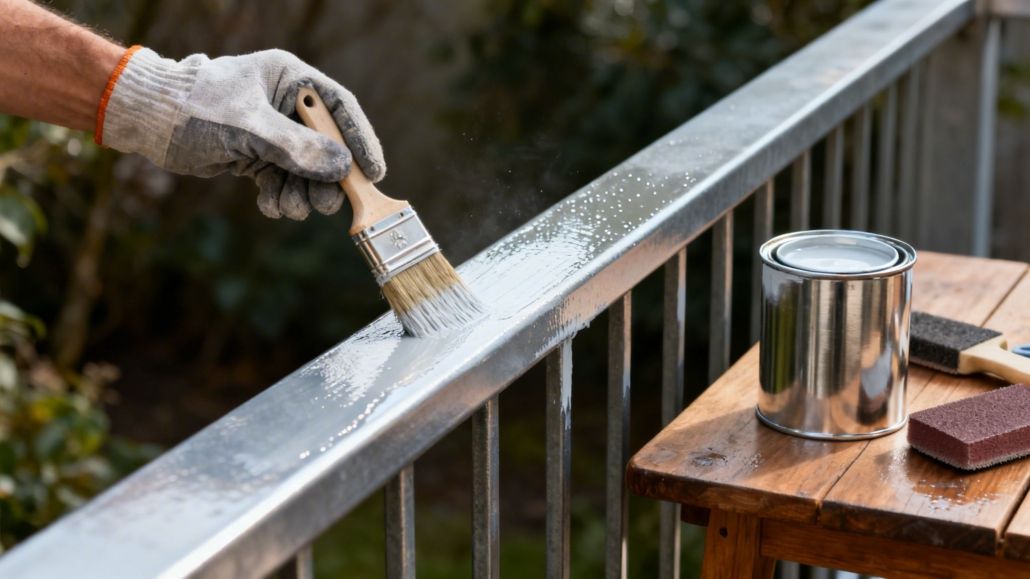
Can You Paint Metal? A Pro Guide for Lasting Results
Absolutely, you can paint metal. The real question is, can you paint it so it lasts? For homeowners and business owners in our local community, a quick paint job is a recipe for failure. A quality coating is the single most important barrier between your property’s metalwork and the damp air that’s always looking to start rust.
Why a Proper Paint Job is Non-Negotiable for Metal
As a local painting and construction contractor, I’ve seen it countless times: a commercial steel door or a beautiful aluminum railing that starts peeling and blistering within a year. Why? Because someone skipped a step. Painting metal isn't just about changing the color; it's a technical process designed to protect an expensive asset from corroding into dust.
Cutting corners—like painting over dirt or skipping primer—guarantees you'll be redoing the work sooner rather than later, and it will cost you more the second time around.
For anyone managing a business, facility, or home, understanding the right way to do this is crucial. It gives you the confidence to tackle a project yourself or to know exactly what to look for when you're hiring a commercial painting contractor.
The Real-World Payoff of Doing It Right
A meticulously painted metal surface does more than just look good. It delivers tangible benefits that protect your investment, whether it’s for a commercial facility, retail space, or your own home.
-
Stops Corrosion in Its Tracks: This is the big one. A complete coating system seals the metal off from moisture and oxygen. For a business with steel support beams or a homeowner with a wrought iron gate, preventing rust isn't just a good idea—it's essential maintenance.
-
Extends the Life of Your Assets: Metal doors, window frames, siding, and railings aren't cheap. A proper paint job can add years to their lifespan, pushing back expensive replacement costs and saving facilities managers and homeowners significant money in the long run.
-
Boosts Curb Appeal and Value: There’s no denying the visual impact. A crisp, uniform finish on metal elements makes a property look sharp and well-maintained. On a commercial building, it signals professionalism. On a house, it directly contributes to its market value.
-
Improves Safety and Functionality: Rust isn't just ugly; it's destructive. Corrosion actively weakens metal. By keeping rust at bay, a quality paint job maintains the structural integrity of critical components like handrails, fire escapes, and support posts.
The secret to a durable finish that stands up to our local weather is sticking to a proven method. It's all about the prep work—cleaning, sanding, and priming—before a drop of paint is even applied. Get that right, and you'll have a coating that adheres properly and protects your property for years.
Preparing Metal Surfaces for a Flawless Finish
A great paint job on metal is all about what you do before you even crack open a can of paint. If you’ve ever wondered, "Can you paint metal?" the answer is yes, but it’s the prep work that makes or breaks the project. Slapping a new coat over grease, rust, or flaking old paint is a surefire recipe for peeling and blistering in just a few months.
Every metal painting job, whether it’s a simple handrail or a large commercial steel building, starts with a good, hard look at the surface. Get up close and inspect it for rust spots, paying special attention to welds and crevices where moisture loves to hide. You'll also want to check for peeling paint, chalky residue from old coatings, and any oily films. These are the enemies of adhesion.
Cleaning and Etching for Lasting Adhesion
Once you know what you’re up against, it’s time to clean. And we don’t mean a quick wipe-down. Each type of metal needs a specific approach to get it ready for primer and paint to grab hold and stay there.
- Steel and Iron: These ferrous metals are all about rust. Your first move is to get aggressive with a wire brush or scraper to knock off all the loose rust and failing paint. For bigger jobs, a power washer can do a lot of the heavy lifting. Once the loose stuff is gone, wipe the entire surface down with a good degreaser to get rid of any grime or oil.
- Aluminum: Aluminum is tricky. It doesn’t rust like steel, but it quickly forms an invisible layer of oxidation that paint simply won't stick to. After cleaning it with a degreaser, you need to scuff the entire surface. This process, called etching, can be done with fine-grit sandpaper or an abrasive pad to create a microscopic texture for the primer to grip.
- Galvanized Metal: New galvanized metal is notorious for shedding paint because of its slick, oily zinc coating. You have to start by cleaning it with a solvent to cut through that oily residue. After that, a mild acid wash—something as simple as white vinegar works great—will gently etch the surface, giving it the tooth it needs for a lasting finish.
For business owners and homeowners in the area dealing with years of built-up grime, looking into professional power washing services near me can be a game-changer. It saves a ton of time and ensures you’re starting with a truly clean slate.
Our rule of thumb is simple: If the surface isn’t perfectly clean and properly profiled, the paint will fail. This is non-negotiable in our local climate, where relentless dampness will find and exploit any weakness in your paint job. A little extra time spent on prep will save you a world of headaches down the road.
This diagram really boils the process down to its three essential parts.
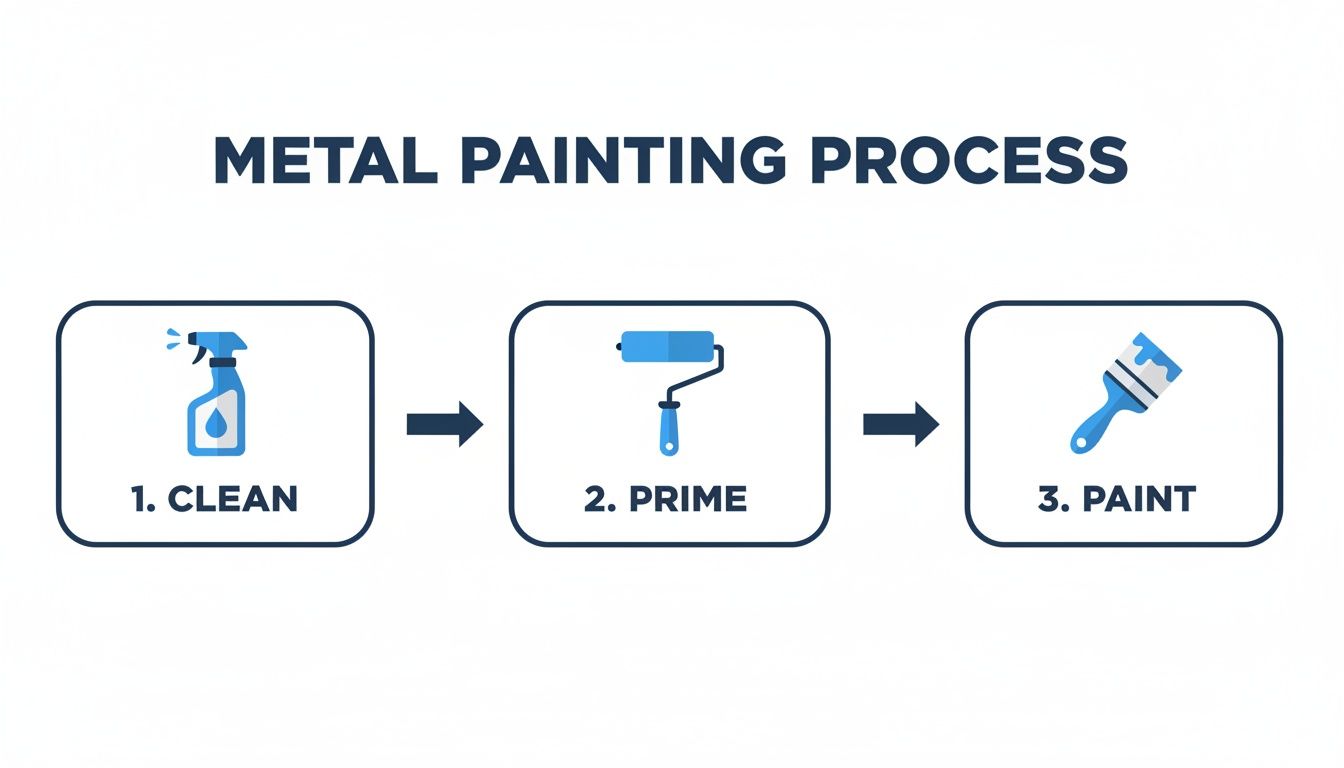
Think of it this way: painting is just the final step. The real work that guarantees a beautiful, durable finish happens long before you pick up a brush.
Choosing the Right Primer and Paint for Your Project
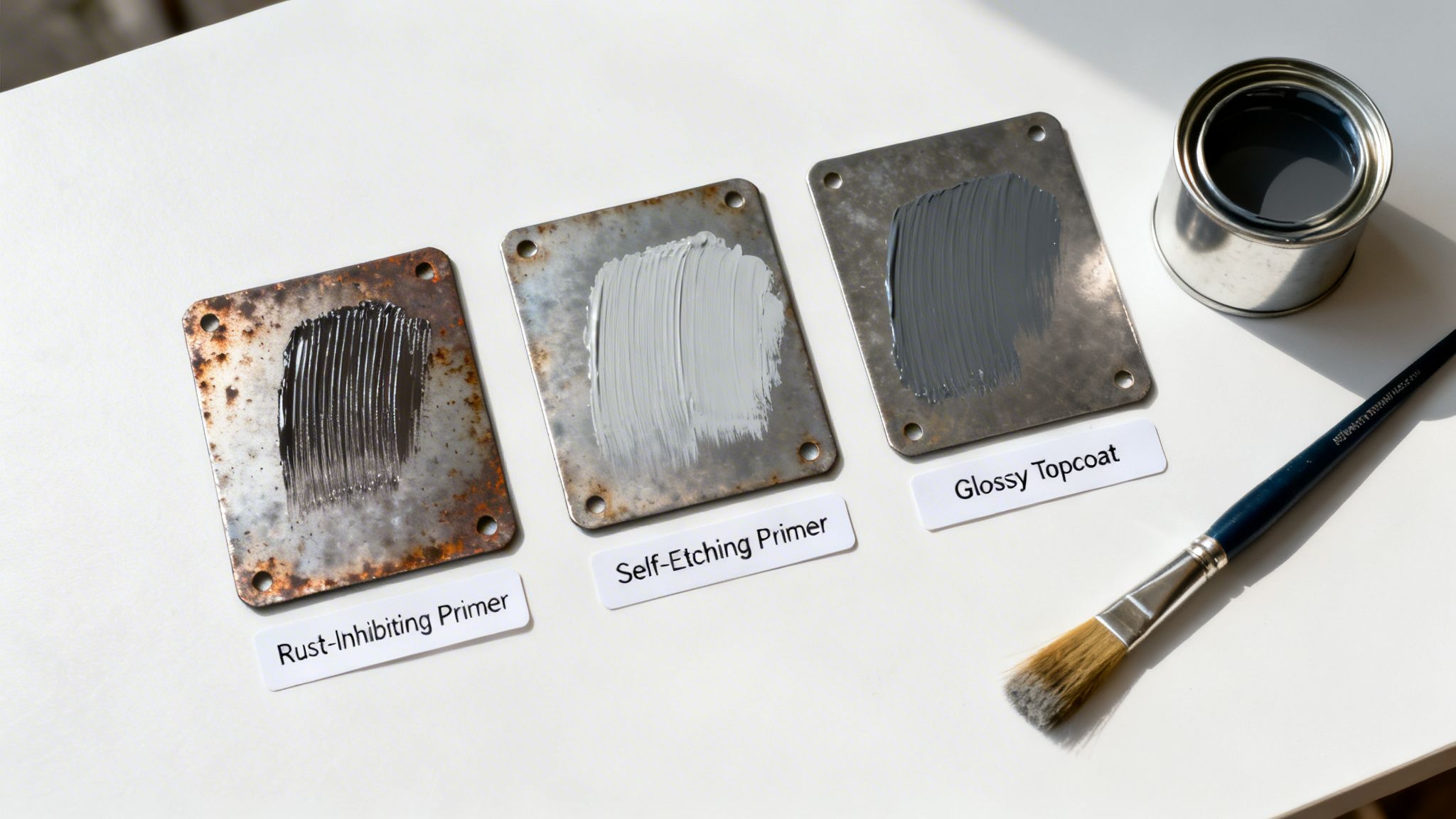
You’ve put in the hard work to get your metal surface perfectly clean and prepped. Honestly, that’s half the battle right there. But the choices you make now—the primer and paint—will determine whether that beautiful finish lasts for years or starts failing in a few seasons.
Think of primer as the ultimate peacemaker between the metal and the paint. Without the right one, your topcoat simply has nothing to grab onto, and it's only a matter of time before it starts to peel and flake away. This is one step you absolutely cannot skip.
I’ve seen it countless times: a beautiful paint job fails because the wrong primer was used—or worse, none at all. The primer’s job is to create an unbreakable bond for the paint while also providing the first line of defense against the elements. It’s the foundation for a lasting finish.
Matching Primer to the Metal
Your primer choice comes down to one thing: the type of metal you're painting. Grabbing a generic can off the shelf is a recipe for disaster. Each formula is designed to solve a specific problem.
- For Steel and Iron: In our damp local climate, rust is your number one enemy. You need a rust-inhibiting primer, plain and simple. These are typically loaded with zinc, which actively fights corrosion by creating a barrier that locks out moisture. It’s non-negotiable for iron railings, steel gates, or any ferrous metal exposed to our weather.
- For Aluminum: Aluminum is slick and non-porous, making it notoriously difficult for paint to stick. The solution is a self-etching primer. This stuff is brilliant—it contains a mild acid that microscopically "bites" into the surface, creating a textured profile for the paint to grip onto for a tenacious bond.
- For Galvanized Metal: That shiny zinc coating on galvanized steel is designed to prevent rust, but it also repels paint. You need a dedicated galvanized metal primer that’s formulated to adhere to that slick surface without damaging the protective zinc layer underneath.
Selecting a Durable Topcoat
With the primer properly applied and cured, you’re ready for the topcoat. This is what provides the color, the sheen, and the final shield against UV rays, rain, and physical abuse. What you choose depends entirely on where and how the metal will be used.
For highly specialized applications, like marine environments, the product choice is even more critical. You can find excellent resources on topics like choosing antifouling paint for aluminum boats that show just how specific you need to get.
For most residential and commercial projects, these are our go-to options:
- Oil-Based Enamel: A true workhorse. We use it on high-touch surfaces like handrails, doors, and machinery because it dries to an incredibly hard, durable finish that stands up to a ton of wear and tear.
- Acrylic Latex Paint: Modern acrylics are fantastic for exterior metal that expands and contracts, like siding or architectural features. Their built-in flexibility prevents the cracking and chipping that can happen with more rigid paints.
- Epoxy Coatings: When you need maximum durability, this is the answer. Two-part epoxies create a finish that’s practically bulletproof, offering unmatched resistance to chemicals, moisture, and abrasion. We rely on them for demanding commercial spaces like warehouse floors and professional kitchens.
Choosing Your Tools: How to Apply Paint for a Professional Finish
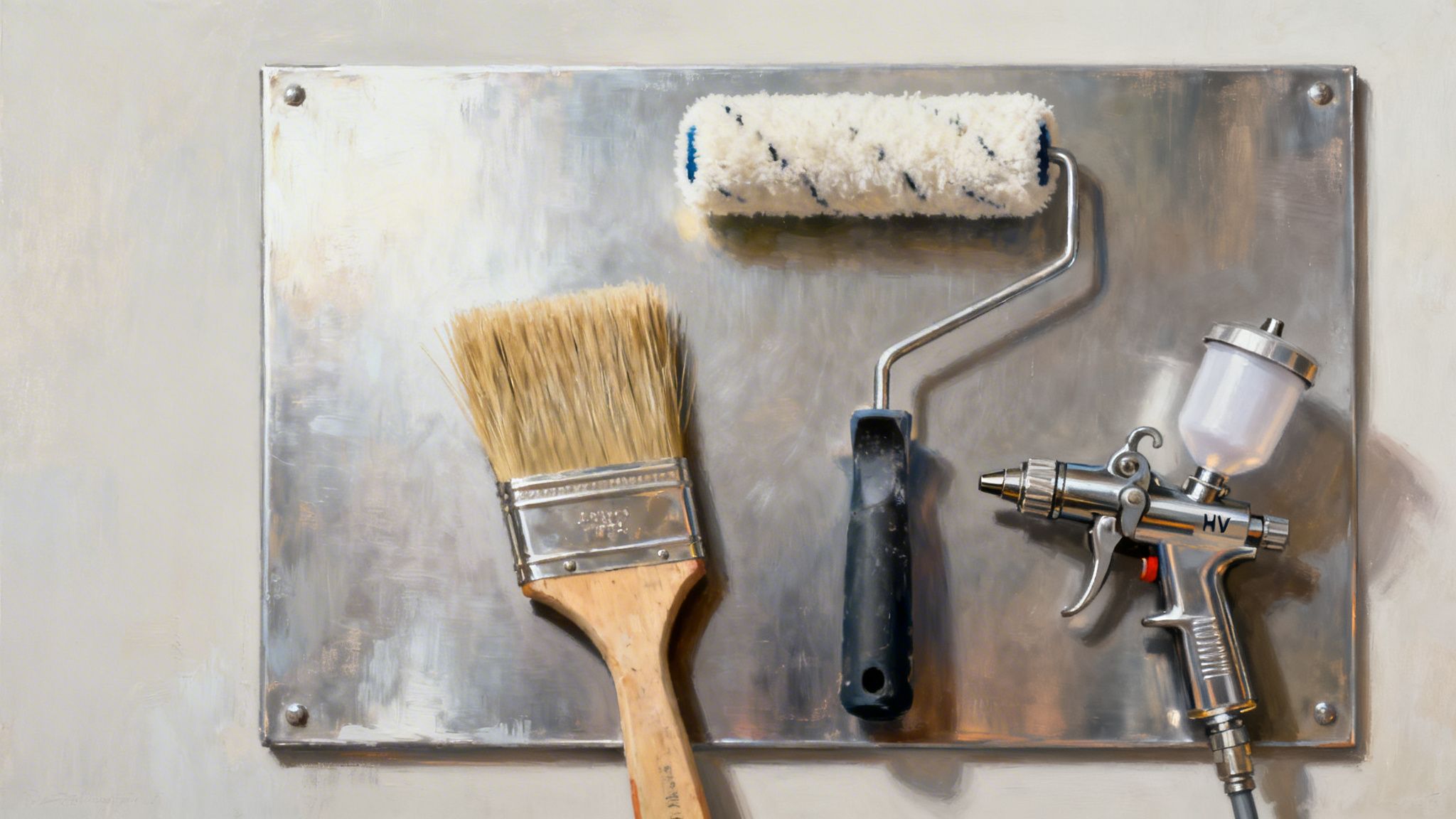
You've done the prep work and picked the perfect paint. Now comes the moment of truth: the application. The tool you choose is what separates an amateur job from a durable, professional-grade finish. Your choice really depends on the size, shape, and texture of the metal surface you're working on.
Brushing: For Control and Detail Work
When it comes to intricate jobs, nothing gives you more control than a good brush. This is perfect for projects like wrought-iron railings, metal window frames, or cutting in the edges of a metal door.
A high-quality, synthetic-bristle angled sash brush is your best friend here. It’s designed for creating those razor-sharp lines. The trick is to dip only the first third of the bristles into the paint and then use long, steady strokes with light pressure. This helps you avoid overloading the surface and leaving behind those telltale brush marks.
Rolling: The Go-To for Large, Flat Areas
If you’re facing a big, flat surface like a commercial roll-up door, a large metal gate, or siding panels, a roller will be your most efficient option. But not just any roller will do—the roller cover (or nap) is everything.
- Smooth Metal: For a perfectly smooth surface, grab a short-nap roller, something in the 1/4" to 3/8" range. This gives you great coverage without laying the paint on too thick, which is key to avoiding drips and getting a clean, uniform look.
- Textured or Corrugated Metal: If your surface has some texture, like corrugated siding, you’ll want a slightly thicker nap of around 1/2". This ensures the paint gets into every groove and valley for complete protection.
Spraying: For the Ultimate Flawless Finish
For that pristine, straight-from-the-factory look, you simply can't beat spraying. This is the method we use for most of our commercial painting services near me, especially on large-scale projects. High-Volume, Low-Pressure (HVLP) or airless sprayers atomize the paint into a fine mist, which lays down in a perfectly even layer without a single brush or roller mark.
Of course, professional spray equipment requires maintenance to perform at its best. If you're managing your own gear, knowing about topics like choosing the right pump repair kit for your airless sprayer is essential for keeping your projects on track.
Even aerosol spray cans can give you a great finish on smaller jobs. The secret is to keep the can moving in smooth, overlapping passes about 8-12 inches from the. Always apply several thin coats rather than one thick one to prevent runs.
No matter which tool you use, the golden rule is this: thin, even coats are always better. It might feel slower, but two or three thin coats will cure harder, look smoother, and last significantly longer than one thick, heavy coat that's prone to sagging and drips.
When to Call a Professional for Your Painting Project
Let's be honest, not every metal painting job is a good fit for a DIY weekend. While tackling a small fence or some outdoor furniture can be rewarding, knowing when to call in a professional is the real key to a great result that protects your investment.
Sometimes, the scale, complexity, or materials involved just demand a professional touch. For both homeowners and facilities managers, making that call can be the difference between a finish that lasts for years and one that fails before the next season. It's less about whether you can do it and more about whether you can do it safely, efficiently, and to a standard that protects your property.
Large-Scale and Complex Projects
The most obvious sign it's time to look for professional painting and construction services is the sheer size of the job. Are you thinking about painting the entire metal siding of a commercial building, a huge warehouse, or an extensive metal roof? This is where a DIY approach quickly becomes impractical and, frankly, unsafe.
Professional crews have this down to a science. They arrive with commercial-grade sprayers for a perfectly uniform coat, along with the proper scaffolding and aerial lifts to safely reach every corner. A coordinated team can get a massive project done in a fraction of the time, minimizing disruption to your business. This is especially critical for projects involving large-scale facility construction services.
Specialized Coatings and Finishes
Some projects require coatings that you just can't find at the local hardware store. When you step into the world of industrial-grade finishes, it’s time to bring in someone who handles them every day.
We see this all the time with:
- Two-Part Epoxies: These are fantastic for high-traffic floors or commercial kitchens, but they require precise mixing and have a very short window for application. Get it wrong, and the product won't cure.
- Specialty Urethanes: Perfect for providing UV resistance on exterior architectural metal, but they can be tricky to apply without streaks or bubbles.
- Complex Commercial Renovations: Jobs like retail build-outs or an office space renovation often have strict specifications for durability and performance that only professional-grade products can meet.
A seasoned professional has the muscle memory that comes from working with these demanding products. They know exactly how to prep the surface, the right application technique for a flawless finish, and how to manage curing times to ensure the coating performs exactly as it's designed to.
The Value of Local Expertise
Here in our community, the perpetually damp climate is the ultimate test for any paint job. This is where a local professional's experience becomes invaluable. They’ve spent years seeing what works—and what doesn't—in our soggy environment.
A local contractor who truly understands the weather knows which primers are essential for fighting off relentless moisture and how to time an application so it cures properly, even on a cool, overcast day.
Partnering with an experienced local team like Wheeler Painting isn't just about hiring painters; it's an investment in a guaranteed, long-lasting result. You’re getting peace of mind and protecting your property from the costly cycle of paint failure and repairs.
Frequently Asked Questions About Painting Metal
After years of serving homeowners and businesses in our area, we’ve found that the same few questions come up on almost every job. Everyone wants to know how to get a paint job that lasts. So, let's clear up some of the most common concerns.
Can I Just Paint Over Rust?
It’s tempting, we get it. You see a little rust and think a quick coat of paint will hide it. But this is probably the single biggest mistake you can make.
Painting over rust is like putting a small bandage on a serious wound. The rust won't stop growing just because it's covered. It will continue to eat away at the metal underneath, causing your brand-new paint to bubble, crack, and flake off in no time. You'll be right back where you started, but with a bigger mess.
The only way to get a lasting finish is to deal with the rust head-on. You have to remove every bit of loose, flaky rust with a wire brush, scraper, or sander. For really stubborn areas, a rust converter can be a lifesaver—it chemically changes the rust into a stable, paintable surface. Only then, once the surface is clean and sound, can you even think about priming.
What’s the Best Paint for Outdoor Metal?
In our damp climate, choosing the right paint is all about fighting off moisture. There’s no single "best" paint—the right choice depends entirely on what kind of metal you're working with.
- For Steel or Wrought Iron: We almost always lean toward a direct-to-metal (DTM) oil-based enamel. These create a tough, rock-hard shell that’s fantastic at blocking moisture and preventing rust from starting.
- For Aluminum: You'll want to go with a high-quality acrylic latex paint. Aluminum expands and contracts a lot with our temperature swings, and acrylics are flexible enough to move with it without cracking.
No matter which paint you choose, the real secret to success is the prep work. A thorough cleaning followed by the right primer—a rust-inhibiting one for steel and a self-etching one for aluminum—is what makes the topcoat stick and gives you that long-term protection.
Do I Always Need to Use a Primer on Metal?
Yes. Pretty much always. Skipping the primer is the most common shortcut we see, and it’s almost always the reason a metal paint job fails. Primer does two critical jobs: adhesion and protection.
Metals like aluminum and galvanized steel are notoriously slick, and paint has a hard time grabbing on. A self-etching primer actually bites into the metal, creating a perfect surface for your paint to adhere to. For iron and steel, a rust-inhibiting primer acts as your frontline defense against corrosion, which is a constant battle in our local climate.
We get asked about "paint-and-primer-in-one" products all the time. While they have their place for certain indoor projects, they simply don't offer the same level of grip or long-term protection as a dedicated primer coat, especially for anything that lives outside.
How Long Does Professionally Painted Metal Last?
This depends on a few things: the quality of the prep work, the specific coatings used, and how much abuse the metal takes from weather and use.
For a professionally painted exterior metal surface in our region, you can realistically expect the finish to last anywhere from 5 to 15 years. For example, a commercial steel door we coat with a high-performance two-part epoxy might look great for over a decade. A decorative wrought iron railing painted with a standard enamel, on the other hand, will probably need a refresh in about 5-7 years.
A little maintenance, like annual cleaning, can go a long way in getting the most life out of any paint job.
For residential or commercial construction projects big or small, having a professional handle the job ensures the prep is done right and the finish is built to last. If you're considering a painting or renovation project for your property, the team at Wheeler Painting is here to help our community.




 “Like” us on Facebook!