
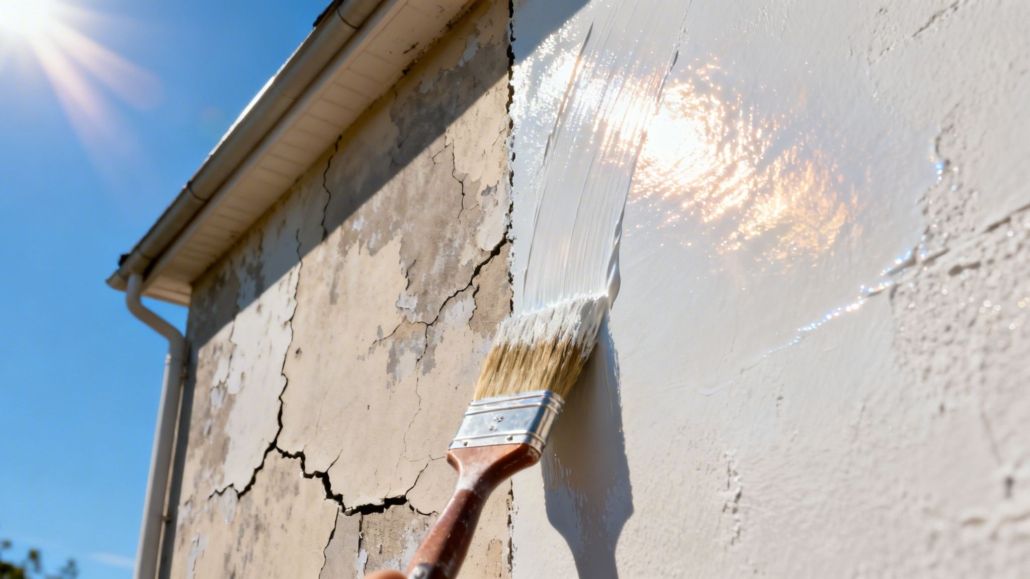
A Property Owner’s Guide to UV Resistant Paint
Let’s get straight to it: UV resistant paint is essentially high-performance sunscreen for your home or commercial property. It’s a special kind of coating formulated specifically to stand up to the sun’s relentless ultraviolet (UV) rays, which are the real culprits behind faded, cracked, and peeling paint. Making the right choice can feel overwhelming, but this guide will walk you through what you need to know in simple, helpful terms.
Protecting Your Property With UV Resistant Paint

Here in our local service area, we cherish our sunny days, but that intense summer sun can be brutal on a building's exterior. That rich, vibrant color you loved when you first painted can look dull and chalky in just a few years. This isn't just about looks—it’s a clear warning that your property's first line of defense is failing.
Most standard exterior paints just aren't built to handle the constant UV exposure. Day after day, the sun’s radiation breaks down the chemical binders in the paint, a process called photo-oxidation. This assault leaves the paint film brittle and weak, unable to protect the wood, fiber cement, or metal underneath.
The Long-Term Value of Advanced Protection
Opting for a quality uv resistant paint is one of the smartest long-term decisions a property owner, business owner, or facilities manager can make. These advanced coatings contain special pigments and additives that either absorb or reflect UV radiation before it can degrade the paint. This means colors stay true and the paint finish remains flexible and intact for far longer than you'd get from a conventional paint.
For a business, that means maintaining a sharp, professional curb appeal. For a homeowner, it’s about protecting your biggest asset and avoiding premature maintenance headaches.
A great paint job isn't just cosmetic; it's a protective shield. By deflecting the sun's attack, UV resistant paints drastically cut down on how often you need to repaint, saving you thousands of dollars over the life of your building.
This level of protection is a game-changer in our region. Our unique climate cycle of damp winters followed by bright, dry summers puts incredible stress on any painted surface. Applying the right coating—and applying it correctly—is the key to a beautiful finish that lasts. At Wheeler Painting, a trusted local provider, we specialize in helping property owners choose and apply coatings designed to withstand our local weather, ensuring your investment looks fantastic for years to come.
How UV-Resistant Paint Defends Your Surfaces
Ever wonder why the paint on an old shed or park bench gets that dull, chalky look? Or why a once-vibrant front door starts to fade after just a few years? The culprit is the sun. Its invisible ultraviolet (UV) rays are constantly bombarding your building's exterior, and standard paint just can't hold up.
Think of a newspaper left on the dashboard of a car. In a short time, the sun yellows the paper and makes it brittle enough to crumble. A similar process, called photo-oxidation, happens to regular paint. UV radiation attacks the chemical bonds that hold the paint together, breaking them down one by one. This is what causes colors to fade, the finish to go chalky, and the paint to crack and peel, leaving the surface underneath exposed.
This isn't a minor issue—it's the primary reason exterior paint jobs fail. In fact, solar radiation is responsible for about 80% of all exterior paint failures. It's no surprise, then, that the global market for weather-resistant coatings was valued at USD 8.5 billion in 2024 and is expected to climb to USD 14.3 billion by 2032, according to market analysis from IntelMarketResearch.com. Homeowners and property managers are catching on: fighting the sun requires a specialized formula.
The Science: Sunscreen and a Repair Crew for Your Walls
So, what makes UV-resistant paint different? It's all in the additives. These paints are engineered with a powerful one-two punch that neutralizes UV radiation before it has a chance to wreak havoc.
First up are additives called UV absorbers. Their job is simple: act like a high-SPF sunscreen for your siding. These microscopic compounds are specifically designed to absorb incoming UVA and UVB rays. They take the hit, convert that energy into a tiny, harmless amount of heat, and release it. The paint’s binders and color pigments are never touched.
By essentially sacrificing themselves, these absorbers form the first line of defense, stopping the vast majority of damaging radiation right at the surface.
UV absorbers are the silent heroes in your paint. They take the hit from solar radiation so the paint’s color and structure don’t have to, preserving your property's vibrant appearance and protective layer.
A Microscopic Repair Crew That Never Quits
Even the best sunscreen can miss a few spots. Some UV radiation will inevitably sneak past the absorbers. That's where the second key ingredient comes in: Hindered Amine Light Stabilizers, better known as HALS.
If UV absorbers are the shield, HALS are the microscopic, always-on-call repair crew. When a stray UV ray gets through and creates a destructive molecule known as a "free radical," HALS spring into action. They find these free radicals and neutralize them on the spot, stopping them from starting a chain reaction of damage within the paint film.
The truly amazing thing about HALS is that they are self-regenerating. After neutralizing a free radical, they return to their original state, ready to do it all over again. This means they don't get used up, allowing them to patrol and protect the paint for years.
This powerful combination is what gives uv resistant paint its incredible staying power:
- UV Absorbers: Block most of the incoming solar radiation at the surface.
- HALS: Continuously patrol the paint film, cleaning up any damaging free radicals that form.
Together, they ensure the paint holds its color, stays flexible, and continues to protect your property. This advanced chemistry is why a high-performance coating is such a smart investment for any property owner, especially in our local service area where the summer sun can be surprisingly intense.
Choosing the Right UV Resistant Coating
Picking the right UV resistant paint isn't a one-size-fits-all decision. It's really about matching the product to the surface and the environment. You wouldn't use wall paint on your deck, and for the same reason, different exterior materials need specific kinds of protection to stand a fighting chance against the sun.
Not all UV coatings are built the same. Each type brings something different to the table, whether you're handling a residential home improvement project or painting a massive commercial building. Getting this choice right from the start is the key to a paint job that lasts and looks great for years. Let's walk through the main options and see where they shine.
Exterior Acrylic and Latex Paints
For the vast majority of homes in our community, a high-quality acrylic or latex paint is your best bet for exterior painting. Today’s formulas are light-years ahead of old oil-based paints. They’re durable, they hold their color exceptionally well, and they’re flexible. Most importantly, they breathe, letting moisture escape from inside the walls—a must-have feature in our damp climate.
These paints work beautifully on all sorts of common surfaces:
- Wood Siding and Trim: They expand and contract right along with the wood as temperatures fluctuate, which dramatically cuts down on cracking and peeling.
- Fiber Cement Siding: They create a strong bond with fiber cement, resulting in a smooth, long-lasting finish that handles both sun and relentless rain.
- Vinyl Siding: There are even specialized formulas that stick to vinyl without causing it to warp, giving it a complete refresh as part of a residential remodeling project.
The best of these paints are made with 100% acrylic binders, which are naturally great at resisting UV damage. This makes them a reliable, smart choice for most homes. They deliver solid protection without needing complex or specialized application. And if you're thinking about a new look, our guide on how to choose exterior paint colors can help you find a palette that will last.
This flowchart shows how the special additives in these paints work together as a team to guard the surface.

As you can see, it’s a two-pronged defense: UV absorbers act like a primary shield, and HALS clean up any rays that sneak past, giving the paint a much longer life.
High-Performance Elastomeric Coatings
When you need to protect surfaces like commercial masonry, stucco, or concrete, elastomeric coatings are in a league of their own. This stuff is thick—it can be applied up to 10 times thicker than standard paint. But its real superpower is its incredible flexibility. It can stretch and snap back to its original form without a single crack.
Think of elastomeric paint as a thick, waterproof, rubber-like membrane for your building. It doesn't just color the surface; it seals it completely against the elements.
This amazing stretchiness allows elastomeric coatings to bridge the hairline cracks that inevitably appear in masonry. As a building settles or shifts with temperature changes, the coating simply stretches over the gaps, keeping the waterproof barrier intact. For commercial properties, retail build-outs, and other large facilities, this is a game-changer, preventing water intrusion that could lead to huge repair bills. These are key considerations for "commercial painting services near me."
Specialized UV Resistant Clear Coats
Sometimes, you love the look of a surface and just want to protect it, not cover it up. This is where UV-resistant clear coats are perfect. These transparent finishes create a tough, non-yellowing shield that takes the brunt of the sun's abuse, letting the natural beauty of the material underneath show through.
Clear coats are an ideal solution for:
- Deck & Porch Staining: Protecting decks, front doors, or porches from fading while preserving the rich wood grain.
- Exposed Metal: Stopping architectural metal features from oxidizing or losing their color.
- Painted Artwork: Shielding outdoor murals and other custom finishes from sun damage.
These coatings act as a sacrificial layer, absorbing the UV radiation so the material they're protecting doesn't have to.
UV Resistant Coating Comparison Guide
To make it even clearer, here’s a quick breakdown of how these different coatings stack up and where they’re best used on properties in our service area.
| Coating Type | Best For | Key Benefit | Typical Lifespan (Years) |
|---|---|---|---|
| Acrylic Latex Paint | Wood, fiber cement, vinyl siding | Breathability & color retention | 7 – 10 |
| Elastomeric Coating | Concrete, stucco, masonry, brick | Crack-bridging & waterproofing | 10 – 15+ |
| UV Clear Coat | Stained wood, metal, murals | Protects underlying material | 3 – 7 |
By understanding these options, you can feel confident that your property is not only beautiful but also truly defended against the sun for years to come.
Understanding Paint Performance and Durability
When you invest in a new paint job for your home or business, you're not just picking a color—you're buying protection. But how do you know if a high-quality UV resistant paint is actually going to last? The difference between a paint job that looks great for a decade and one that fails after a few years of local sun and rain comes down to a few key performance metrics.
As professional painters, we see firsthand what holds up and what doesn't. Understanding these factors helps you look past the fresh shine and see the real value you're getting from a superior coating.
Key Metrics of a Lasting Finish
When we're evaluating a paint’s real-world performance, we look at how it's going to stand up to the elements over time. Three of the most critical factors are color retention, gloss retention, and chalk resistance.
Color Retention: This is simply a measure of how well a paint resists fading. A paint with poor color retention will see its vibrant color wash out under UV exposure, turning a deep, rich blue into a dull, dusty gray. The best UV-resistant paints use incredibly stable pigments and binders that lock in color for years.
Gloss Retention: This describes how long a paint keeps its original sheen, whether it's a flat, satin, or semi-gloss finish. When a paint loses its gloss, it’s not just a cosmetic issue; it’s an early sign that the paint film is starting to break down, making it harder to clean and less protective.
Chalk Resistance: Have you ever run your hand over an old, faded paint job and come away with a powdery residue? That’s "chalking." It happens when UV rays destroy the paint’s binders, leaving the pigment particles behind as dust. A great paint will resist this breakdown, maintaining a solid, intact surface that shields your property.
These qualities aren't just about looking good; they have a direct impact on your wallet. A durable paint job means you can go much longer between expensive repaints. The technology making this possible is often adapted from high-stakes industries where failure is not an option. For instance, the market for UV-resistant aircraft exterior paints is expected to hit nearly USD 946.9 million by 2036. For homeowners in our community, that same advanced science gives us paints that resist chalking up to 70% longer than standard acrylics, saving property owners thousands over the life of their home. You can read more on this market's growth at Future Market Insights.
Demystifying Paint Warranties
Many property owners are surprised to learn what a manufacturer's paint warranty actually covers—and more importantly, what it doesn't. It’s crucial to have realistic expectations, because these guarantees are often more limited than you might think.
A paint warranty almost always covers the product itself, not the labor to reapply it. If the paint is found to be defective, the manufacturer will typically provide replacement paint but will not pay for the cost of scraping, preparing, and repainting the surface.
This is exactly why professional application is so vital. A manufacturer will void their warranty in a heartbeat if the paint was applied improperly—over a dirty surface, in the wrong weather, or without the right primer. Warranties also won’t cover failures caused by underlying issues with your home, like moisture intrusion or rotted siding.
Think of a warranty as a statement of the manufacturer's confidence in their product when used correctly. Choosing a top-tier UV resistant paint is the first step. The second, and equally important, step is hiring a trusted local provider who stands behind their own work. For specialized surfaces that need extreme durability, like garage floors or commercial spaces, other coatings like epoxy offer similar protective benefits; you can check out our guide on epoxy floor coatings to see if it's right for you.
Professional Application for Maximum Longevity

Even the most advanced uv resistant paint will fail if it's not applied correctly. Think of it like buying top-of-the-line tires for your car. If they’re mounted improperly, they won't perform well or last long. The exact same principle applies to paint—the quality of the application is just as crucial as the quality of the product itself.
Getting a beautiful, durable finish that can withstand the unique challenges of our local weather is part science, part craft. A professional crew with local experience knows all the variables that can make or break a project, from the condition of the siding to the humidity in the air. That expertise is what turns an investment in premium paint into the outstanding, long-term results you expect when searching for "house painting near me."
The Non-Negotiable Foundation: Surface Preparation
The single most critical step of any paint job happens before a can is even opened. Proper surface preparation is the bedrock of a lasting finish. It's a non-negotiable part of any professional project, because slapping new paint over a dirty, peeling, or failing surface is a surefire recipe for premature failure.
A truly meticulous prep process always includes several key stages:
- Thorough Cleaning: Every square inch of the exterior needs to be pressure washed or hand-washed. This removes all the built-up dirt, mildew, pollen, and chalky old paint residue, giving the new primer and paint a clean, stable surface to grab onto.
- Scraping and Sanding: We scrape away every bit of loose, peeling, or cracking paint. Then, we "feather sand" the edges to create a smooth, seamless transition between the bare surface and the old paint. This prevents ugly lines from telegraphing through the final coats.
- Repairs: Any damaged siding, rotted trim, or other structural problems have to be fixed first. Painting over compromised materials is like putting a bandage on a broken bone—it might hide the problem for a little while, but it doesn’t actually solve it. This is a crucial step for both residential remodeling and commercial renovations.
- Priming: A high-quality primer is applied to any bare wood and repaired spots. Primer is the essential bridge between the surface and the topcoat; it seals stains, ensures a strong bond, and creates a uniform canvas so the final color and sheen look perfect.
Here's a statistic that shocks many property owners: poor surface preparation is the culprit behind over 80% of all paint failures. A professional crew spends the majority of their time on these foundational steps, knowing that this is where the longevity of the job is truly won or lost.
Applying Paint in the Right Conditions
For paint to cure into that hard, protective shell it’s designed to be, it has to be applied within a specific window of temperature and humidity. In our service area, that’s especially important. Our weather can be all over the place, but experienced local painters know how to work with it, not against it.
Putting on paint when it's too cold can stop it from curing properly, leaving the finish soft and vulnerable to damage. On the flip side, painting in direct, hot sun can make it dry too fast, causing brush marks, blisters, and weak adhesion. If you've ever seen paint bubble on walls, for example, the conditions during application were likely a major factor. For a deeper look, our article explaining what causes paint to bubble on walls breaks it down further.
The Value of Experienced Execution
When you hire a seasoned team like Wheeler Painting, you’re not just paying for people to roll paint on your walls. You’re investing in a guaranteed outcome. We have the right equipment, a deep understanding of how different uv resistant paint formulas behave, and the local knowledge to get every single step right.
Whether we’re managing a residential home improvement project or large-scale commercial renovations, our process is built to ensure your property is protected and looks fantastic for years to come.
When to Call in the Pros for Your Project
Most of us have tackled a weekend painting project. But sometimes, what looks like a simple repaint is actually your house telling you something much bigger is wrong. Knowing the difference between a DIY touch-up and a job that needs a professional eye can save you a ton of frustration and money.
If you see paint cracking in a pattern that looks like alligator skin, or if it's peeling off in big sheets, stop and put the scraper down. These aren't just cosmetic issues. They're giant red flags signaling deeper trouble. An experienced pro can spot the real culprits—things like hidden rot in the trim, moisture wicking up through the siding, or failing window seals that are letting water in.
Just slapping new paint over these problems is like putting a small bandage on a major injury. A team that handles both painting and repairs can diagnose the root cause, ensuring you're not just hiding rot but actually fixing it for good.
Beyond Just a Paint Job: The Value of a True Restoration
When you discover that peeling paint is just the tip of the iceberg, the last thing you want is the headache of managing two different contractors. Imagine finding out your siding is compromised. Now you have to find and schedule a construction crew, wait for them to finish, and then bring the painters back.
A full-service team like Wheeler Painting, your "residential contractor near me," eliminates that chaos. We handle both the structural repairs and the flawless finish, all under one roof. This seamless approach is a lifesaver for property owners in our community. We're equipped to manage:
- Residential Remodeling: Whether it's siding replacement or fixing dry rot found under old paint, we coordinate the construction and finishing touches perfectly.
- Commercial Renovations: Time is money for any business. We keep retail build-outs and office space renovations on track, handling everything from new drywall to the final coat of paint.
- Institutional Painting and Facility Construction Services: Our experience with larger projects ensures we deliver on time and within budget, from new builds to major renovations. We are your partner for "commercial construction near me."
Professional expertise also means access to the latest coating technologies. For example, the market for UV-curable coatings is exploding—projected to hit nearly USD 15 billion by 2033—because they dry instantly and offer immediate UV protection. Wheeler Painting uses these advanced finishes to protect everything from high-traffic commercial interiors to custom cabinetry, drastically reducing sun-fading. If you're interested in the data, you can explore the full market research from GrandViewResearch.com.
If your property is showing signs of serious paint failure or you're planning a bigger project, don't leave it to guesswork. Contact Wheeler Painting for an expert consultation. We’ll build a comprehensive plan to restore your property and protect your investment for years to come.
Frequently Asked Questions About UV Resistant Paint
As professional painters in our local community, we get a lot of questions from property owners trying to protect their homes and businesses from the sun. Here are some straightforward answers to the questions we hear most often about UV resistant paint.
Is UV Resistant Paint Really Worth the Extra Cost?
That's a smart question, and we hear it all the time. It's easy to look at the higher price per gallon and wonder if it's just a gimmick. But the real value isn't in the can; it's in the years of performance you get out of it.
These advanced paints are formulated to last, often twice as long as their standard counterparts. This means you can push back your next full, expensive repaint—and all the labor and material costs that come with it—for several more years. For any building in our local service area, that adds up to fewer headaches and a much lower cost to maintain your property over time.
Can I Just Paint Over My Old Flaking Paint?
I know it’s tempting to just slap a coat of new paint over the old stuff, but that’s the fastest way to guarantee your new paint job will fail. The new paint needs a solid, stable surface to grab onto. If the layer underneath is already peeling, the new paint will just come right off with it.
Think of it like this: all the cleaning, scraping, sanding, and priming we do isn't just busywork. It's the foundation of the entire project. Getting that surface preparation perfect is what allows a high-quality coating to bond properly and give you the durable, long-lasting finish you're paying for.
Are UV Resistant and Weatherproof Paints the Same Thing?
They're related, but not quite the same. "Weatherproof" is a catch-all term for paints that can handle moisture, humidity, and big temperature swings. "UV resistant," on the other hand, is all about fighting off damage from the sun's radiation.
The good news is that you don't have to choose. Any high-quality exterior paint worth its salt will have strong UV blockers built right in, because the sun is a huge part of what we call "weather." For our unique climate—wet winters and surprisingly intense sunny summers—you absolutely need a paint that excels at both.
Should I Use UV Resistant Paint Inside My Home?
Yes, it’s often a great idea, especially in rooms that get flooded with natural light. If you have big south-facing windows, French doors, or skylights, you've probably seen how sunlight can fade walls, hardwood floors, and even furniture over time.
Using an interior painting product with built-in UV protection can dramatically slow down that aging process. We also use clear UV-blocking topcoats on things like stained wood cabinets, trim, and built-ins. It's a fantastic way to keep your home’s interior looking fresh and vibrant for years, protecting the investment you've made in its appearance.
Ready to protect your property with a finish that’s built to last? The team at Wheeler Painting has the local expertise to choose and apply the perfect UV resistant paint for your home or business.





 “Like” us on Facebook!