Tag Archive for: commercial painting

How to Fix Cracks in Drywall: A Puget Sound Guide

A wall crack has a way of pulling your eye every time you walk past it. One day the wall looks fine. The next day there is a thin line over a doorway, a split in a corner, or a diagonal crack near a window that makes you wonder whether this is a paint issue, a drywall issue, or something bigger.

Most drywall cracks are fixable. The key is not treating every crack the same way.

A small seam crack in a hallway often needs a careful, methodical repair. A wider crack, a recurring crack, or one paired with staining or sticking doors needs a different response. In Kent, Seattle, Tacoma, and the communities in between, that distinction matters because Pacific Northwest buildings move, absorb moisture, dry out, and sometimes shift just enough to reopen a weak repair.

That Unsettling Crack in the Wall and What to Do Next

The most common call starts the same way. A homeowner notices a crack that was not there a few months ago, usually in a living room corner, over a door, or along a ceiling seam. Property managers often spot the same thing during a unit turn or after a tenant mentions “a line in the wall that keeps coming back.”

That reaction is normal. Drywall cracks look dramatic even when the repair is straightforward.

The first job is to identify what kind of crack you are looking at. Some are hairline stress cracks caused by minor movement, seasonal expansion, or an old seam that was not reinforced well enough the first time. Others point to a larger problem, especially if the crack is wide, diagonal, or paired with moisture staining.

A good repair starts with restraint. Do not smear spackle over a crack just to make it disappear for the week. That is the repair equivalent of painting over rot. It may look better briefly, but it does not hold.

Practical takeaway: If the crack is small and stable, a careful repair can last. If it is growing, recurring, or tied to movement, the wall needs diagnosis before patching.

People searching for how to fix cracks in drywall usually want one clear answer. The solution is simpler than it seems. Match the repair to the cause, use the right materials, and take the finish work seriously. That is how you get a repair that blends in and stays put.

Why Drywall Cracks in Puget Sound Homes and Buildings

In the Seattle to Tacoma corridor, drywall cracks are not just about age. Local conditions play a big role in how walls move and why repairs fail.

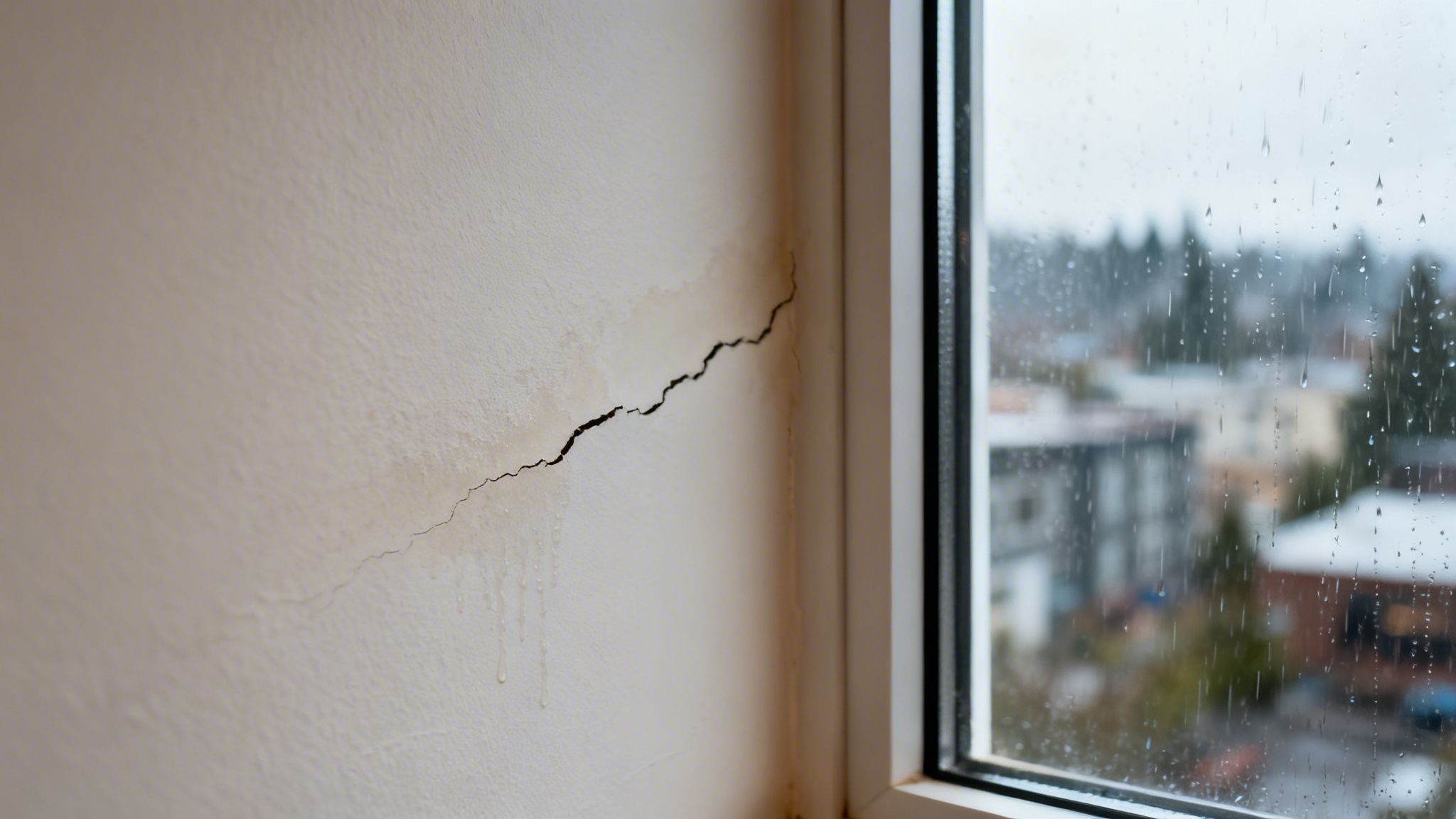
A large diagonal crack in a wall near a window with visible water damage stains

Movement is normal, but not all movement is harmless

Washington sees over 1,000 earthquakes annually, and those minor shifts contribute to drywall cracking in 20 to 30 percent of older homes in seismic areas of Western Washington, according to the verified data tied to the Mr. Handyman drywall crack guidance. Many standard DIY articles skip this point. They show how to fill a crack, but not why the crack returned after the last repair.

That matters in older homes around Kent, Seattle, and Tacoma. A recurring crack may reflect ongoing settling, light seismic movement, or repeated stress around openings like doors and windows.

Moisture changes the equation

The Pacific Northwest adds another layer. Framing takes on moisture and dries back out. That movement may be subtle, but drywall seams and corners are often where it shows up first. A crack near a window or exterior wall can come from normal expansion and contraction, but it can also be tied to water intrusion or trapped moisture.

If you are also seeing paint bubbling, staining, or soft drywall, it is smart to look at moisture first. This guide on what causes paint to bubble on walls is useful when a crack and a finish failure are showing up in the same area.

The crack pattern tells you a lot

Different crack shapes suggest different causes:

  • Thin straight seam cracks often point to tape failure, poor prior repairs, or ordinary movement at a joint.
  • Inside corner cracks usually come from seasonal movement where two planes meet.
  • Diagonal cracks near doors or windows deserve closer attention because openings concentrate stress.
  • Cracks with staining or soft spots suggest moisture, not just movement.
  • Cracks that reopen after repair usually mean the wall is still moving or the original repair had weak prep.

Contractor’s rule of thumb: The more a crack reflects movement, the less likely a simple surface fill will last.

Pros sometimes use crack gauges or flexible backer methods in movement-prone situations because the underlying issue is not the surface line. The core issue is whether the structure behind the finish is still shifting. That is why a durable repair in Puget Sound often starts with diagnosis, not mud.

Gathering Your Tools and Materials for a Flawless Repair

If you want a repair that lasts, the materials matter as much as the technique. A lot of failed drywall repairs happen because the wrong product gets used for the wrong job.

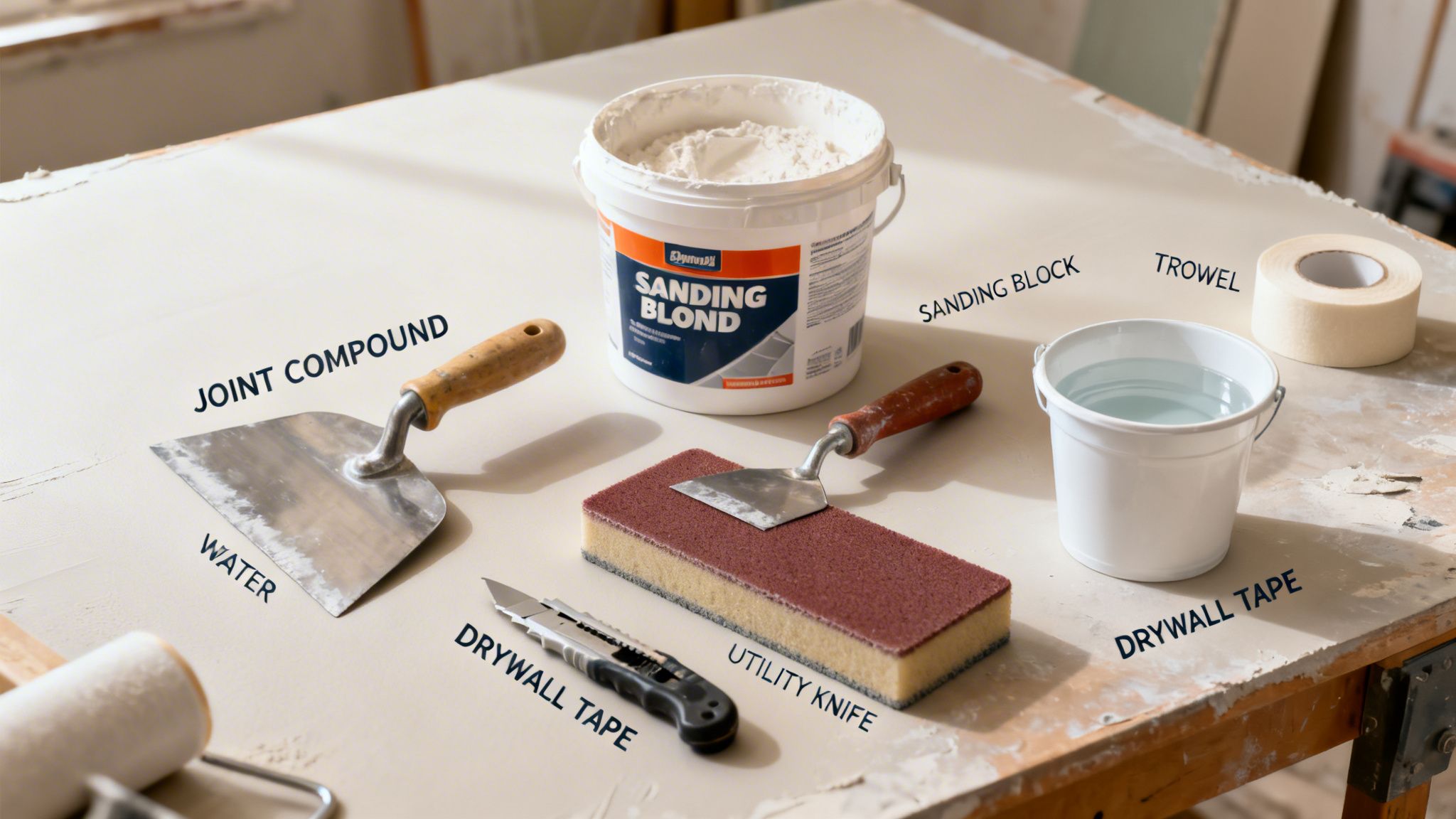
An assortment of essential drywall repair tools including compound, a trowel, tape, and a sanding block.

What belongs in your repair kit

Keep the list simple and job-specific:

  • Utility knife for opening the crack and trimming loose paper.
  • 6-inch drywall knife for filling and first coats.
  • 10-inch or 12-inch knife for feathering wider finish coats.
  • Setting-type joint compound for the crack repair.
  • Fiberglass mesh tape for reinforcing movement-prone cracks.
  • Sanding sponge or fine sanding block for smoothing between coats.
  • Vacuum or brush for dust removal.
  • Primer before paint.
  • Matching paint and texture materials if the wall is not smooth.

What works better in Western Washington

Verified data shows hairline cracks often recur in 60 to 70 percent of DIY repairs that do not use fiberglass mesh reinforcement, and pros get about 95 percent permanence using mesh tape over cleaned fissures, versus 40 percent for spackle alone in movement-prone conditions, as summarized in the verified data tied to the CertaPro drywall cracking article.

That lines up with what contractors see in damp climates. Spackle is fine for tiny nail holes. It is a weak choice for an active crack. Mesh tape and proper compound give the repair some structure.

A few material choices make a big difference

Here is a quick comparison:

Repair item Better use Why it matters
Spackle Tiny dings and nail holes Sands easily, but not ideal for moving cracks
Setting-type compound Crack filling and base coats Harder, stronger, better bond
Fiberglass mesh tape Stress cracks Adds reinforcement and flex
Paper tape Flat seams on broader patch work Good for controlled seam finishing
Primer Before paint Seals the repair so paint finishes evenly

If you are patching raw drywall or fresh compound, primer is not optional. This page on whether you have to prime sheetrock before painting covers why finish paint alone will not hide a repair properly.

One practical option for homeowners and property managers who want the repair handled from patch through finish is Wheeler Painting & Restoration Services, which includes drywall repair and paint prep as part of broader residential and commercial work in the area.

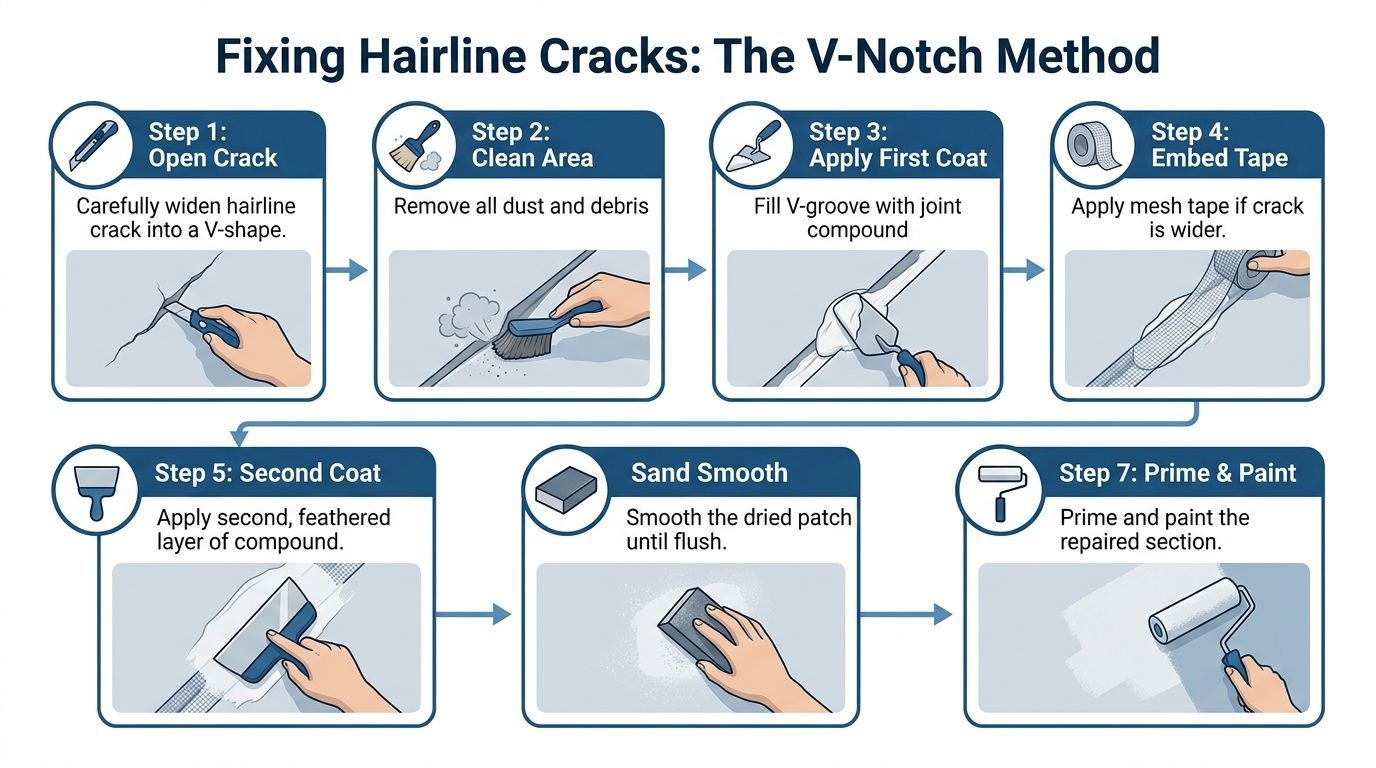
A Step-By-Step Method for Fixing Hairline Cracks

Hairline cracks are often the focus of quick fixes with a swipe of filler. That is also why so many come back.

For this type of damage, the V-notch method is the better approach. Verified data says this method can achieve 95%+ long-term success rates when done correctly, and skipping the cleaning step causes 40% of repair failures from poor bonding, based on the verified data tied to the drywall crack repair guide from Drywall Repair Utah.

Use this graphic as a quick visual reference.

Infographic

Open the crack on purpose

This feels backward, but it is necessary. Use a sharp utility knife to widen the crack into a shallow V-groove. The verified method calls for a V-notch that is shallow and narrow.

Why do this? Because compound needs something to grip. If you smear mud over a closed hairline crack, you are only bridging the surface.

If the crack ends in a small spidered point, round that end slightly with the knife. That helps reduce future splitting at the tip.

Clean out all the dust

Vacuum the groove thoroughly or brush it out and then vacuum it. Dust inside the groove weakens the bond.

Tip: Most surface repairs fail at the prep stage, not the paint stage. Clean drywall dust out before compound goes in.

This is a good point to stop and inspect the crack. If you can press on the wall and feel movement, or if the crack is wider than it first looked, move to a more structural repair approach.

Fill the groove with setting compound

Mix a setting-type joint compound to a workable consistency. Press it firmly into the V-groove with a 6-inch knife and overfill it slightly. Firm pressure matters because shallow filling can leave air pockets.

The goal is not a pretty first coat. The goal is a solid fill.

A video walkthrough can help if you have not done this kind of knife work before.

Reinforce with fiberglass mesh tape

Lay 2-inch fiberglass mesh tape over the wet compound. The verified data notes that pros prefer mesh for cracks because it offers increased crack resistance in movement-prone conditions.

Keep the tape centered. Extend it slightly beyond each end of the crack. Press it down evenly so it beds into the compound without bubbles.

Build the repair in thin coats

After the base sets, add finish coats in widening passes:

  1. First skim coat over tape, about 6 to 8 inches wide.
  2. Second coat after drying, around 10 to 12 inches wide.
  3. Final feather coat out to about 14 to 16 inches.

Each coat should be thin. The wider knife comes into play on the second and third coats because it lets you blend the repair into the wall without leaving a hump.

Sand, prime, and paint

Sand lightly between coats with a fine sanding sponge or 120 to 220 grit abrasive. You are smoothing ridges, not grinding the repair down.

Prime the patched area before painting. Then apply your finish paint in a way that blends sheen as well as color. On many walls, the paint match is where DIY work starts to stand out.

If the wall has orange peel, knockdown, or another texture, duplicate that texture before final paint. A flat patch on a textured wall is still obvious, even with a perfect color match.

How to Tackle Large, Recurring, and Corner Cracks

Some cracks need more than tape and compound. If the crack is wider, keeps reopening, or has damaged board edges, the stronger fix is to remove the weak section and install a proper patch.

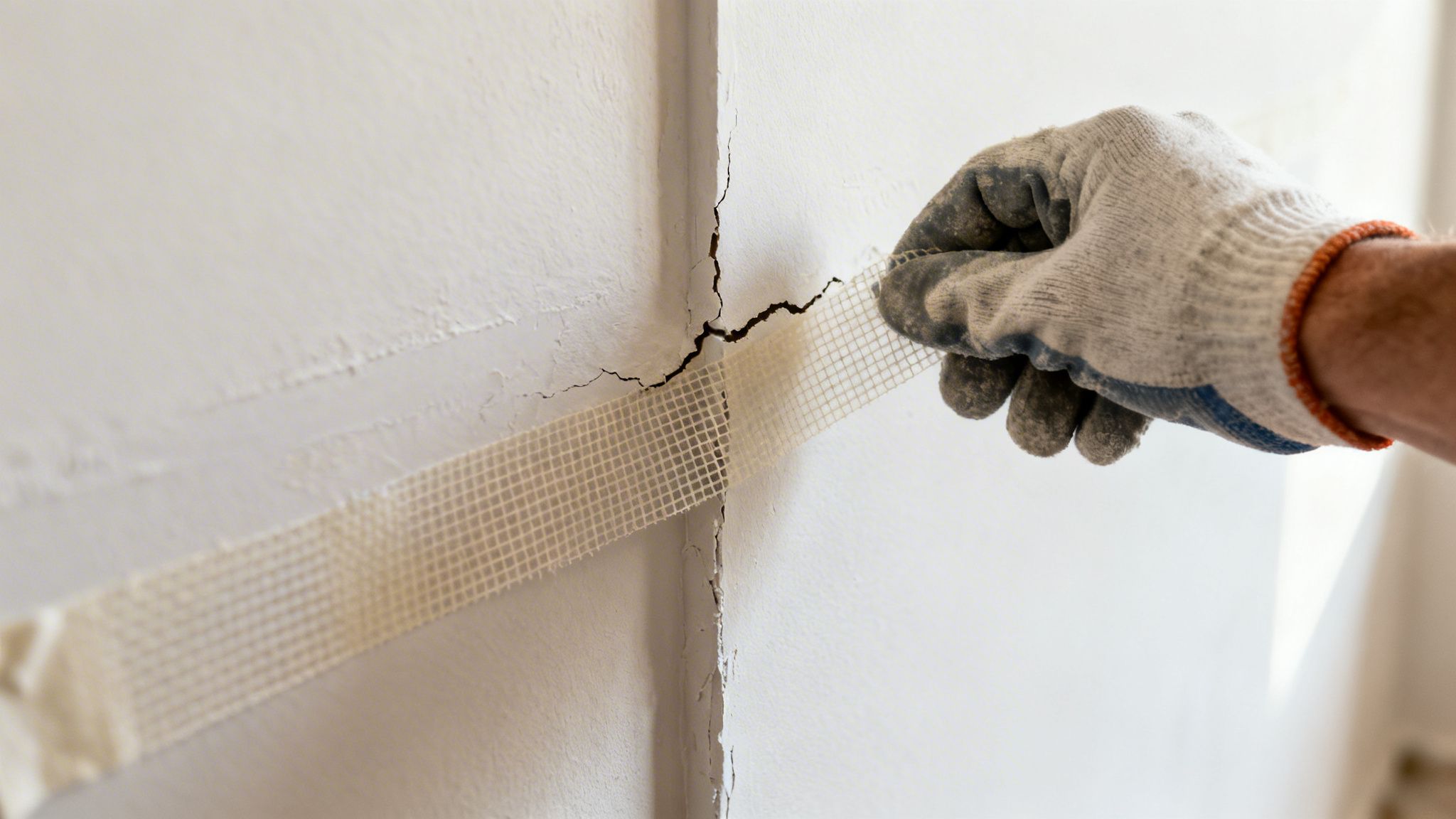
A construction worker applying adhesive mesh tape to repair a large crack on a white interior wall.

When a patch beats a fill

Verified data shows that for large cracks greater than 1/8 inch, the backing-plus-patch method yields 90 to 98 percent durability, and 65 percent of large patch repairs fail within a year without backing because the area flexes, based on the verified data tied to the Nations Drywall repair guide.

That is why big cracks should be treated like damaged drywall, not like a cosmetic seam.

The backing-plus-patch method

This is the sequence that holds up:

  1. Square the damage
    Mark clean lines around the crack and cut out the damaged section. Clean edges are easier to patch and finish.

  2. Install backing
    Slip 1×3 furring strips behind the drywall and fasten them so the new patch has solid support.

  3. Cut the patch to fit
    Match the drywall thickness and trim the patch for a tight fit. Large gaps make finishing harder and weaker.

  4. Secure the patch
    Fasten the new piece to the backing, keeping screws set properly without tearing the face paper.

  5. Tape and mud the seams
    Use tape at the seams, then build out finish coats in wider passes.

  6. Sand, prime, and paint
    Finish the patch like the surrounding wall, including texture if needed.

Why recurring cracks need a different mindset

If a crack has already been “fixed” once or twice, the wall is telling you something. Either the first repair had poor prep, or the assembly is still moving.

That is where trade-offs become real:

  • Fast cosmetic fill looks acceptable for a short time.
  • Cut-out and stabilization takes longer, creates more dust, and usually solves the right problem.

For owners who like to compare methods before deciding, this overview of DIY Gyprock repairs is a helpful outside resource because it shows the broader logic behind patching damaged wallboard instead of only surface filling.

Inside corner cracks need cleaner technique

Corners are their own category. They move more than field areas of a wall, and they are easy to overbuild with too much mud.

For inside corners:

  • Remove loose material first.
  • Re-establish the corner with tape, not just compound.
  • Keep coats thin and symmetrical on both sides.
  • Use a corner knife if you have one, or work each face carefully with a smaller drywall knife.

Key point: A bulky corner repair catches light. Even if it does not crack again, it can still look patched forever.

This comes up often in offices, multifamily properties, and tenant improvement work because corners take abuse from traffic, carts, furniture moves, and repeated repaint cycles. In those settings, durability matters as much as appearance.

When to Skip the DIY and Call a Drywall Contractor

Some cracks are repair projects. Others are warning signs.

The clearest line is width. Verified data states that cracks wider than 1/4 inch are a critical benchmark for potential structural problems and should get professional investigation rather than patching. That same verified data says superficial fixes often fail and reappear within a year, and that ignoring these issues in Puget Sound can lead to repairs in the $5,000 to $15,000 range, compared with $200 to $500 for early professional intervention. It also notes that 80% of recurring cracks come from unaddressed foundational issues, based on the verified data tied to the Proper Painting drywall crack article.

Red flags that move this out of DIY territory

Watch for these signs:

  • Crack width over 1/4 inch
  • Diagonal cracking above doors or windows
  • A crack that reopens after you repair it
  • Moisture stains, bubbling paint, or soft drywall
  • Doors or windows that start sticking near the same area
  • Long horizontal cracking or multiple cracks in one zone

A patch over any of those conditions may look tidy for a while, but it does not solve the cause.

Why paying for diagnosis is usually cheaper

Homeowners sometimes hesitate to make the call because they assume any professional visit means a major project. Usually, the opposite is true. Early evaluation can separate a manageable drywall issue from movement or moisture that will damage more finishes if left alone.

If water is part of the picture, this page on how to repair water damaged drywall is worth reviewing because wet drywall follows a different repair path than dry, stable board.

If you are hiring help and want a practical checklist first, these top questions to ask before hiring a contractor are useful for vetting scope, communication, and who will handle the work.

A simple decision rule

Try the repair yourself only if the crack is minor, stable, dry, and clearly cosmetic. Call a drywall contractor when the crack suggests movement, moisture, or repeated failure.

That is not about selling fear. It is about avoiding the common mistake of treating a structural or moisture symptom like a paint prep issue.

Frequently Asked Questions About Drywall Repair

Can I just paint over a crack

No. Paint does not bridge movement well enough to create a lasting repair. At best, the crack line telegraphs through. At worst, it opens again quickly and leaves a sharper visible line than before.

Is matching texture harder than filling the crack

Usually, yes. On smooth walls, the repair depends on flat knife work and good sanding. On textured walls, you also have to duplicate the surrounding pattern closely enough that the patch does not flash in side light.

What if the crack keeps coming back in the same spot

That usually points to ongoing movement or a weak prior repair. A recurring crack needs a different approach than a first-time cosmetic fix. Depending on the crack, that may mean reinforcement, a cut-out patch, or evaluation of the structure or moisture conditions behind it.

How disruptive is professional drywall repair

For a small crack repair, disruption is usually limited to dust control, drying time, and paint curing. Larger patching work takes more coordination, especially in occupied homes, offices, or tenant spaces, but it is still manageable when the work area is protected properly.

Will the repaired area always show

Not necessarily. A well-executed repair can blend very well. The places where DIY work usually gives itself away are ridges, poor feathering, texture mismatch, and paint sheen mismatch.

Is it worth repairing a small crack before repainting

Yes. Small cracks rarely look smaller after fresh paint. New paint often makes a weak repair more noticeable because the sheen becomes uniform everywhere except at the flaw.


If you have a crack that keeps returning, a damaged seam, or a wall issue tied to moisture or movement, Wheeler Painting & Restoration Services can evaluate the condition and handle the drywall repair and finish work for homes and commercial spaces in Kent, Seattle, Tacoma, and nearby communities.

Can You Paint Metal? A Pro Guide for Lasting Results

Absolutely, you can paint metal. The real question is, can you paint it so it lasts? For homeowners and business owners in our local community, a quick paint job is a recipe for failure. A quality coating is the single most important barrier between your property’s metalwork and the damp air that’s always looking to start rust.

Why a Proper Paint Job is Non-Negotiable for Metal

As a local painting and construction contractor, I’ve seen it countless times: a commercial steel door or a beautiful aluminum railing that starts peeling and blistering within a year. Why? Because someone skipped a step. Painting metal isn't just about changing the color; it's a technical process designed to protect an expensive asset from corroding into dust.

Cutting corners—like painting over dirt or skipping primer—guarantees you'll be redoing the work sooner rather than later, and it will cost you more the second time around.

For anyone managing a business, facility, or home, understanding the right way to do this is crucial. It gives you the confidence to tackle a project yourself or to know exactly what to look for when you're hiring a commercial painting contractor.

The Real-World Payoff of Doing It Right

A meticulously painted metal surface does more than just look good. It delivers tangible benefits that protect your investment, whether it’s for a commercial facility, retail space, or your own home.

  • Stops Corrosion in Its Tracks: This is the big one. A complete coating system seals the metal off from moisture and oxygen. For a business with steel support beams or a homeowner with a wrought iron gate, preventing rust isn't just a good idea—it's essential maintenance.

  • Extends the Life of Your Assets: Metal doors, window frames, siding, and railings aren't cheap. A proper paint job can add years to their lifespan, pushing back expensive replacement costs and saving facilities managers and homeowners significant money in the long run.

  • Boosts Curb Appeal and Value: There’s no denying the visual impact. A crisp, uniform finish on metal elements makes a property look sharp and well-maintained. On a commercial building, it signals professionalism. On a house, it directly contributes to its market value.

  • Improves Safety and Functionality: Rust isn't just ugly; it's destructive. Corrosion actively weakens metal. By keeping rust at bay, a quality paint job maintains the structural integrity of critical components like handrails, fire escapes, and support posts.

The secret to a durable finish that stands up to our local weather is sticking to a proven method. It's all about the prep work—cleaning, sanding, and priming—before a drop of paint is even applied. Get that right, and you'll have a coating that adheres properly and protects your property for years.

Preparing Metal Surfaces for a Flawless Finish

A great paint job on metal is all about what you do before you even crack open a can of paint. If you’ve ever wondered, "Can you paint metal?" the answer is yes, but it’s the prep work that makes or breaks the project. Slapping a new coat over grease, rust, or flaking old paint is a surefire recipe for peeling and blistering in just a few months.

Every metal painting job, whether it’s a simple handrail or a large commercial steel building, starts with a good, hard look at the surface. Get up close and inspect it for rust spots, paying special attention to welds and crevices where moisture loves to hide. You'll also want to check for peeling paint, chalky residue from old coatings, and any oily films. These are the enemies of adhesion.

Cleaning and Etching for Lasting Adhesion

Once you know what you’re up against, it’s time to clean. And we don’t mean a quick wipe-down. Each type of metal needs a specific approach to get it ready for primer and paint to grab hold and stay there.

  • Steel and Iron: These ferrous metals are all about rust. Your first move is to get aggressive with a wire brush or scraper to knock off all the loose rust and failing paint. For bigger jobs, a power washer can do a lot of the heavy lifting. Once the loose stuff is gone, wipe the entire surface down with a good degreaser to get rid of any grime or oil.
  • Aluminum: Aluminum is tricky. It doesn’t rust like steel, but it quickly forms an invisible layer of oxidation that paint simply won't stick to. After cleaning it with a degreaser, you need to scuff the entire surface. This process, called etching, can be done with fine-grit sandpaper or an abrasive pad to create a microscopic texture for the primer to grip.
  • Galvanized Metal: New galvanized metal is notorious for shedding paint because of its slick, oily zinc coating. You have to start by cleaning it with a solvent to cut through that oily residue. After that, a mild acid wash—something as simple as white vinegar works great—will gently etch the surface, giving it the tooth it needs for a lasting finish.

For business owners and homeowners in the area dealing with years of built-up grime, looking into professional power washing services near me can be a game-changer. It saves a ton of time and ensures you’re starting with a truly clean slate.

Our rule of thumb is simple: If the surface isn’t perfectly clean and properly profiled, the paint will fail. This is non-negotiable in our local climate, where relentless dampness will find and exploit any weakness in your paint job. A little extra time spent on prep will save you a world of headaches down the road.

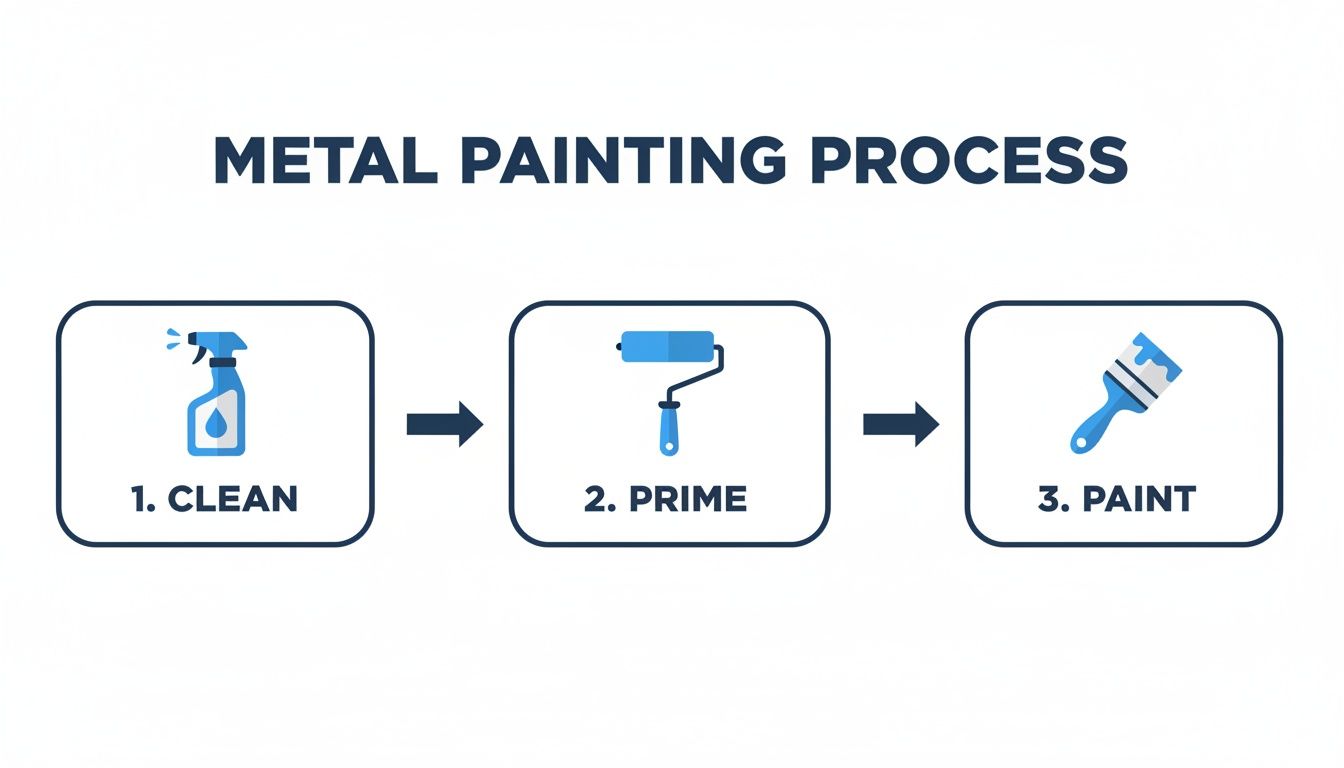
This diagram really boils the process down to its three essential parts.

A diagram illustrating the three-step metal painting process: clean, prime, and paint.

Think of it this way: painting is just the final step. The real work that guarantees a beautiful, durable finish happens long before you pick up a brush.

Choosing the Right Primer and Paint for Your Project

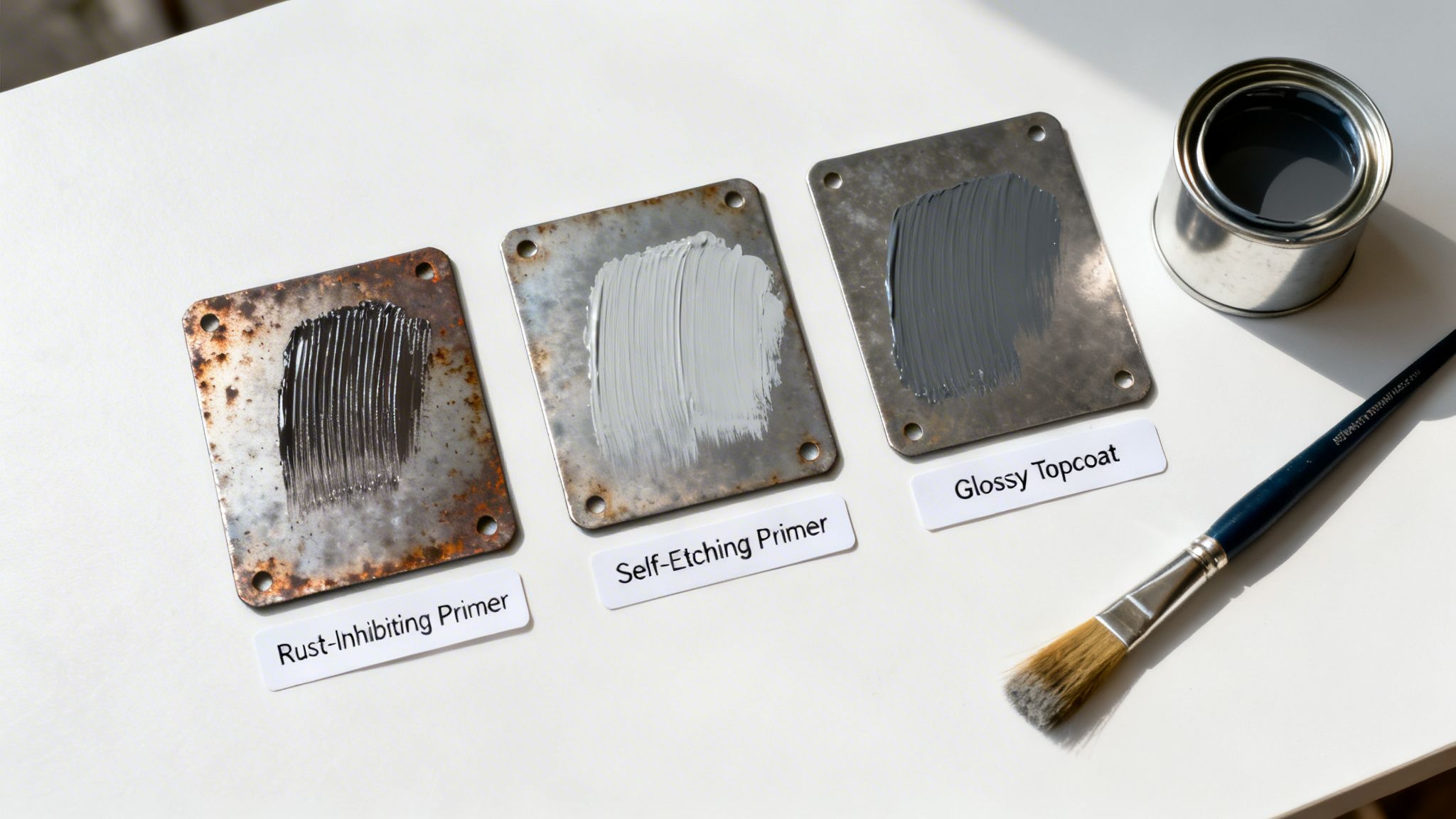
Three metal plates display rust-inhibiting primer, self-etching primer, and a glossy topcoat with paint can and brush.

You’ve put in the hard work to get your metal surface perfectly clean and prepped. Honestly, that’s half the battle right there. But the choices you make now—the primer and paint—will determine whether that beautiful finish lasts for years or starts failing in a few seasons.

Think of primer as the ultimate peacemaker between the metal and the paint. Without the right one, your topcoat simply has nothing to grab onto, and it's only a matter of time before it starts to peel and flake away. This is one step you absolutely cannot skip.

I’ve seen it countless times: a beautiful paint job fails because the wrong primer was used—or worse, none at all. The primer’s job is to create an unbreakable bond for the paint while also providing the first line of defense against the elements. It’s the foundation for a lasting finish.

Matching Primer to the Metal

Your primer choice comes down to one thing: the type of metal you're painting. Grabbing a generic can off the shelf is a recipe for disaster. Each formula is designed to solve a specific problem.

  • For Steel and Iron: In our damp local climate, rust is your number one enemy. You need a rust-inhibiting primer, plain and simple. These are typically loaded with zinc, which actively fights corrosion by creating a barrier that locks out moisture. It’s non-negotiable for iron railings, steel gates, or any ferrous metal exposed to our weather.
  • For Aluminum: Aluminum is slick and non-porous, making it notoriously difficult for paint to stick. The solution is a self-etching primer. This stuff is brilliant—it contains a mild acid that microscopically "bites" into the surface, creating a textured profile for the paint to grip onto for a tenacious bond.
  • For Galvanized Metal: That shiny zinc coating on galvanized steel is designed to prevent rust, but it also repels paint. You need a dedicated galvanized metal primer that’s formulated to adhere to that slick surface without damaging the protective zinc layer underneath.

Selecting a Durable Topcoat

With the primer properly applied and cured, you’re ready for the topcoat. This is what provides the color, the sheen, and the final shield against UV rays, rain, and physical abuse. What you choose depends entirely on where and how the metal will be used.

For highly specialized applications, like marine environments, the product choice is even more critical. You can find excellent resources on topics like choosing antifouling paint for aluminum boats that show just how specific you need to get.

For most residential and commercial projects, these are our go-to options:

  • Oil-Based Enamel: A true workhorse. We use it on high-touch surfaces like handrails, doors, and machinery because it dries to an incredibly hard, durable finish that stands up to a ton of wear and tear.
  • Acrylic Latex Paint: Modern acrylics are fantastic for exterior metal that expands and contracts, like siding or architectural features. Their built-in flexibility prevents the cracking and chipping that can happen with more rigid paints.
  • Epoxy Coatings: When you need maximum durability, this is the answer. Two-part epoxies create a finish that’s practically bulletproof, offering unmatched resistance to chemicals, moisture, and abrasion. We rely on them for demanding commercial spaces like warehouse floors and professional kitchens.

Choosing Your Tools: How to Apply Paint for a Professional Finish

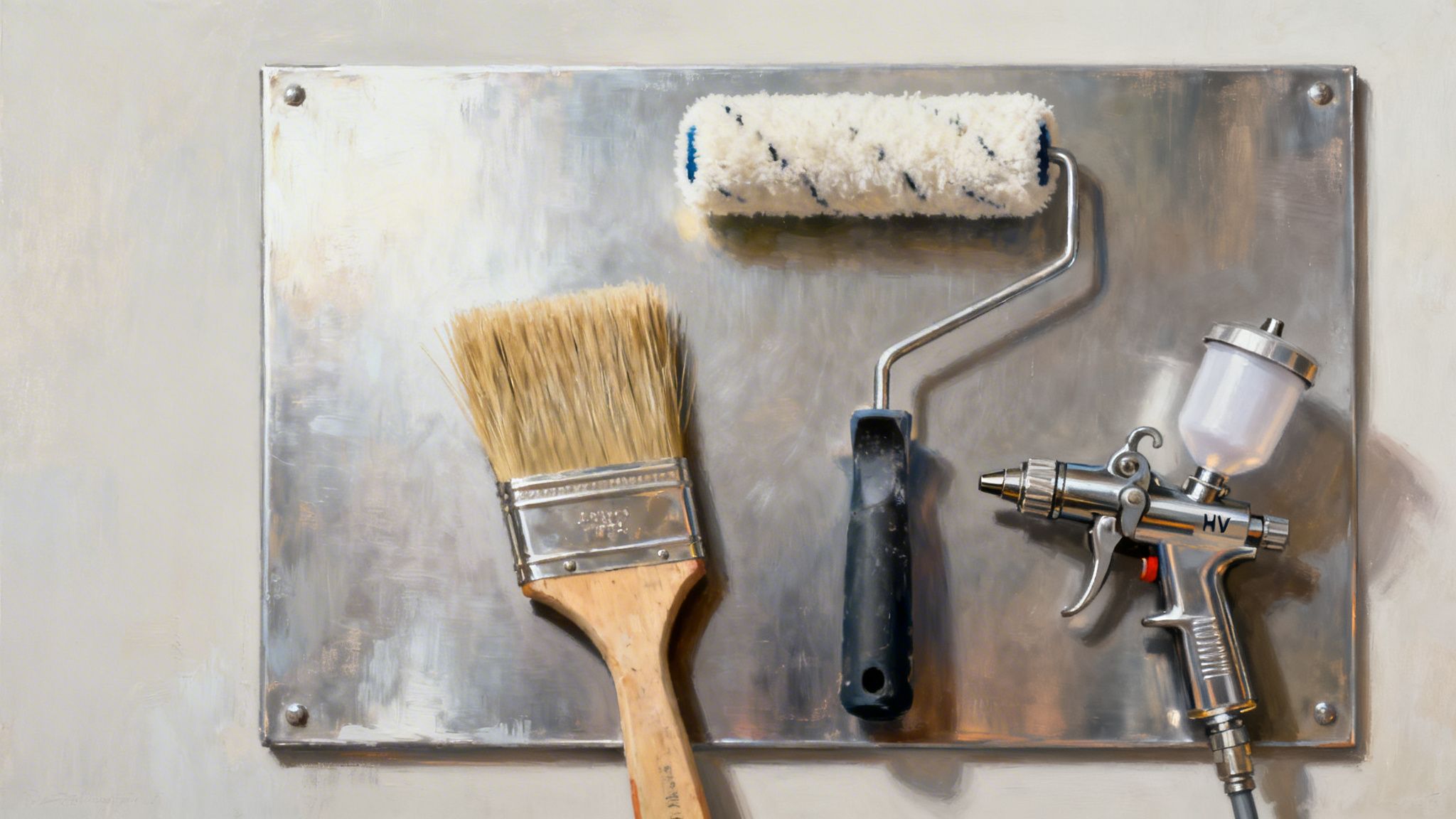
A paint brush, paint roller, and spray gun displayed on a brushed metal sheet.

You've done the prep work and picked the perfect paint. Now comes the moment of truth: the application. The tool you choose is what separates an amateur job from a durable, professional-grade finish. Your choice really depends on the size, shape, and texture of the metal surface you're working on.

Brushing: For Control and Detail Work

When it comes to intricate jobs, nothing gives you more control than a good brush. This is perfect for projects like wrought-iron railings, metal window frames, or cutting in the edges of a metal door.

A high-quality, synthetic-bristle angled sash brush is your best friend here. It’s designed for creating those razor-sharp lines. The trick is to dip only the first third of the bristles into the paint and then use long, steady strokes with light pressure. This helps you avoid overloading the surface and leaving behind those telltale brush marks.

Rolling: The Go-To for Large, Flat Areas

If you’re facing a big, flat surface like a commercial roll-up door, a large metal gate, or siding panels, a roller will be your most efficient option. But not just any roller will do—the roller cover (or nap) is everything.

  • Smooth Metal: For a perfectly smooth surface, grab a short-nap roller, something in the 1/4" to 3/8" range. This gives you great coverage without laying the paint on too thick, which is key to avoiding drips and getting a clean, uniform look.
  • Textured or Corrugated Metal: If your surface has some texture, like corrugated siding, you’ll want a slightly thicker nap of around 1/2". This ensures the paint gets into every groove and valley for complete protection.

Spraying: For the Ultimate Flawless Finish

For that pristine, straight-from-the-factory look, you simply can't beat spraying. This is the method we use for most of our commercial painting services near me, especially on large-scale projects. High-Volume, Low-Pressure (HVLP) or airless sprayers atomize the paint into a fine mist, which lays down in a perfectly even layer without a single brush or roller mark.

Of course, professional spray equipment requires maintenance to perform at its best. If you're managing your own gear, knowing about topics like choosing the right pump repair kit for your airless sprayer is essential for keeping your projects on track.

Even aerosol spray cans can give you a great finish on smaller jobs. The secret is to keep the can moving in smooth, overlapping passes about 8-12 inches from the. Always apply several thin coats rather than one thick one to prevent runs.

No matter which tool you use, the golden rule is this: thin, even coats are always better. It might feel slower, but two or three thin coats will cure harder, look smoother, and last significantly longer than one thick, heavy coat that's prone to sagging and drips.

When to Call a Professional for Your Painting Project

Let's be honest, not every metal painting job is a good fit for a DIY weekend. While tackling a small fence or some outdoor furniture can be rewarding, knowing when to call in a professional is the real key to a great result that protects your investment.

Sometimes, the scale, complexity, or materials involved just demand a professional touch. For both homeowners and facilities managers, making that call can be the difference between a finish that lasts for years and one that fails before the next season. It's less about whether you can do it and more about whether you can do it safely, efficiently, and to a standard that protects your property.

Large-Scale and Complex Projects

The most obvious sign it's time to look for professional painting and construction services is the sheer size of the job. Are you thinking about painting the entire metal siding of a commercial building, a huge warehouse, or an extensive metal roof? This is where a DIY approach quickly becomes impractical and, frankly, unsafe.

Professional crews have this down to a science. They arrive with commercial-grade sprayers for a perfectly uniform coat, along with the proper scaffolding and aerial lifts to safely reach every corner. A coordinated team can get a massive project done in a fraction of the time, minimizing disruption to your business. This is especially critical for projects involving large-scale facility construction services.

Specialized Coatings and Finishes

Some projects require coatings that you just can't find at the local hardware store. When you step into the world of industrial-grade finishes, it’s time to bring in someone who handles them every day.

We see this all the time with:

  • Two-Part Epoxies: These are fantastic for high-traffic floors or commercial kitchens, but they require precise mixing and have a very short window for application. Get it wrong, and the product won't cure.
  • Specialty Urethanes: Perfect for providing UV resistance on exterior architectural metal, but they can be tricky to apply without streaks or bubbles.
  • Complex Commercial Renovations: Jobs like retail build-outs or an office space renovation often have strict specifications for durability and performance that only professional-grade products can meet.

A seasoned professional has the muscle memory that comes from working with these demanding products. They know exactly how to prep the surface, the right application technique for a flawless finish, and how to manage curing times to ensure the coating performs exactly as it's designed to.

The Value of Local Expertise

Here in our community, the perpetually damp climate is the ultimate test for any paint job. This is where a local professional's experience becomes invaluable. They’ve spent years seeing what works—and what doesn't—in our soggy environment.

A local contractor who truly understands the weather knows which primers are essential for fighting off relentless moisture and how to time an application so it cures properly, even on a cool, overcast day.

Partnering with an experienced local team like Wheeler Painting isn't just about hiring painters; it's an investment in a guaranteed, long-lasting result. You’re getting peace of mind and protecting your property from the costly cycle of paint failure and repairs.

Frequently Asked Questions About Painting Metal

After years of serving homeowners and businesses in our area, we’ve found that the same few questions come up on almost every job. Everyone wants to know how to get a paint job that lasts. So, let's clear up some of the most common concerns.

Can I Just Paint Over Rust?

It’s tempting, we get it. You see a little rust and think a quick coat of paint will hide it. But this is probably the single biggest mistake you can make.

Painting over rust is like putting a small bandage on a serious wound. The rust won't stop growing just because it's covered. It will continue to eat away at the metal underneath, causing your brand-new paint to bubble, crack, and flake off in no time. You'll be right back where you started, but with a bigger mess.

The only way to get a lasting finish is to deal with the rust head-on. You have to remove every bit of loose, flaky rust with a wire brush, scraper, or sander. For really stubborn areas, a rust converter can be a lifesaver—it chemically changes the rust into a stable, paintable surface. Only then, once the surface is clean and sound, can you even think about priming.

What’s the Best Paint for Outdoor Metal?

In our damp climate, choosing the right paint is all about fighting off moisture. There’s no single "best" paint—the right choice depends entirely on what kind of metal you're working with.

  • For Steel or Wrought Iron: We almost always lean toward a direct-to-metal (DTM) oil-based enamel. These create a tough, rock-hard shell that’s fantastic at blocking moisture and preventing rust from starting.
  • For Aluminum: You'll want to go with a high-quality acrylic latex paint. Aluminum expands and contracts a lot with our temperature swings, and acrylics are flexible enough to move with it without cracking.

No matter which paint you choose, the real secret to success is the prep work. A thorough cleaning followed by the right primer—a rust-inhibiting one for steel and a self-etching one for aluminum—is what makes the topcoat stick and gives you that long-term protection.

Do I Always Need to Use a Primer on Metal?

Yes. Pretty much always. Skipping the primer is the most common shortcut we see, and it’s almost always the reason a metal paint job fails. Primer does two critical jobs: adhesion and protection.

Metals like aluminum and galvanized steel are notoriously slick, and paint has a hard time grabbing on. A self-etching primer actually bites into the metal, creating a perfect surface for your paint to adhere to. For iron and steel, a rust-inhibiting primer acts as your frontline defense against corrosion, which is a constant battle in our local climate.

We get asked about "paint-and-primer-in-one" products all the time. While they have their place for certain indoor projects, they simply don't offer the same level of grip or long-term protection as a dedicated primer coat, especially for anything that lives outside.

How Long Does Professionally Painted Metal Last?

This depends on a few things: the quality of the prep work, the specific coatings used, and how much abuse the metal takes from weather and use.

For a professionally painted exterior metal surface in our region, you can realistically expect the finish to last anywhere from 5 to 15 years. For example, a commercial steel door we coat with a high-performance two-part epoxy might look great for over a decade. A decorative wrought iron railing painted with a standard enamel, on the other hand, will probably need a refresh in about 5-7 years.

A little maintenance, like annual cleaning, can go a long way in getting the most life out of any paint job.


For residential or commercial construction projects big or small, having a professional handle the job ensures the prep is done right and the finish is built to last. If you're considering a painting or renovation project for your property, the team at Wheeler Painting is here to help our community.

Get Your Free Estimate from Wheeler Painting

Finding the Best Stain for Fences in Western Washington

When you’re trying to pick the best stain for your fence, the answer really depends on what you're trying to achieve. If you want serious durability and water repellency for our wet Pacific Northwest climate, an oil-based, semi-transparent stain is hard to beat. But if you're looking to completely refresh an older fence or get maximum UV protection, a solid-color stain is probably your best bet. It all comes down to finding that sweet spot between the look you want and the protection your fence desperately needs.

Protecting Your Fence in the Pacific Northwest Climate

For any property owner in Western Washington, a fence is a huge investment. It gives you privacy, adds a layer of security, and frames your home or business. But our local climate is notoriously tough on wood. The constant rain, high humidity, and even our seasonal sun exposure create a perfect storm that can wreck an unprotected fence in just a few years.

Staining your fence isn’t just about making it look nice—it’s the single most important thing you can do to protect it and make it last. A quality stain is your frontline defense against everything the PNW weather throws at it. A trusted local provider like Wheeler Painting can help you make the right choice for your home or commercial property.

Key Threats to Fences in Western Washington

Here in the Pacific Northwest, we know a thing or two about rain. But it’s the combination of threats that really does a number on wood fences.

  • Moisture Saturation: All that dampness soaks into the wood, causing it to swell and then shrink as it dries. This constant movement leads to warping, cracking, and splitting, which gives rot an open invitation.
  • Mold and Mildew: High humidity is the ideal breeding ground for mold and mildew. Before you know it, you’ll see those ugly black and green streaks that don't just look bad—they can permanently stain the wood.
  • Sun Damage (UV Rays): It's not just about the rain. Even our cloudy days let enough UV rays through to break down wood fibers. This is what turns a beautiful cedar fence gray and brittle over time.

A well-chosen fence stain does more than just add color. It actively pushes water away, contains fungicides to stop mold in its tracks, and uses pigments to shield the wood from damaging UV radiation. It's a proactive investment in your property's value.

Why Staining is a Smart Financial Decision

This protective quality is exactly why stained coatings dominate the global wood fencing market. It’s a massive industry—valued at USD 8.71 billion in 2024—and stained coatings make up USD 7.03 billion of that. The numbers don't lie. Professionals and property owners alike rely on stains to fight oxidation and preserve the wood's natural color, especially in demanding climates like ours. You can dig deeper into the data by checking out the full market research on wood fencing trends.

By applying the right stain, you can head off expensive repairs down the road and potentially double the life of your fence. This holds true whether you're a homeowner trying to protect your backyard oasis or a facilities manager tasked with maintaining perimeter fencing for a commercial property. Getting the timing right is just as important as the stain you choose. For more on that, take a look at our guide on the best time to paint your house exterior, as many of the same rules apply to staining.

Oil-Based vs. Water-Based Stain Performance

When it comes to protecting your fence, the first and most important choice you'll make is between an oil-based and a water-based stain. This decision is everything. It will dictate how well your fence weathers the relentless dampness we know all too well here in the Pacific Northwest. Let's move beyond a generic pro/con list and dig into how each type actually holds up against Western Washington’s specific challenges.

This is a core part of property maintenance. As the flowchart below shows, every property owner faces a clear choice: proactively protect your investment, or get ready for the much higher cost of replacing it down the road.

A flowchart guiding decisions on fence protection, from start to maintenance or replacement.

The takeaway is simple: in our wet climate, staining isn't just an aesthetic choice—it's the only way to ensure your fence lasts.

Understanding Oil-Based Stains

For decades, oil-based stains have been the go-to workhorse for exterior wood, and for good reason. They are formulated with natural oils, like linseed or tung, which are suspended in a solvent base. When you apply an oil-based stain, it doesn’t just sit on top; it soaks deep into the wood fibers.

This deep penetration is its superpower, especially in our climate. By saturating the wood from the inside out, the oil creates a robust, water-repelling barrier. For a fence in the Puget Sound that's constantly battered by rain and humidity, this is your best defense against rot and decay.

The numbers back this up. Oil-based wood stains represent 26.1% of the U.S. market, with USD 628.5 million in sales in 2024 and a projected 8.4% CAGR. Their ability to form a tenacious bond deep within the wood grain provides lasting color and adhesion that often outmatches water-based options, which is why exterior applications alone accounted for USD 2 billion in 2023. You can see more details in these industry-leading wood stain statistics.

Key Differentiator: The real strength of an oil-based stain is its deep penetration. It’s like conditioning leather—it nourishes the wood while building a resilient, water-repellent shield that’s exceptionally effective against our constant moisture.

However, this high performance comes with some trade-offs. Oil-based stains contain higher levels of volatile organic compounds (VOCs), which means a strong odor during application and a bigger environmental footprint. Cleanup requires mineral spirits, and the drying time is significantly longer—you'll often need a 24-48 hour rain-free window for it to cure properly.

The Rise of Modern Water-Based Stains

For years, water-based stains had a reputation for being unsuitable for tough outdoor jobs, but modern chemistry has completely changed the game. Today’s premium water-based (often called acrylic) stains are a fantastic alternative with their own distinct advantages.

Instead of penetrating like an oil, a water-based stain is engineered to form a protective, flexible film on the wood's surface. This flexibility is a huge plus in a climate with our temperature swings. As the wood naturally expands and contracts, the acrylic film moves with it, making it far less likely to crack, peel, or blister over time.

This surface-level protection also gives it superior color retention and UV resistance. Because the pigments are locked into that acrylic film, they are much less prone to fading from sun exposure.

For homeowners and business owners, the practical benefits are hard to ignore:

  • Faster Drying Times: Most are dry to the touch in a few hours, dramatically lowering the risk of a surprise rain shower ruining your work.
  • Low VOCs: The odor is much milder, making them a more pleasant and environmentally sound choice for homes and businesses.
  • Easy Cleanup: All you need is soap and water. This simplifies the entire project, whether you're a DIYer or a seasoned residential contractor.

While they don't soak in as deeply as oils, the best water-based stains create a tough, breathable barrier. This is a critical feature, as it allows any moisture vapor trapped inside the wood to escape, preventing the perfect conditions for mold and mildew to grow from within.


To make the decision clearer, here’s a direct comparison of how these two stain types perform in our wet environment.

Oil-Based vs Water-Based Fence Stains Performance in Wet Climates

Performance Factor Oil-Based Stain Water-Based Stain Best Use Case in the PNW
Water Repellency Excellent; penetrates deep to block water from within the wood fibers. Good to Excellent; forms a protective surface film that sheds water. Oil-Based: For maximum protection on older, weathered fences or those in extremely damp, shaded areas.
Durability Prone to cracking/fading over time, especially in direct sun. Requires reapplication every 2-3 years. Highly flexible; resists cracking and peeling. Better UV resistance means less fading. Reapplication every 3-5 years. Water-Based: For newer fences or those in sunny spots where flexibility and color retention are key.
Application Longer dry time (24-48 hrs), strong odor (high VOCs), requires mineral spirits for cleanup. Fast dry time (1-4 hrs), low odor (low VOCs), easy soap-and-water cleanup. Water-Based: Ideal for DIY projects or when you need to finish the job quickly with minimal disruption.
Mold/Mildew Can be susceptible to mildew growth if additives are not included. The breathable film allows moisture to escape, reducing the risk of mold growth from within. Both: Look for products with high-quality mildewcides, but water-based has a slight edge due to breathability.

Ultimately, for anyone prioritizing ease of use, environmental impact, and long-term color stability, a premium water-based stain is an outstanding choice for protecting a fence in Western Washington.

Choosing Your Stain Finish and Opacity

Once you’ve decided between an oil or water-based formula, the next big question is about appearance and protection. How much of that wood grain do you want to see? This choice, called opacity, is where you balance the look you want with the level of durability you need.

It's a practical decision. The opacity you choose determines how much the natural wood shows through, but it also dictates how much UV protection your fence gets. This is a crucial factor for any home or commercial property, especially with the kind of weather we get here. Your fence's age and condition will play a big part in this decision, too.

Three sets of wooden fence pickets showing solid, semi-transparent, and clear stain finishes.

Solid Color Stains: Maximum Protection, Total Transformation

Think of a solid color stain as being closer to paint. It completely covers the wood grain, creating an opaque, uniform finish. This makes it the undisputed champion for hiding imperfections and delivering the absolute best UV protection available. The pigments form a powerful shield against the sun, which is why solid stains last longer than any other option.

A solid stain is often the perfect solution for:

  • Older or Weathered Fences: If your fence has seen better days—with uneven coloring, old repairs, or different types of wood—a solid stain creates a clean, consistent surface that looks brand new.
  • Precise Color Matching: Need to match your company’s branding or your home’s trim? Solid stains can be tinted to virtually any color, offering total design control.
  • High-Traffic Commercial Areas: These coatings are tough. Their durability is ideal for the perimeters of retail centers, office parks, and busy businesses where fences see more wear and tear.

The demand for high-performance coatings like these is soaring. The global wood coatings market is expected to jump from USD 12.22 billion in 2025 to USD 17.83 billion by 2033. Much of that growth comes from powerful polyurethane resins, which made up 60.14% of coatings in 2025 and are a key ingredient in the toughest solid stains we use at Wheeler Painting for commercial painting services.

Semi-Transparent Stains: The Best of Both Worlds

For many property owners, a semi-transparent stain hits the sweet spot. It offers a beautiful compromise between protection and natural aesthetics. It has enough pigment to add rich color and provide substantial UV defense, but it’s still sheer enough to let the wood's unique grain and texture shine through.

This makes it our most popular request for homeowners and businesses who want to enhance their wood fence, not hide it. It's the perfect choice for a beautiful new cedar fence where you want that classic, high-quality wood look to be the star.

Key Insight: Here in the Pacific Northwest, a semi-transparent stain is our go-to for most deck & porch staining projects. It delivers the protection we need against our notorious rain and sun while preserving the authentic, rustic character of wood that defines so many of our local properties.

Because they have a good amount of pigment, semi-transparent stains are great at preventing wood from turning gray and brittle. If you're curious about the science, you can learn more by reading our guide on choosing a UV-resistant paint.

Clear Sealers: A Natural Look with a Trade-Off

Clear sealers, which are sometimes just called water repellents, contain almost no pigment. As the name implies, their main job is to repel moisture and stop water from soaking into the wood. They do this very well, but they offer virtually no protection from the sun’s damaging UV rays.

Without pigments to block the sun, the wood underneath will naturally weather and turn gray over time. This makes clear sealers a very specific choice. They’re best for situations where you actually want the wood to develop that silvery-gray patina as it ages, but you still need to protect it from rot and decay caused by moisture.

A clear sealer might be right for you if:

  • You have a new, high-quality wood fence like cedar or redwood.
  • You prefer a naturally weathered, rustic look for your property.
  • You're committed to more frequent reapplication (often yearly) to keep the water repellency effective.

Ultimately, the best stain for your fence comes down to what you value most. If maximum lifespan and color control are your top priorities for a commercial or older residential fence, a solid stain can't be beaten. But for that classic, protected wood look, a semi-transparent stain is the perfect middle ground.

Why Professional Prep is Everything for a Lasting Fence Stain

You can pick the absolute best stain on the market, but if you put it on a poorly prepped fence, it’s going to fail. It's a hard truth we've seen play out time and time again. Think about it—you wouldn't slap a coat of paint on a dirty, greasy wall inside your home. So why would you do it on an exterior fence that’s constantly battling rain, sun, and grime?

Proper prep isn't just a suggestion; it's the entire foundation for a finish that looks great and actually lasts. For a facilities manager trying to keep a large commercial fence looking sharp or a homeowner protecting their investment, cutting corners here is a guaranteed way to see peeling, blotchy color within a year. A professional crew knows the real work happens before a single drop of stain is even opened.

Man in safety glasses and gloves applies cedar stain to a wooden fence with an applicator.

Step 1: A Deep Clean to Eliminate Contaminants

Here in Western Washington, fences are a magnet for organic growth. Those green and black streaks aren't just an eyesore; they're mold, mildew, and algae actively eating away at the wood fibers. If you just stain over them, you’re essentially trapping the enemy inside. The growth will continue to flourish under the stain, eventually pushing the new finish right off the surface.

That’s why a professional cleaning is non-negotiable. We start with a specialized wood cleaner designed to kill every last organic spore. Then, we follow up with a careful power wash—not to blast the wood, but to gently strip away the dead growth, dirt, and weathered gray fibers. Getting this step right is exactly why clients often have us handle all their property's power washing needs at the same time.

Step 2: Patience is Key—Letting the Wood Dry Completely

After a thorough wash, the next step is the one that tests everyone's patience in our damp climate: waiting for the wood to dry completely. Applying stain to damp wood is a catastrophic mistake. The moisture gets trapped, preventing the stain from soaking into the wood pores. Instead of bonding, the stain just sits on top, ready to fail.

So, how long is long enough? Depending on the weather, a fence might need 24 to 72 hours—sometimes more—to dry out. A pro doesn't guess; we use a moisture meter to get a definitive reading. This single, patient step is what separates a quality job from a failure in the Puget Sound region.

A professional's most valuable tool is often patience. Waiting for the wood to dry completely is the single most critical factor in preventing stain failure in the Pacific Northwest. Rushing this step will compromise the entire project.

Step 3: A Light Sand to Open the Wood's Pores

Once the fence is clean and bone-dry, we often give it a light sanding. The goal here isn't to make the wood feel like a piece of furniture. It’s all about opening up the wood’s pores. The power washing process, while essential, can sometimes flatten the surface fibers, especially on older wood.

A quick scuff with the right grit sandpaper roughens the surface just enough to allow for maximum stain absorption. This ensures the stain penetrates deeply and evenly, which means you get richer color and a much stronger, more durable bond. It’s a small detail that makes a huge difference in the final look and longevity.

Step 4: The Art of a Flawless Application

Finally, it’s time to apply the stain, and how it’s done matters. A DIYer might reach for a roller and brush, but for a truly professional finish, we rely on a "spray and back-brush" method. This technique gives you the speed of a sprayer and the quality control of a brush.

It’s a two-person job that works like this:

  • Spray: The first person applies a thin, even coat of stain with a professional-grade sprayer, covering the area quickly.
  • Back-Brush: A second person follows immediately behind with a high-quality brush, working the stain into the wood grain, corners, and between the boards.

This system eliminates drips, prevents pooling, and forces the stain deep into every nook and cranny. The result is a beautiful, uniform finish that's built to withstand the elements. This is the kind of meticulous process that separates a professional project from a weekend attempt, ensuring you get the absolute best performance out of your stain.

Long-Term Maintenance and Stain Lifespan

Once your fence is beautifully stained, the next question is always the same: How long will it last? It’s a great question, especially here in Western Washington where the constant rain and surprisingly strong summer sun put any exterior finish to the test.

Thinking about maintenance right from the start isn’t just about planning—it’s about protecting your investment. A good stain job isn't a one-and-done deal. It’s the beginning of a simple care routine that keeps your fence looking great and prevents costly repairs down the road, whether for your home or at a commercial facility.

Expected Lifespan for Different Stain Types

The real-world lifespan of a fence stain comes down to two things: the quality of the product and its opacity. The more pigment a stain contains, the more UV protection it offers, and that's the single biggest factor in how long it will hold up.

Here are some honest timelines we’ve seen over the years in the Puget Sound region:

  • Solid Color Stains: These are your workhorses. Because they're opaque like paint, they provide a powerful barrier against sun and moisture. You can realistically expect a solid stain to last 5 to 7 years before needing a fresh coat.
  • Semi-Transparent Stains: This is the go-to for many who want to see the wood grain. They strike a nice balance but offer less UV defense, so you're looking at a shorter maintenance cycle—typically re-coating every 2 to 4 years.
  • Clear Sealers: With little to no pigment, these products are all about repelling water. They offer minimal UV protection, which means the sun will break them down quickly. Plan on reapplying a clear sealer every 1 to 2 years to keep the wood protected from moisture.

Keep in mind that a fence's exposure plays a huge role. A south-facing fence that gets direct sunlight all day may need attention sooner than one in a shaded, protected area.

Your Practical Maintenance Schedule

A little bit of attention each year goes a long way. A straightforward maintenance plan will dramatically extend the life of your stain, pushing back the need for a full re-staining project and keeping your property looking sharp.

Annual Inspection (Spring is the perfect time)
Take a slow walk along your fence line once a year. You’re looking for the first signs of wear:

  • Fading or Discoloration: Does one side look more washed-out than the other? This is usually the side that gets the most sun.
  • Peeling or Flaking: Look closely for any spots where the stain is lifting away from the wood. This is a clear sign the finish is starting to fail.
  • Mold or Mildew Growth: Check for those tell-tale green or black specks, especially in damp corners or areas shaded by trees.
  • Water Absorption: This is the key test. After it rains, does water bead up nicely on the surface? Or does it soak in and make the wood look dark and wet? If it’s soaking in, the seal has been compromised.

Gentle Annual Cleaning
Every spring, give your fence a quick bath. All you need is a garden hose, a soft-bristled brush, and a gentle, pH-neutral wood cleaner. This isn’t about aggressive scrubbing; it’s about rinsing away the winter’s accumulation of dirt, pollen, and mildew spores that can eat away at the stain.

This simple wash prevents grime from working its way into the finish and causing it to break down prematurely. When your annual inspection shows it's finally time for a professional re-coat, Wheeler Painting is ready to step in and get your fence’s protection and beauty fully restored.

Why Choose a Local Pro for Your Staining Project

Picking the right stain is just half the battle. The real test comes down to who applies it, because even the best product will fail if it's not put on correctly. While going the DIY route can seem like a good way to save money, a bad staining job in Western Washington often leads to peeling, blistering, and trapped moisture—problems that can cost a fortune to fix later.

Simply put, you need a contractor who knows our climate as well as they know their products. That local expertise is what makes all the difference.

Experience That Matters in the Puget Sound

Wheeler Painting & Restoration Services is more than just another name in the phone book. We've been staining fences and protecting properties right here in the Puget Sound area since 1991. That's over three decades of seeing exactly what our damp winters and surprisingly strong summer sun can do to wood.

This hands-on, local experience means we know which stains hold up and which ones don't. We've honed our application techniques specifically for this environment to ensure your fence gets the maximum protection possible. We’re not just a company; we’re your neighbors, committed to doing the job right.

Serving Both Residential and Commercial Needs

Whether it’s the fence around your backyard or the perimeter of a large commercial property, our team brings the same level of care and attention to detail. A properly maintained fence is just as important for a home's curb appeal as it is for a business's professional image.

  • For Homeowners: We protect your investment with a beautiful finish that enhances your property and stands up to the weather.
  • For Businesses: Facility managers rely on us for large-scale commercial painting and institutional painting because we deliver consistent, professional results that safeguard their assets without disrupting operations.

When you hire a long-standing local pro like Wheeler Painting, you’re getting a team that’s accountable to the community. We build our reputation on dependable work and clear, honest communication from the first meeting to the final inspection.

We manage the entire project from start to finish, making sure everything stays on schedule and on budget. From the initial on-site consultation to the detailed proposal and the final walkthrough, you’ll know you’ve picked a trusted partner for the job.

Ready to protect your investment with a flawless, durable finish? Whether you need professional fence staining, a residential remodel, or commercial construction services near you, the Wheeler Painting team is here to help. Contact us today for a comprehensive estimate and see why we've been a trusted name in Western Washington for over 30 years.

Common Questions About Staining Your Fence

If you're thinking about staining your fence, you've probably got a few questions. That's a good thing. Making the right choices upfront saves a lot of headaches later on. Here are the answers to some of the most common questions we get from homeowners and business owners around Puget Sound.

How Long Should I Wait to Stain a New Cedar Fence?

This is a big one. For a new cedar fence here in Western Washington, you’ll want to let it "weather" for 3 to 12 weeks before you even think about staining it. It might seem strange to leave beautiful new wood exposed, but this waiting period is non-negotiable.

New cedar is often slick with a "mill glaze" from the milling process and is also full of natural oils. Letting it sit allows the rain and sun to break down that glaze and wash away those surface oils. If you stain too soon, the product won't be able to penetrate the wood, leading to a weak finish that peels and fails in a hurry.

Can You Stain a Fence That's Already Been Painted or Stained?

Yes, you absolutely can, but be prepared for some serious prep work. If the fence was painted, the old paint has to come off—all of it. Stain has to soak into bare wood, and it simply can't get through a layer of paint.

If it has an old stain on it, the job involves a deep cleaning and usually a light sanding to open up the wood pores again. This is especially true if you're switching from a dark, solid stain to a lighter, semi-transparent one. It's a tough, labor-intensive process, and getting the prep right is what makes or breaks the final result.

Pro Tip: The best application method is what we call 'spray and back-brush.' We spray the stain on for speed and even coverage, but then immediately follow with a brush to work it deep into the wood's grain. This gives you the best of both worlds: efficiency and a durable, uniform finish without any drips.

How Often Will My Fence Need to Be Restained?

How long your stain lasts really comes down to the product you choose and how much weather it sees. Our damp climate is tough on wood finishes.

  • A quality solid stain is the most durable, typically lasting 5 to 7 years.
  • A semi-transparent stain, which lets the wood grain show through, will need a fresh coat every 2 to 4 years.

Keep in mind that a fence side that gets blasted by direct sun all afternoon will fade faster than a shaded side. A little preventative maintenance, like a gentle wash each spring, can go a long way in helping your stain last as long as possible.


Ready to protect your fence with a professional, long-lasting finish? Wheeler Painting & Restoration Services has been serving homeowners and commercial clients in the Puget Sound area for over 30 years.

Contact us today for a comprehensive estimate

A Property Owner’s Guide to UV Resistant Paint

Let’s get straight to it: UV resistant paint is essentially high-performance sunscreen for your home or commercial property. It’s a special kind of coating formulated specifically to stand up to the sun’s relentless ultraviolet (UV) rays, which are the real culprits behind faded, cracked, and peeling paint. Making the right choice can feel overwhelming, but this guide will walk you through what you need to know in simple, helpful terms.

Protecting Your Property With UV Resistant Paint

A vibrant green house by the ocean with a shimmering protective shield over its windows.

Here in our local service area, we cherish our sunny days, but that intense summer sun can be brutal on a building's exterior. That rich, vibrant color you loved when you first painted can look dull and chalky in just a few years. This isn't just about looks—it’s a clear warning that your property's first line of defense is failing.

Most standard exterior paints just aren't built to handle the constant UV exposure. Day after day, the sun’s radiation breaks down the chemical binders in the paint, a process called photo-oxidation. This assault leaves the paint film brittle and weak, unable to protect the wood, fiber cement, or metal underneath.

The Long-Term Value of Advanced Protection

Opting for a quality uv resistant paint is one of the smartest long-term decisions a property owner, business owner, or facilities manager can make. These advanced coatings contain special pigments and additives that either absorb or reflect UV radiation before it can degrade the paint. This means colors stay true and the paint finish remains flexible and intact for far longer than you'd get from a conventional paint.

For a business, that means maintaining a sharp, professional curb appeal. For a homeowner, it’s about protecting your biggest asset and avoiding premature maintenance headaches.

A great paint job isn't just cosmetic; it's a protective shield. By deflecting the sun's attack, UV resistant paints drastically cut down on how often you need to repaint, saving you thousands of dollars over the life of your building.

This level of protection is a game-changer in our region. Our unique climate cycle of damp winters followed by bright, dry summers puts incredible stress on any painted surface. Applying the right coating—and applying it correctly—is the key to a beautiful finish that lasts. At Wheeler Painting, a trusted local provider, we specialize in helping property owners choose and apply coatings designed to withstand our local weather, ensuring your investment looks fantastic for years to come.

How UV-Resistant Paint Defends Your Surfaces

Ever wonder why the paint on an old shed or park bench gets that dull, chalky look? Or why a once-vibrant front door starts to fade after just a few years? The culprit is the sun. Its invisible ultraviolet (UV) rays are constantly bombarding your building's exterior, and standard paint just can't hold up.

Think of a newspaper left on the dashboard of a car. In a short time, the sun yellows the paper and makes it brittle enough to crumble. A similar process, called photo-oxidation, happens to regular paint. UV radiation attacks the chemical bonds that hold the paint together, breaking them down one by one. This is what causes colors to fade, the finish to go chalky, and the paint to crack and peel, leaving the surface underneath exposed.

This isn't a minor issue—it's the primary reason exterior paint jobs fail. In fact, solar radiation is responsible for about 80% of all exterior paint failures. It's no surprise, then, that the global market for weather-resistant coatings was valued at USD 8.5 billion in 2024 and is expected to climb to USD 14.3 billion by 2032, according to market analysis from IntelMarketResearch.com. Homeowners and property managers are catching on: fighting the sun requires a specialized formula.

The Science: Sunscreen and a Repair Crew for Your Walls

So, what makes UV-resistant paint different? It's all in the additives. These paints are engineered with a powerful one-two punch that neutralizes UV radiation before it has a chance to wreak havoc.

First up are additives called UV absorbers. Their job is simple: act like a high-SPF sunscreen for your siding. These microscopic compounds are specifically designed to absorb incoming UVA and UVB rays. They take the hit, convert that energy into a tiny, harmless amount of heat, and release it. The paint’s binders and color pigments are never touched.

By essentially sacrificing themselves, these absorbers form the first line of defense, stopping the vast majority of damaging radiation right at the surface.

UV absorbers are the silent heroes in your paint. They take the hit from solar radiation so the paint’s color and structure don’t have to, preserving your property's vibrant appearance and protective layer.

A Microscopic Repair Crew That Never Quits

Even the best sunscreen can miss a few spots. Some UV radiation will inevitably sneak past the absorbers. That's where the second key ingredient comes in: Hindered Amine Light Stabilizers, better known as HALS.

If UV absorbers are the shield, HALS are the microscopic, always-on-call repair crew. When a stray UV ray gets through and creates a destructive molecule known as a "free radical," HALS spring into action. They find these free radicals and neutralize them on the spot, stopping them from starting a chain reaction of damage within the paint film.

The truly amazing thing about HALS is that they are self-regenerating. After neutralizing a free radical, they return to their original state, ready to do it all over again. This means they don't get used up, allowing them to patrol and protect the paint for years.

This powerful combination is what gives uv resistant paint its incredible staying power:

  • UV Absorbers: Block most of the incoming solar radiation at the surface.
  • HALS: Continuously patrol the paint film, cleaning up any damaging free radicals that form.

Together, they ensure the paint holds its color, stays flexible, and continues to protect your property. This advanced chemistry is why a high-performance coating is such a smart investment for any property owner, especially in our local service area where the summer sun can be surprisingly intense.

Choosing the Right UV Resistant Coating

Picking the right UV resistant paint isn't a one-size-fits-all decision. It's really about matching the product to the surface and the environment. You wouldn't use wall paint on your deck, and for the same reason, different exterior materials need specific kinds of protection to stand a fighting chance against the sun.

Not all UV coatings are built the same. Each type brings something different to the table, whether you're handling a residential home improvement project or painting a massive commercial building. Getting this choice right from the start is the key to a paint job that lasts and looks great for years. Let's walk through the main options and see where they shine.

Exterior Acrylic and Latex Paints

For the vast majority of homes in our community, a high-quality acrylic or latex paint is your best bet for exterior painting. Today’s formulas are light-years ahead of old oil-based paints. They’re durable, they hold their color exceptionally well, and they’re flexible. Most importantly, they breathe, letting moisture escape from inside the walls—a must-have feature in our damp climate.

These paints work beautifully on all sorts of common surfaces:

  • Wood Siding and Trim: They expand and contract right along with the wood as temperatures fluctuate, which dramatically cuts down on cracking and peeling.
  • Fiber Cement Siding: They create a strong bond with fiber cement, resulting in a smooth, long-lasting finish that handles both sun and relentless rain.
  • Vinyl Siding: There are even specialized formulas that stick to vinyl without causing it to warp, giving it a complete refresh as part of a residential remodeling project.

The best of these paints are made with 100% acrylic binders, which are naturally great at resisting UV damage. This makes them a reliable, smart choice for most homes. They deliver solid protection without needing complex or specialized application. And if you're thinking about a new look, our guide on how to choose exterior paint colors can help you find a palette that will last.

This flowchart shows how the special additives in these paints work together as a team to guard the surface.

Flowchart illustrating how UV paint works, explaining its components: UV absorbers and HALS.

As you can see, it’s a two-pronged defense: UV absorbers act like a primary shield, and HALS clean up any rays that sneak past, giving the paint a much longer life.

High-Performance Elastomeric Coatings

When you need to protect surfaces like commercial masonry, stucco, or concrete, elastomeric coatings are in a league of their own. This stuff is thick—it can be applied up to 10 times thicker than standard paint. But its real superpower is its incredible flexibility. It can stretch and snap back to its original form without a single crack.

Think of elastomeric paint as a thick, waterproof, rubber-like membrane for your building. It doesn't just color the surface; it seals it completely against the elements.

This amazing stretchiness allows elastomeric coatings to bridge the hairline cracks that inevitably appear in masonry. As a building settles or shifts with temperature changes, the coating simply stretches over the gaps, keeping the waterproof barrier intact. For commercial properties, retail build-outs, and other large facilities, this is a game-changer, preventing water intrusion that could lead to huge repair bills. These are key considerations for "commercial painting services near me."

Specialized UV Resistant Clear Coats

Sometimes, you love the look of a surface and just want to protect it, not cover it up. This is where UV-resistant clear coats are perfect. These transparent finishes create a tough, non-yellowing shield that takes the brunt of the sun's abuse, letting the natural beauty of the material underneath show through.

Clear coats are an ideal solution for:

  • Deck & Porch Staining: Protecting decks, front doors, or porches from fading while preserving the rich wood grain.
  • Exposed Metal: Stopping architectural metal features from oxidizing or losing their color.
  • Painted Artwork: Shielding outdoor murals and other custom finishes from sun damage.

These coatings act as a sacrificial layer, absorbing the UV radiation so the material they're protecting doesn't have to.

UV Resistant Coating Comparison Guide

To make it even clearer, here’s a quick breakdown of how these different coatings stack up and where they’re best used on properties in our service area.

Coating Type Best For Key Benefit Typical Lifespan (Years)
Acrylic Latex Paint Wood, fiber cement, vinyl siding Breathability & color retention 7 – 10
Elastomeric Coating Concrete, stucco, masonry, brick Crack-bridging & waterproofing 10 – 15+
UV Clear Coat Stained wood, metal, murals Protects underlying material 3 – 7

By understanding these options, you can feel confident that your property is not only beautiful but also truly defended against the sun for years to come.

Understanding Paint Performance and Durability

When you invest in a new paint job for your home or business, you're not just picking a color—you're buying protection. But how do you know if a high-quality UV resistant paint is actually going to last? The difference between a paint job that looks great for a decade and one that fails after a few years of local sun and rain comes down to a few key performance metrics.

As professional painters, we see firsthand what holds up and what doesn't. Understanding these factors helps you look past the fresh shine and see the real value you're getting from a superior coating.

Key Metrics of a Lasting Finish

When we're evaluating a paint’s real-world performance, we look at how it's going to stand up to the elements over time. Three of the most critical factors are color retention, gloss retention, and chalk resistance.

  • Color Retention: This is simply a measure of how well a paint resists fading. A paint with poor color retention will see its vibrant color wash out under UV exposure, turning a deep, rich blue into a dull, dusty gray. The best UV-resistant paints use incredibly stable pigments and binders that lock in color for years.

  • Gloss Retention: This describes how long a paint keeps its original sheen, whether it's a flat, satin, or semi-gloss finish. When a paint loses its gloss, it’s not just a cosmetic issue; it’s an early sign that the paint film is starting to break down, making it harder to clean and less protective.

  • Chalk Resistance: Have you ever run your hand over an old, faded paint job and come away with a powdery residue? That’s "chalking." It happens when UV rays destroy the paint’s binders, leaving the pigment particles behind as dust. A great paint will resist this breakdown, maintaining a solid, intact surface that shields your property.

These qualities aren't just about looking good; they have a direct impact on your wallet. A durable paint job means you can go much longer between expensive repaints. The technology making this possible is often adapted from high-stakes industries where failure is not an option. For instance, the market for UV-resistant aircraft exterior paints is expected to hit nearly USD 946.9 million by 2036. For homeowners in our community, that same advanced science gives us paints that resist chalking up to 70% longer than standard acrylics, saving property owners thousands over the life of their home. You can read more on this market's growth at Future Market Insights.

Demystifying Paint Warranties

Many property owners are surprised to learn what a manufacturer's paint warranty actually covers—and more importantly, what it doesn't. It’s crucial to have realistic expectations, because these guarantees are often more limited than you might think.

A paint warranty almost always covers the product itself, not the labor to reapply it. If the paint is found to be defective, the manufacturer will typically provide replacement paint but will not pay for the cost of scraping, preparing, and repainting the surface.

This is exactly why professional application is so vital. A manufacturer will void their warranty in a heartbeat if the paint was applied improperly—over a dirty surface, in the wrong weather, or without the right primer. Warranties also won’t cover failures caused by underlying issues with your home, like moisture intrusion or rotted siding.

Think of a warranty as a statement of the manufacturer's confidence in their product when used correctly. Choosing a top-tier UV resistant paint is the first step. The second, and equally important, step is hiring a trusted local provider who stands behind their own work. For specialized surfaces that need extreme durability, like garage floors or commercial spaces, other coatings like epoxy offer similar protective benefits; you can check out our guide on epoxy floor coatings to see if it's right for you.

Professional Application for Maximum Longevity

Man in high-visibility vest and hard hat painting a house exterior white with a paint roller.

Even the most advanced uv resistant paint will fail if it's not applied correctly. Think of it like buying top-of-the-line tires for your car. If they’re mounted improperly, they won't perform well or last long. The exact same principle applies to paint—the quality of the application is just as crucial as the quality of the product itself.

Getting a beautiful, durable finish that can withstand the unique challenges of our local weather is part science, part craft. A professional crew with local experience knows all the variables that can make or break a project, from the condition of the siding to the humidity in the air. That expertise is what turns an investment in premium paint into the outstanding, long-term results you expect when searching for "house painting near me."

The Non-Negotiable Foundation: Surface Preparation

The single most critical step of any paint job happens before a can is even opened. Proper surface preparation is the bedrock of a lasting finish. It's a non-negotiable part of any professional project, because slapping new paint over a dirty, peeling, or failing surface is a surefire recipe for premature failure.

A truly meticulous prep process always includes several key stages:

  1. Thorough Cleaning: Every square inch of the exterior needs to be pressure washed or hand-washed. This removes all the built-up dirt, mildew, pollen, and chalky old paint residue, giving the new primer and paint a clean, stable surface to grab onto.
  2. Scraping and Sanding: We scrape away every bit of loose, peeling, or cracking paint. Then, we "feather sand" the edges to create a smooth, seamless transition between the bare surface and the old paint. This prevents ugly lines from telegraphing through the final coats.
  3. Repairs: Any damaged siding, rotted trim, or other structural problems have to be fixed first. Painting over compromised materials is like putting a bandage on a broken bone—it might hide the problem for a little while, but it doesn’t actually solve it. This is a crucial step for both residential remodeling and commercial renovations.
  4. Priming: A high-quality primer is applied to any bare wood and repaired spots. Primer is the essential bridge between the surface and the topcoat; it seals stains, ensures a strong bond, and creates a uniform canvas so the final color and sheen look perfect.

Here's a statistic that shocks many property owners: poor surface preparation is the culprit behind over 80% of all paint failures. A professional crew spends the majority of their time on these foundational steps, knowing that this is where the longevity of the job is truly won or lost.

Applying Paint in the Right Conditions

For paint to cure into that hard, protective shell it’s designed to be, it has to be applied within a specific window of temperature and humidity. In our service area, that’s especially important. Our weather can be all over the place, but experienced local painters know how to work with it, not against it.

Putting on paint when it's too cold can stop it from curing properly, leaving the finish soft and vulnerable to damage. On the flip side, painting in direct, hot sun can make it dry too fast, causing brush marks, blisters, and weak adhesion. If you've ever seen paint bubble on walls, for example, the conditions during application were likely a major factor. For a deeper look, our article explaining what causes paint to bubble on walls breaks it down further.

The Value of Experienced Execution

When you hire a seasoned team like Wheeler Painting, you’re not just paying for people to roll paint on your walls. You’re investing in a guaranteed outcome. We have the right equipment, a deep understanding of how different uv resistant paint formulas behave, and the local knowledge to get every single step right.

Whether we’re managing a residential home improvement project or large-scale commercial renovations, our process is built to ensure your property is protected and looks fantastic for years to come.

When to Call in the Pros for Your Project

Most of us have tackled a weekend painting project. But sometimes, what looks like a simple repaint is actually your house telling you something much bigger is wrong. Knowing the difference between a DIY touch-up and a job that needs a professional eye can save you a ton of frustration and money.

If you see paint cracking in a pattern that looks like alligator skin, or if it's peeling off in big sheets, stop and put the scraper down. These aren't just cosmetic issues. They're giant red flags signaling deeper trouble. An experienced pro can spot the real culprits—things like hidden rot in the trim, moisture wicking up through the siding, or failing window seals that are letting water in.

Just slapping new paint over these problems is like putting a small bandage on a major injury. A team that handles both painting and repairs can diagnose the root cause, ensuring you're not just hiding rot but actually fixing it for good.

Beyond Just a Paint Job: The Value of a True Restoration

When you discover that peeling paint is just the tip of the iceberg, the last thing you want is the headache of managing two different contractors. Imagine finding out your siding is compromised. Now you have to find and schedule a construction crew, wait for them to finish, and then bring the painters back.

A full-service team like Wheeler Painting, your "residential contractor near me," eliminates that chaos. We handle both the structural repairs and the flawless finish, all under one roof. This seamless approach is a lifesaver for property owners in our community. We're equipped to manage:

  • Residential Remodeling: Whether it's siding replacement or fixing dry rot found under old paint, we coordinate the construction and finishing touches perfectly.
  • Commercial Renovations: Time is money for any business. We keep retail build-outs and office space renovations on track, handling everything from new drywall to the final coat of paint.
  • Institutional Painting and Facility Construction Services: Our experience with larger projects ensures we deliver on time and within budget, from new builds to major renovations. We are your partner for "commercial construction near me."

Professional expertise also means access to the latest coating technologies. For example, the market for UV-curable coatings is exploding—projected to hit nearly USD 15 billion by 2033—because they dry instantly and offer immediate UV protection. Wheeler Painting uses these advanced finishes to protect everything from high-traffic commercial interiors to custom cabinetry, drastically reducing sun-fading. If you're interested in the data, you can explore the full market research from GrandViewResearch.com.

If your property is showing signs of serious paint failure or you're planning a bigger project, don't leave it to guesswork. Contact Wheeler Painting for an expert consultation. We’ll build a comprehensive plan to restore your property and protect your investment for years to come.

Frequently Asked Questions About UV Resistant Paint

As professional painters in our local community, we get a lot of questions from property owners trying to protect their homes and businesses from the sun. Here are some straightforward answers to the questions we hear most often about UV resistant paint.

Is UV Resistant Paint Really Worth the Extra Cost?

That's a smart question, and we hear it all the time. It's easy to look at the higher price per gallon and wonder if it's just a gimmick. But the real value isn't in the can; it's in the years of performance you get out of it.

These advanced paints are formulated to last, often twice as long as their standard counterparts. This means you can push back your next full, expensive repaint—and all the labor and material costs that come with it—for several more years. For any building in our local service area, that adds up to fewer headaches and a much lower cost to maintain your property over time.

Can I Just Paint Over My Old Flaking Paint?

I know it’s tempting to just slap a coat of new paint over the old stuff, but that’s the fastest way to guarantee your new paint job will fail. The new paint needs a solid, stable surface to grab onto. If the layer underneath is already peeling, the new paint will just come right off with it.

Think of it like this: all the cleaning, scraping, sanding, and priming we do isn't just busywork. It's the foundation of the entire project. Getting that surface preparation perfect is what allows a high-quality coating to bond properly and give you the durable, long-lasting finish you're paying for.

Are UV Resistant and Weatherproof Paints the Same Thing?

They're related, but not quite the same. "Weatherproof" is a catch-all term for paints that can handle moisture, humidity, and big temperature swings. "UV resistant," on the other hand, is all about fighting off damage from the sun's radiation.

The good news is that you don't have to choose. Any high-quality exterior paint worth its salt will have strong UV blockers built right in, because the sun is a huge part of what we call "weather." For our unique climate—wet winters and surprisingly intense sunny summers—you absolutely need a paint that excels at both.

Should I Use UV Resistant Paint Inside My Home?

Yes, it’s often a great idea, especially in rooms that get flooded with natural light. If you have big south-facing windows, French doors, or skylights, you've probably seen how sunlight can fade walls, hardwood floors, and even furniture over time.

Using an interior painting product with built-in UV protection can dramatically slow down that aging process. We also use clear UV-blocking topcoats on things like stained wood cabinets, trim, and built-ins. It's a fantastic way to keep your home’s interior looking fresh and vibrant for years, protecting the investment you've made in its appearance.


Ready to protect your property with a finish that’s built to last? The team at Wheeler Painting has the local expertise to choose and apply the perfect UV resistant paint for your home or business.

Contact us today to schedule your consultation.

What Causes Paint to Bubble on Walls and How to Fix It

When you see paint bubbling on a wall, it’s easy to feel frustrated. But those bubbles are more than just an eyesore—they’re a clear signal that something’s wrong underneath the surface. The number one reason paint starts to bubble is almost always moisture. Still, other issues like poor prep work, using the wrong kind of paint, or even too much heat can also be the culprit.

Understanding the cause is the first step toward a lasting solution, whether you're a homeowner or a business owner managing a commercial property.

Why Is My Wall Paint Bubbling?

Man inspecting bubbling and peeling paint on a wall in a home, indicating water damage.

It helps to think of a paint bubble as a warning light on your car’s dashboard. It’s an undeniable sign of a problem, and just painting over it is like putting a piece of tape over the light—it doesn't fix the engine. The real issue could be anything from a hidden plumbing leak and trapped humidity to mistakes made the last time the room was painted.

For a homeowner, bubbling paint in a bathroom often points straight to a ventilation issue. If you're a business owner or facilities manager, it might mean the sealant is failing on the outside of your commercial building. Figuring out the root cause is the critical first step toward a fix that will actually last.

The Science Behind a Paint Bubble

Paint is supposed to create a strong, protective film that sticks tightly to the surface below, whether it's drywall, wood, or plaster. A bubble is simply what happens when that bond breaks. Something gets trapped between the paint film and the wall itself, physically pushing the paint away from the surface.

So, what breaks that bond? The most common culprits are:

  • Water or Moisture: From leaks, high humidity, or condensation.
  • Air or Solvents: Trapped during painting because of high heat or bad technique.
  • Contaminants: Any dirt, grease, or dust left on the wall before painting.

Moisture: The Arch-Nemesis of Paint

Water is, without a doubt, the biggest enemy of a flawless paint job, especially here in our local service area. Industry data shows that water is behind up to 70% of paint bubbling issues in residential and commercial properties. As trapped moisture heats up and cools down, it expands and contracts, literally forcing the paint off the wall and creating those familiar blisters. You can find more details on how this works over at alsqualitypainting.com.

This guide will help you play detective and understand what’s happening behind the paint. This knowledge is crucial whether you’re a homeowner planning a weekend repaint or a facilities manager overseeing a commercial renovation. It’s the only way to ensure the problem gets solved for good.

The Role of Moisture and Hidden Leaks

Peeling paint and water bubbles on a wall next to a window with condensation, indicating water damage.

When you see paint bubbling, your first thought should always be water. Moisture is almost always the culprit. Just think of the drywall or plaster on your wall as a stiff sponge. It will quietly soak up any water it comes across, whether from a dripping pipe or just humid air. This is the single biggest reason what causes paint to bubble on walls is such a headache for property owners.

The real problem begins when that trapped moisture tries to get out. As the wall warms up and cools down, the water caught behind your paint expands and contracts. That movement creates a surprising amount of pressure, pushing outward until it finally breaks the paint's grip on the wall. The result? Those ugly blisters and bubbles.

For anyone managing property in our local communities, this fight against moisture can feel never-ending. And the source isn't always something dramatic like a burst pipe; it's often a much quieter, sneakier problem.

Finding the Source of the Water

To fix the problem for good, you have to figure out if you're dealing with a direct leak or just high humidity. Water is a sneaky invader. It can get into your walls from all sorts of places, and the bubble you see might be far from the actual entry point. An experienced pro knows exactly where to start looking.

Here are some of the usual suspects we see in residential and commercial buildings:

  • Plumbing Leaks: That slow, silent drip from a pipe hidden in a wall can saturate drywall for months before you ever see a bubble.
  • Failing Roof Flashing: The seals around chimneys, vents, and skylights are common weak spots. Rain gets in, runs down through the attic, and shows up on an interior wall.
  • Improperly Sealed Windows and Doors: In our climate, wind-driven rain is a fact of life. If the caulk around your windows and doors is old and cracked, water will find its way in.
  • Clogged Gutters: When gutters get backed up, water can pour over the side and run down your siding. It doesn't take much for that water to get behind the paint and into the wall itself.

Expert Insight: In both homes and commercial buildings around here, the most deceptive source of moisture is condensation. Our cool, damp climate creates the perfect storm. Warm, moist air inside hits a cold exterior wall, and that water vapor turns right back into liquid. This is why you so often see bubbling paint on the exterior walls of poorly ventilated kitchens and bathrooms.

Direct Leaks vs. High Humidity

It’s critical to know what kind of water problem you have. If you press on a paint bubble and it feels soft, squishy, or even drips a little, you almost certainly have a direct and active leak. These need immediate attention to stop serious structural damage. For these kinds of complex water issues, our team offers professional guidance on water removal and restoration to make sure the root cause is solved before we even think about painting.

On the other hand, if you see lots of small, hard blisters scattered across a wall, that's usually a sign of high humidity or condensation. We see this all the time in bathrooms without a good exhaust fan or in certain commercial spaces. While it’s not as urgent as an active leak, it’s still telling you that the environment is ruining your paint job. The fix usually involves improving ventilation or using a paint designed specifically for high-moisture areas. A professional assessment will save you the frustration of a repair that just fails again.

How Poor Surface Prep Guarantees Bubbles

While moisture gets most of the blame for bubbling paint, a rushed or lazy prep job is right behind it. Think of your wall as a canvas. Trying to paint over a dirty, dusty, or greasy surface is like slapping a sticker on a sandy beach—it’s just not going to hold. Paint needs a perfectly clean, stable foundation to grab onto and form a lasting bond.

Even contaminants you can't see will sabotage your new paint. Things like oil from fingerprints, airborne cooking grease in a kitchen, or even the residue left behind by common cleaning products can create a microscopic barrier. This film stops the new paint from gripping the surface properly, creating weak spots that are guaranteed to bubble and peel away.

The Professional Prep Process

For any experienced painting contractor, surface preparation isn't a suggestion; it's a non-negotiable part of the job that ensures the final finish actually lasts. It’s the most critical phase of any residential remodel or commercial construction project we undertake.

A proper prep job always includes these steps:

  • Thorough Cleaning: A simple wipe-down with water won’t cut it. Professionals use solutions like trisodium phosphate (TSP) to break down years of accumulated grime, grease, and other contaminants that normal cleaning leaves behind.
  • Sanding for Grip: Old glossy or semi-gloss surfaces are sanded to "scuff up" the finish. This microscopic abrasion gives the new paint a rougher texture to mechanically grab onto, creating a much stronger bond.
  • Meticulous Dust Removal: After sanding, every last speck of dust has to go. We use tack cloths or shop vacuums with brush attachments. Any dust left behind will just mix into the wet paint and prevent it from sticking to the wall.

Meticulous preparation is the difference between a paint job that looks great for a decade and one that fails in a year. A significant 60% of bubbling complaints stem from painting over unclean surfaces, especially in homes with residue from cooking or smoking. You can find more about how surface issues cause paint failure by reading this informative guide from makeitright.ca.

Why Priming Is Not Optional

After cleaning and sanding comes the final, crucial step: priming. A good primer acts as the ultimate bridge, connecting the wall to the paint. It seals the underlying surface, blocks tough stains from bleeding through, and creates the perfect uniform base for your topcoat to adhere to beautifully. Skipping this, especially over new drywall or patched areas, is one of the fastest ways to see bubbles pop up.

For our teams, whether it's a small bedroom or a huge retail build-out, priming is non-negotiable. To see why this step is so vital for professional-grade results, check out our guide on why you must prime new sheetrock before painting. It’s a step that protects your investment and is the key to a bubble-free finish, saving homeowners and facilities managers from expensive repairs down the road.

When Heat and Humidity Are the Problem

Even if you’ve prepped a surface perfectly, the environment itself can sabotage your paint job. Extreme temperatures and humidity are notorious culprits behind paint bubbling, especially in a place with unpredictable weather like our local area. Think of paint like a cake batter—if the oven is too hot or the kitchen is too humid, it’s just not going to turn out right.

Painting a wall while it's baking in direct sunlight is a classic mistake. The intense heat flash-dries the very top layer of the paint, creating a skin before the solvents or water underneath can evaporate. These trapped vapors have to go somewhere, so they push up against that semi-dry skin, creating a rash of blisters across the surface.

The Problem With Local Humidity

Just as bad as high heat is the high humidity we’re so familiar with here in our community. When the air is already heavy with moisture, the water in latex paint has nowhere to go. This slows the curing process to a crawl, leaving the paint film weak and susceptible to problems. Before you know it, you can see sagging, streaking, and eventually, bubbling as moisture remains trapped.

We see this all the time on both residential and commercial projects. For facilities managers overseeing office space renovations, a wall next to a new heat-generating appliance or a large, sun-drenched window can become a bubble-prone hotspot. A fresh coat of paint in these areas requires a careful eye on the climate to stand a chance.

A 2026 Angi survey of Pacific Northwest contractors revealed that our region's wild temperature and humidity swings contribute to 30% of all paint bubbling service calls. The data also shows a 40% spike in paint failure when surface temperatures climb over 90°F, as the top layer dries too fast and traps solvents.

Common Application Mistakes That Create Bubbles

Beyond just the weather, simple mistakes during the application process can introduce bubbles into the finish. Using the wrong technique or tool can be just as damaging as painting on a blistering hot day.

Two of the most common errors we fix are:

  • Applying Coats Too Thickly: It’s tempting to slather on a heavy coat to finish faster, but this is a recipe for disaster. A thick layer of paint traps air and solvents, preventing it from drying evenly and leading straight to bubbles.
  • Using the Wrong Roller Cover: A roller with a nap that’s too long for a smooth wall will whip tiny air bubbles into the paint film as you roll. A pro knows to match the roller nap to the surface texture for a smooth, bubble-free application.

Managing all these environmental and technical details is exactly why professional timing is so crucial. A skilled painter understands the ideal conditions needed for a durable, long-lasting finish. You can learn more about this in our guide on the best time to paint your house exterior. This expertise is what separates a quick job from a quality result, whether it’s for a home remodel or a large-scale commercial building.

Your Step-by-Step Guide to Fixing Paint Bubbles

Seeing paint bubbles pop up is one of those frustrating home or property maintenance moments. The good news is that fixing them is usually a straightforward process, but only if you do it right. We'll walk you through how to repair those small, annoying bubbles and, just as importantly, how to spot the signs that you’re dealing with a bigger issue that needs a pro.

The absolute first step is a bit of detective work. Before you can even think about picking up a scraper, you have to figure out what causes paint to bubble on walls in your specific spot. Once you’ve solved that mystery—whether it's a slow leak, a steamy bathroom with no ventilation, or just a bad prep job from years ago—you can finally start the repair.

A Three-Step Repair Process

If you're dealing with a few small, localized bubbles (and you're positive there isn't an active leak), this is a repair you can likely handle yourself. The key is to create a perfectly smooth, clean, and stable foundation for the new paint.

  1. Scrape and Remove: Grab a putty knife or a good paint scraper. You'll want to carefully get under the bubble and lift off all the loose, peeling paint. Don't be shy here—keep scraping a little bit beyond the bubbled spot until you hit paint that's firmly stuck to the wall.
  2. Sand the Edges: Now, take some 180-grit sandpaper and feather the edges where the old paint meets the bare patch. The goal is to make the transition so smooth you can't feel it when you run your hand over it. This little step is what keeps that ugly paint ridge from showing through your fresh coat.
  3. Clean and Prime: Wipe down the entire area to get rid of every last speck of dust. Then, apply a high-quality primer to the bare spot. This seals the surface and gives the new paint something to really grab onto.

This handy flowchart can help you quickly run through the likely culprits behind your paint bubbling woes.

A flowchart diagnosing paint bubbles by checking conditions like hot, humid, or wrong tools.

As you can see, what’s happening in the room—like high heat or humidity—is often just as critical as the tools and techniques you used to paint.

When to Call a Professional Contractor

A quick DIY fix is perfect for small cosmetic flaws. But sometimes, those little bubbles are like the tip of an iceberg, signaling a much bigger problem lurking beneath the surface. For both homeowners and facilities managers, knowing when to put the tools down and call for help is the most important step of all.

If you scrape off a paint bubble and the drywall or plaster behind it feels soft, damp, or looks discolored, stop what you're doing immediately. This is a clear sign of a serious moisture issue that a simple patch-and-paint job will never fix.

You should get in touch with a professional contractor like Wheeler Painting if you’re seeing any of these red flags:

  • Bubbles that keep coming back in the same spot, even after you've repaired them.
  • Widespread bubbling across an entire wall or even multiple walls.
  • Paint bubbles that feel soft or squishy when you press on them.
  • Any visible water stains, dark spots, or a musty smell near the bubbles.

When you're facing these more complex scenarios in a home or commercial building, a professional diagnosis is the only way to safeguard your property. A trusted local pro can pinpoint the true source of the problem, whether it's a hidden pipe leak or a flaw in the building's exterior, and make sure the fix is a permanent one.

Your Partner for Lasting Painting and Construction

At the end of the day, bubbling paint is more than just an eyesore. It’s a clear signal from your walls that something deeper is wrong, and a quick-fix paint job just won’t cut it. As we’ve covered, a truly lasting repair means getting to the root of the problem, and that requires a professional eye. With decades of local experience, Wheeler Painting is here to provide exactly that kind of peace of mind.

We offer a full range of painting, restoration, and construction services for homeowners and businesses all over our local service area. Whether you're planning a major residential remodeling project, managing a commercial renovation, or just need a reliable partner for facility construction services, our team is built on clear communication and craftsmanship you can count on.

We believe complex projects should be straightforward for our clients. By handling everything from the initial diagnosis to the final coat of paint, we take the stress out of your next project and ensure every detail is handled correctly.

Our team has been serving the community since 1991, and we're ready to help protect your investment for years to come. From retail build-outs and office space renovations to siding replacement and interior painting, we have the expertise to deliver results that last. Contact us for an on-site consultation and see how our commitment to quality can make all the difference.

Common Questions About Paint Bubbling

We get asked all the time about what causes paint to bubble on walls. It's a frustrating problem, but understanding why it happens is the first step to getting it fixed for good, whether you're a homeowner or a facilities manager. Here are some quick, straightforward answers to the questions we hear most often.

Can I Just Scrape and Paint Over the Bubbles?

That’s probably the most common mistake people make, and it’s a recipe for frustration. Just scraping off the blister and slapping on a new coat of paint only hides the problem for a little while. The issue that caused the bubble in the first place—usually moisture or a contaminated surface—is still trapped underneath.

Before you know it, the bubble will be back, and it's often worse the second time around. The only way to fix it properly is to get to the root of the problem. You have to scrape away all the loose and failing paint, sand the edges smooth, fix what caused the bubble, prime the bare spot, and then you can repaint.

Why Does My Bathroom Paint Always Bubble?

Ah, the bathroom. It’s the perfect storm for paint problems. The constant humidity from hot showers and baths creates a ton of moisture in the air. This steamy air then condenses into water droplets on the cooler surfaces of your walls and ceiling.

That water eventually works its way behind the paint, breaking the bond with the wall and causing those familiar bubbles and blisters.

Pro Tip: Your best defense is a good exhaust fan. Run it during every shower and leave it on for at least 30 minutes afterward to pull all that damp air out. Also, make sure you’re using a high-quality paint formulated specifically for high-moisture areas like bathrooms and kitchens. It makes a huge difference.

Will Bubbles Go Away on Their Own?

It would be nice if they did, but unfortunately, no. Once the paint has lifted and the bond with the surface is broken, it can't re-adhere on its own. The bubble is there to stay.

If you ignore it, the problem will only get worse. The bubble will likely grow, the paint will start to flake and peel, and you could even end up with damage to the drywall or plaster underneath.


If you’re seeing bubbles that point to a bigger moisture problem, getting a professional opinion is your best bet. The experienced teams at Wheeler Painting can pinpoint the exact cause and deliver a solution that lasts. Schedule your on-site consultation today and protect your property.

Best Time to Paint Your House Exterior: A Guide for Puget Sound Property Owners

Let's get straight to the point: if you're planning to paint your house exterior in the unpredictable climate of Western Washington, your best bet is from late spring through early fall. This ideal window, generally running from May through September, gives residential homes and commercial buildings the best possible chance at a beautiful, durable finish that will last for years.

Finding the Perfect Window for Exterior Painting in the Puget Sound

Timing a painting project in our region is everything. Think of it as giving the paint the perfect environment to do its job—curing into a hard, protective shell that can stand up to our notoriously damp winters. Nailing this timeframe is the single most important step toward a successful project that not only boosts your curb appeal but also protects your property investment.

This decision is critical whether you're a homeowner looking to refresh your siding or a facilities manager scheduling a large-scale commercial renovation. A well-timed project is your best defense against costly failures like peeling, blistering, and premature fading, which are common when paint is applied in less-than-ideal weather.

The Goldilocks Zone for Painting

For anyone living in the Puget Sound, the goal is to find that “Goldilocks” period—not too hot, not too cold, and definitely not too wet. This simple timeline shows the ideal, acceptable, and risky times for exterior painting right here in our community.

A painting seasons timeline graphic, indicating summer (June-August) as ideal, and winter (Dec-Feb), spring/autumn (Mar-May / Sep-Nov) as risky times for painting.

As you can see, summer offers the most reliable window. The shoulder seasons of spring and fall can be a gamble, and winter is a definite no-go for a quality finish.

This seasonal sweet spot is backed by decades of on-the-job experience and paint chemistry. Here in the Puget Sound, the prime time to paint is when temperatures are consistently between 50°F and 85°F. Why? Because most exterior latex paints are formulated to adhere and cure best within this range. The absolute sweet spot for maximum durability is actually a bit cooler, around 50–70°F. You can dig deeper into how temperature affects paint application with resources from industry leaders.

Choosing the right time to paint isn't just about convenience; it's a strategic decision that directly impacts the longevity and performance of your home or building's protective coating. A project completed in July will almost always outperform one rushed in November.

To give you a clearer picture, here’s a quick breakdown of what to expect throughout the year.

Puget Sound's Annual Painting Calendar at a Glance

This table summarizes the painting conditions for each season, helping you plan your exterior project with confidence.

Season Months Conditions & Temperature Paint Application Suitability
Winter December–February Cold, rainy, and often freezing. Temps regularly dip below 40°F. Not Recommended. High risk of paint failure due to moisture and low temps.
Spring March–May Unpredictable. Mix of sun and rain, with temps often fluctuating below 50°F. Risky. Possible, but requires careful weather monitoring. Late May is more reliable.
Summer June–August Warm, dry, and stable. Temps consistently stay in the 60s-80s. Ideal. This is the prime season for exterior painting with the best results.
Fall September–November Variable. Early fall can be great, but rain and cooler temps increase by October. Acceptable to Risky. September is often excellent, but the window closes quickly.

Ultimately, a paint job is only as good as the conditions it's applied in, which is why timing is so crucial in our unique climate.

Why This Timing Matters for Your Property

Whether you’re managing a retail build-out or planning a simple residential repaint, proper paint adhesion is your first line of defense against the elements.

Painting during the optimal summer window provides several key benefits:

  • Superior Adhesion: Paint bonds much more effectively to surfaces that are warm and completely dry, which is the best way to prevent future peeling and chipping.
  • Proper Curing: Consistent, mild temperatures allow the paint to cure (harden) correctly, forming a tough, resilient film that protects your property.
  • Avoiding Moisture Issues: Lower humidity and less rainfall mean moisture won’t get trapped under the new paint, which is what causes ugly blistering and bubbling.
  • Predictable Scheduling: Booking your project during stable weather helps local contractors deliver on time and on budget, without frustrating weather delays.

At the end of the day, respecting the season ensures your investment pays off. A professional finish applied under the right conditions will protect your siding and trim for years to come, saving you the headache and expense of premature repairs.

How Weather Science Impacts Your Paint Job

Exterior house painting project in progress by a lake, with a ladder, paint can, and brush.

Ever notice how professional painters seem obsessed with the weather forecast? It’s not just about staying dry. The real secret to a lasting paint job is understanding how the science of weather interacts with the chemistry of paint. This is what separates a beautiful, durable finish from one that starts failing in just a year or two.

Applying paint is a chemical process. For it to properly cure into a hard, protective layer, it needs the right atmospheric conditions. Get it wrong, and you're looking at a mess that leads to costly repairs.

The Temperature Sweet Spot

Temperature is the most important piece of the puzzle. The vast majority of exterior latex and acrylic paints are formulated to be applied when both the air and surface temperatures are between 50°F and 85°F.

  • Too Cold (Below 50°F): When it's too chilly, the chemical reactions that allow paint to cure slow down significantly. The paint can't form a strong bond with the surface, which is a recipe for future cracking and peeling.

  • Too Hot (Above 85°F): On the flip side, extreme heat makes the paint dry way too fast. This prevents the paint from leveling out smoothly, leaving you with ugly brush marks and an uneven texture. This rapid surface drying can also trap moisture underneath, causing blisters and bubbles.

Here in Western Washington, that means we’re always looking for those precious days where the temperature will reliably stay above 50°F for a full 24-hour cycle—especially overnight. This gives the new paint a fighting chance to begin curing properly.

Humidity and the Dew Point Danger

Just as critical as temperature is the amount of moisture in the air, or humidity. The ideal range for most paint jobs is a relative humidity between 40% and 70%. When the air is too damp, the water in latex paint can't evaporate efficiently, which dramatically slows down drying time.

This leads us to a common problem that trips up many property owners: the dew point.

The dew point is the exact temperature at which air gets so saturated with moisture that dew begins to form on surfaces. If your siding's temperature drops to the dew point while your new paint is still wet, it’s like giving your house a fine mist of water—effectively ruining the finish.

This is a classic issue during the cool evenings of spring and fall in the Puget Sound. A seasoned professional knows to watch this closely. A non-negotiable rule is to stop painting when the surface temperature is within 5°F of the dew point. This foresight prevents an entire day's work from being ruined and is a huge reason why hiring an experienced residential or commercial painting contractor makes all the difference for a reliable result.

Why Professional Painters Often Prefer the Fall

Most people think of summer as prime time for exterior painting, but ask any seasoned pro in Western Washington, and they'll likely let you in on a little secret: early fall is often the real best season for the job. That window from September into early October gives us a unique set of advantages we rely on to deliver a superior, long-lasting finish on homes and commercial buildings alike.

This isn't just a preference; it's a strategic move based on the science of how paint actually works. The intense, direct heat of summer can be a problem, causing paint to dry too quickly. When that happens, solvents get trapped, and the paint can't form a strong, even bond with the surface—a classic recipe for premature failure.

The Perfect Mix of Temperature and Humidity

Fall in the Puget Sound region offers a much more stable and forgiving environment. The weather usually settles into a rhythm of mild, warm days and lower humidity—the absolute sweet spot for painting. Instead of getting baked onto the siding by the harsh summer sun, the paint is able to dry and cure at a slower, more predictable rate.

That slower cure time is the key to durability. It gives the paint polymers the time they need to cross-link correctly, creating a much harder, more resilient film. This powerful bond is exactly what you need to protect your property from our long, damp winters, whether it’s your home's siding or a large commercial exterior.

Forget the "Hotter is Better" Myth

It’s a common belief that the hottest, sunniest days are perfect for painting. Truthfully, that’s almost never the case.

  • The Summer Heat Problem: High temperatures cause the paint to "skin over" almost instantly, trapping moisture underneath. This is a leading cause of bubbles and blisters.
  • The Fall Stability Advantage: Cooler fall temperatures allow the liquids in the paint to evaporate evenly. This ensures the entire layer cures as one solid, cohesive unit.

The goal of a professional paint job isn't just to get the paint to dry fast; it's to make sure it cures properly. Fall’s moderate weather gives us the ideal timeline for this crucial chemical process, leading to a finish that’s tougher and more weather-resistant.

It’s all about focusing on long-term quality over short-term speed. We’re not just trying to make a building look good for a season; we’re creating a protective shield that will perform for years.

Why Fall is a Smart Move for Property Owners

For homeowners and facilities managers, the benefits of painting in the fall are clear. In a mild climate like ours, fall stands out by offering lower humidity and stable temperatures that dramatically reduce the risk of paint failure. September and October typically give us average temperatures of 60-70°F with humidity dropping to 50-60%. Compare that to summer's 70%+ humidity peaks, which can disrupt film formation and shorten the paint's lifespan. You can find more details on how weather impacts paint adhesion on AGWilliamsPainting.com.

Here at Wheeler Painting, we often guide our clients toward this "secret season" because it aligns with our commitment to dependable craftsmanship. Whether we’re tackling a complex office space renovation or providing expert exterior painting for a neighborhood home, we always aim for the conditions that will give you the most durable and flawless result. By understanding and taking advantage of the fall painting season, we help you protect your investment.

The Critical Role of Surface Prep and Curing

You can have the perfect weather and the ideal season, but none of it matters if the surface of your home isn’t properly prepared. A professional paint job that lasts for years is built on a foundation of meticulous prep work. This is the single biggest difference between a finish that lasts a decade and one that starts to fail after a couple of seasons.

This is where our focus shifts from when you paint to how a surface needs to be treated before a single can is even opened.

New paint needs a clean, stable, and completely dry surface to grab onto. Skipping or rushing this groundwork is a recipe for disaster, and for us, it's a non-negotiable part of any project, from a simple residential repaint to a full commercial construction job.

The Foundation of a Flawless Finish

Before our team even thinks about laying down a coat of primer, we follow a strict preparation process. It’s all about creating the perfect canvas for your new paint.

Our essential steps always include:

  • Thorough Cleaning: First, we get rid of years of built-up dirt, grime, mildew, and pollen. This usually means a professional power wash to strip away anything that could get between the new paint and the siding.
  • Scraping and Repairing: Next, we get hands-on, scraping away every bit of loose or peeling paint. If we find wood rot or damaged siding, we repair or replace it to create a solid surface.
  • Sanding for Adhesion: After scraping, we sand the edges to feather them smoothly into the surrounding surface. This is crucial for getting that seamless look and helping the new paint bond tightly.
  • Priming Bare Spots: Any exposed wood or repaired areas get a coat of primer. Primer is the ultimate bonding agent, sealing the surface and preventing old stains from bleeding through.

This is where true craftsmanship makes a difference. It’s time-consuming, but it’s what a quality paint job is all about. To learn more about how this first stage sets up the entire project for success, check out our guide on the benefits of professional power washing services.

The Hidden Importance of Curing Time

Once the last coat of paint is on, another critical phase begins: curing. This is easily the most misunderstood part of the whole process. Paint might feel "dry to the touch" within a few hours, but it’s nowhere near fully hardened.

Curing is the chemical process where the polymers in the paint cross-link and bond together, forming a hard, durable film. This takes a lot longer than simple drying and can last up to 30 days, depending on the paint and the weather.

It’s a lot like pouring concrete. You can walk on a new sidewalk after a day, but it takes nearly a month for that slab to reach its maximum strength. Paint is no different. While it’s curing, it's still vulnerable.

That’s why a professional team’s patience is so valuable. We manage the project to give the paint the uninterrupted time it needs to cure into a tough, weather-resistant shield. This attention to the "unseen" part of the job is what protects your investment and ensures your property can stand up to Puget Sound winters for years to come.

Getting Your Painting Project on the Calendar

House exterior showing before and after renovation: fresh white paint vs. peeling green paint with tools.

Knowing the perfect window for exterior painting is one thing, but actually getting the project done right is another. It all comes down to smart planning and scheduling. Whether you're a homeowner or a facilities manager, a little foresight can transform a potentially chaotic job into a smooth, rewarding experience.

The best local painting contractors get booked up fast. Their schedules for the prime summer and early fall seasons often fill up months in advance. If you start calling around for estimates in June, you’ll likely find that the top-tier crews are already booked solid through September.

Locking in Your Spot

This is where being proactive pays off. By reaching out to a trusted local contractor in the late winter or early spring, you’re not just getting a quote—you’re securing your spot in that coveted prime-weather window.

Booking early does more than just get you on the list.

  • You get your first choice of painters. You won’t be stuck settling for a less experienced crew.
  • It’s far less stressful. Planning ahead eliminates the last-minute scramble and gives you plenty of time to choose colors and ask questions.
  • It creates a weather buffer. If a surprise squall delays the start, your project is still a priority and can be easily shifted within the optimal season.

What to Expect From a Professional Consultation

Once you’ve scheduled a consultation, a true professional will have a two-way conversation with you, listening to your goals while inspecting every inch of your property.

During this on-site meeting, the contractor should be assessing the condition of your siding, trim, and other surfaces. They’ll point out areas needing extra attention—like scraping, sanding, or wood repair—and walk you through the best product options for our climate.

A detailed, itemized proposal is the hallmark of a true professional. It should spell out every single step, from the exact prep work and materials to the project timeline and total cost. No surprises, no ambiguity.

This document is your project's blueprint. It empowers you by showing exactly what you're paying for and setting clear expectations. To get a sense of how detailed this process should be, take a look at a professional construction quality control checklist; it reveals how meticulous planning leads to a successful outcome.

Prepping Your Property for the Painting Crew

With your project officially booked, the final step is getting your home or building ready. A little bit of prep on your end helps the entire project run more efficiently.

Here are a few simple things you can do:

  1. Clear the perimeter. Move patio furniture, grills, potted plants, and hoses at least 10-15 feet away from the exterior walls.
  2. Trim back landscaping. Cut back any shrubs, vines, or tree branches that are touching or hanging close to the siding.
  3. Plan for family and pets. Figure out a plan to keep kids and pets safely away from the work zone.
  4. Point out the essentials. Make sure the crew knows where to find outdoor water spigots and electrical outlets.

By taking care of these small tasks, you create a work environment where the pros can focus on what they do best: delivering a beautiful, durable finish.

Finding the Right Partner for a Flawless Finish

A woman and a contractor discuss house plans and color options at an outdoor table.

Knowing the perfect time to paint is half the battle. The other half is finding a local professional who can deliver a paint job that lasts. Bringing it all together requires a team that truly understands the unique challenges of the Puget Sound climate.

That's where we come in. As a trusted local provider, we have decades of hands-on experience, from cozy residential repaints to large-scale commercial painting and construction projects that need to stay on schedule. We understand how to navigate logistics and keep disruptions to a minimum, no matter the job.

Our promise is simple: top-tier craftsmanship, dependable schedules, and a completely transparent, stress-free process. We're here to deliver a beautiful, durable finish that protects your investment.

So, whether you're planning a full siding replacement or just searching for the best exterior painters near me, our team is ready to help. If you're looking for a trusted local expert who treats your project with the care it deserves, your search ends here.

Ready to get started? Contact Wheeler Painting for a detailed, no-obligation consultation and see how our community-focused approach makes all the difference.

Your Top Exterior Painting Questions Answered

When you're thinking about painting your property's exterior, a lot of questions come up. As a local painting and construction company that has served the Pacific Northwest for years, we hear the same concerns time and again. Here are some simple, straightforward answers to the questions we get asked most.

Can You Paint My House Exterior If It Rains?

In a word: no. We can't, and frankly, no professional painter ever should. Applying paint in the rain or when it's about to pour is asking for trouble.

Fresh paint needs a few hours of dry weather to form its initial protective "skin." Rain hitting it too soon can wash the paint right off your siding or leave ugly streaks and blisters. We're constantly watching the local forecast and will only start painting when we see a clear, dry window. If a surprise shower does pop up, we wait until the surface is bone dry, which can sometimes mean waiting a full day or more.

How Long Does Siding Need to Dry After Pressure Washing?

This completely depends on the weather. On a perfect, warm summer day here in Western Washington, wood or composite siding might be ready for primer in about 24-48 hours.

However, if we're working in the cooler, damper days of late spring or early fall, that drying time can easily stretch to 3-4 days. Painting over a damp surface traps moisture underneath, which is the number one cause of blistering and peeling paint. Our crew doesn't guess; we use professional moisture meters to get an exact reading. We won't touch a surface with a primer brush until we know for a fact it's dry enough for the paint to hold tight.

Is It Ever Possible to Paint in the Winter?

Generally, winter is the worst time for an exterior paint job. You’re fighting a constant battle against low temperatures, high humidity, and limited daylight. While special low-temperature paints exist that claim to work in weather as cold as 35°F, their use is extremely limited.

Think of these specialty paints as a last resort for urgent touch-ups or a commercial project with a deadline that absolutely cannot move. For nearly every home and commercial building, trying to paint in the winter is a gamble. The risk of paint failure and a much shorter lifespan just isn't worth it. We will always advise waiting for that prime spring-to-fall window to get the durable, high-quality finish you're paying for.

How Does Timing Differ for Commercial Properties Versus Homes?

The science behind a great paint job doesn't change—the perfect weather conditions are the same whether we're painting a house or a storefront. The real difference is all about logistics and scheduling.

Commercial painting projects, like updating a retail space or an office building, usually come with tight deadlines and the need to work around business hours to avoid disrupting customers and employees. This makes the stable, predictable weather of late summer and early fall even more critical for our commercial clients. With our extensive experience in commercial renovations, we excel at building detailed plans that respect your business operations while ensuring every coat of paint goes on during the perfect weather window for a flawless, long-lasting result.


Your property deserves a finish that can handle whatever the Pacific Northwest throws at it. Whether you’re a homeowner preparing for a residential remodeling project or a facilities manager undertaking a large-scale commercial renovation, trust the local experts who live and work in the Puget Sound climate. For dependable craftsmanship and a stress-free process, contact Wheeler Painting & Restoration Services for a detailed estimate today at https://wheelerpainting.com.