

Design Build vs General Contractor: Your 2026 Project Guide
When starting a renovation or construction project, one of the first decisions you'll make is choosing between design-build vs. a general contractor. It might sound technical, but the choice is simple: Do you want one unified team handling everything, or do you prefer to hire a separate designer and builder? A design-build firm offers a single, integrated team for both the creative design and the physical construction, all under one roof. The traditional general contractor route, on the other hand, means you hire an architect first, finalize the plans, and then find a builder to bring them to life.
Understanding this choice is the first step toward a successful project, and as your local Kent, WA, construction partner, we want to make the process feel clear and reassuring, not overwhelming.
Your Project's First Big Decision
Picking your project delivery model is one of the most critical decisions for your home or commercial property. It sets the foundation for communication, budget management, and the final timeline. For property owners, business owners, and facilities managers in the Seattle and Tacoma areas, getting this right from the start is the key to a smooth and successful project.
The path you choose determines who is responsible for what. With the design-build model, a single company takes ownership of the entire project, from the first sketch to the final walkthrough. This creates a single point of accountability, which naturally encourages better teamwork and simplifies communication for you.
In contrast, the classic general contractor approach, often called design-bid-build, splits these duties. You'll manage two separate contracts—one for the architect or designer and another for the general contractor who handles construction. While this can offer a wider range of initial design ideas, it often puts you in the middle, playing coordinator between the two separate teams.
Quick Comparison: Key Differences at a Glance
To make this clearer, let's break down the core differences in how each model handles project structure, accountability, and workflow.
| Key Aspect | Design-Build Model | General Contractor Model |
|---|---|---|
| Team Structure | A single, unified team handles both design and construction. | Separate teams and contracts for the designer and builder. |
| Accountability | One company is responsible for the entire project outcome. | Responsibility is split between the architect and contractor. |
| Communication | Streamlined communication with a single point of contact. | Property owner or manager often coordinates between parties. |
| Timeline | Faster project delivery due to overlapping design and build phases. | Slower, sequential process (design, then bid, then build). |
| Cost Control | Costs are more predictable with early builder input during design. | Bidding may offer a low initial price, but risks cost growth and changes. |
This table shows how the integrated nature of design-build contrasts with the segmented approach of the traditional model. Your preference for a single trusted partner versus separate specialists is a major factor in your decision.
This decision tree offers a great visual for weighing whether a unified team or separate specialists is the right fit for your project.
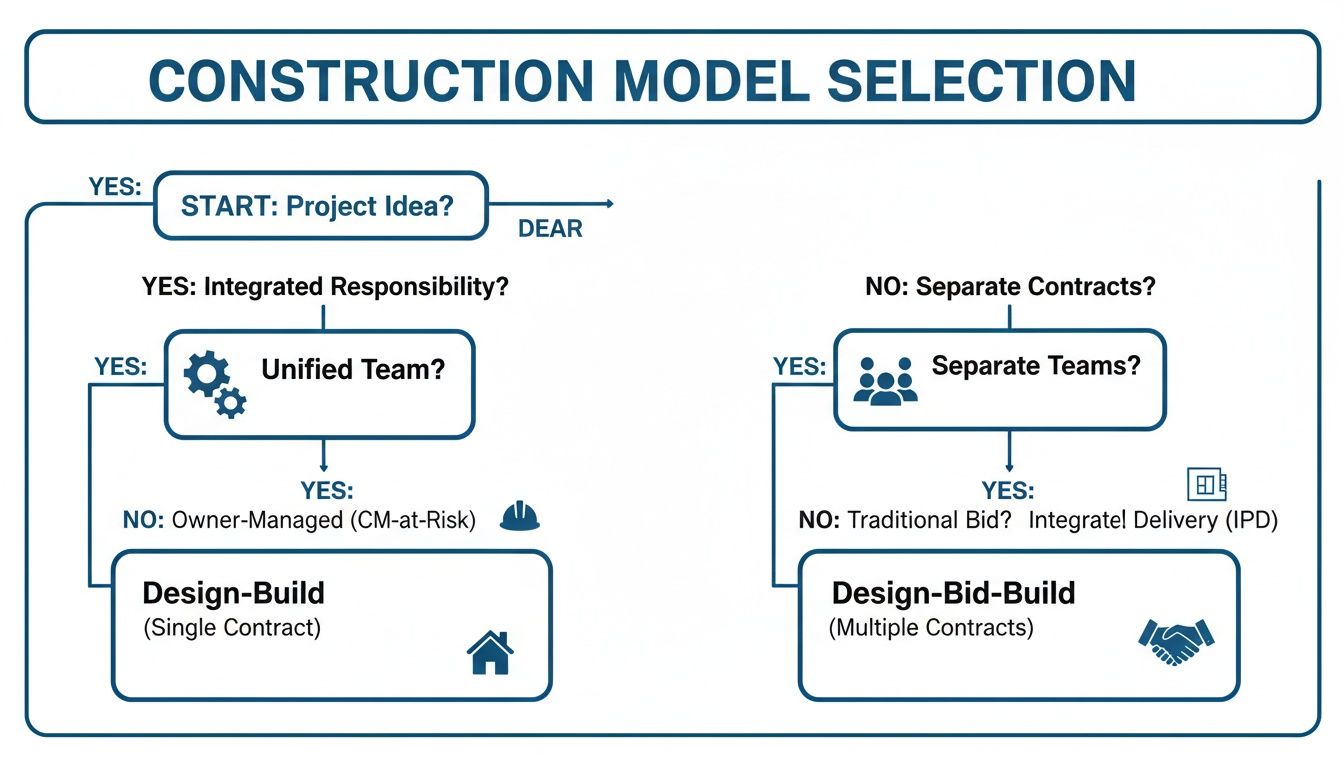
As the flowchart illustrates, the core of your decision hinges on whether you'd rather have a single, integrated partner or work with separate, specialized firms.
As a full-service residential and commercial contractor, Wheeler Painting has deep experience excelling within both models. We can guide your project in Seattle, Tacoma, or Kent, whether you need a single, accountable partner for a tenant improvement or a trusted builder to execute your existing residential remodeling plans.
Our flexibility means we're focused on making your project a success, no matter which path you take. To see how this works in practice, you might find our detailed guide on the design build project delivery method helpful.
Why Design-Build is Reshaping Modern Construction
If you’ve been involved in construction recently, you've probably noticed a major shift in how projects get done. The design-build model is rapidly becoming the preferred approach for projects all across Western Washington and the rest of the country. This isn’t just an industry trend; it’s a smarter, more efficient way to deliver a project from the first sketch to the final walkthrough.
For property owners and facility managers here in the Puget Sound, understanding this shift is crucial. It’s about making an informed decision for your next retail build-out or residential renovation, one that prioritizes efficiency and clear responsibility from start to finish.
A National Shift with Local Impact
This isn't just a local trend. The growth of design-build is a nationwide story. Industry research shows that design-build is on track to represent over 47% of all construction spending in major non-residential markets by 2028. That's a huge leap from just a few years ago. You can review the findings on project delivery methods from industry research.
What this means for homeowners and commercial clients in Western Washington is clear: the market is moving away from the fragmented design-bid-build process. The reason is simple—design-build offers a more integrated and reliable path to a finished project, helping you feel reassured and in control.
The Power of Single-Source Accountability
At its heart, the appeal of design-build comes down to one thing: single-source accountability. Instead of juggling separate contracts for an architect and a builder, you have one unified team responsible for everything.
This setup puts an end to the "blame game" that often happens in traditional projects when design issues cause construction headaches. When one team owns both the design and the construction, everyone is pulling in the same direction—yours.
With a single contract and a single point of contact, the design-build model streamlines communication and decision-making. This ensures that your vision, budget, and schedule remain the central focus throughout the project lifecycle.
This unified approach is a game-changer for commercial projects, especially for:
- Office space renovations in Seattle: Tight timelines demand seamless coordination. Design-build minimizes business disruption by getting your office space renovation done right the first time.
- Retail build-outs in Tacoma: Getting doors open on schedule is non-negotiable. This model fast-tracks delivery so you can start generating revenue sooner.
- Facility construction services for building owners: For facility maintenance and upgrades, you need a partner who understands the building inside and out. As a smaller firm, Wheeler Painting provides the focused attention needed for these mid-size tenant improvement projects.
Because the builder is at the table during the design phase, they provide real-world input on cost and constructability from day one. This early collaboration prevents expensive redesigns and ensures the final plans are not only inspiring but also practical and on budget.
Comparing Project Workflows and Team Responsibilities
How your project unfolds day-to-day depends entirely on the construction model you choose. The differences in workflow between the design-build and general contractor approaches are significant, and they directly shape communication, accountability, and the demands placed on you as the property owner.
Let's break down what the journey really looks like for each model in a clear, straightforward way.
The Traditional Path: Design, Bid, Then Build
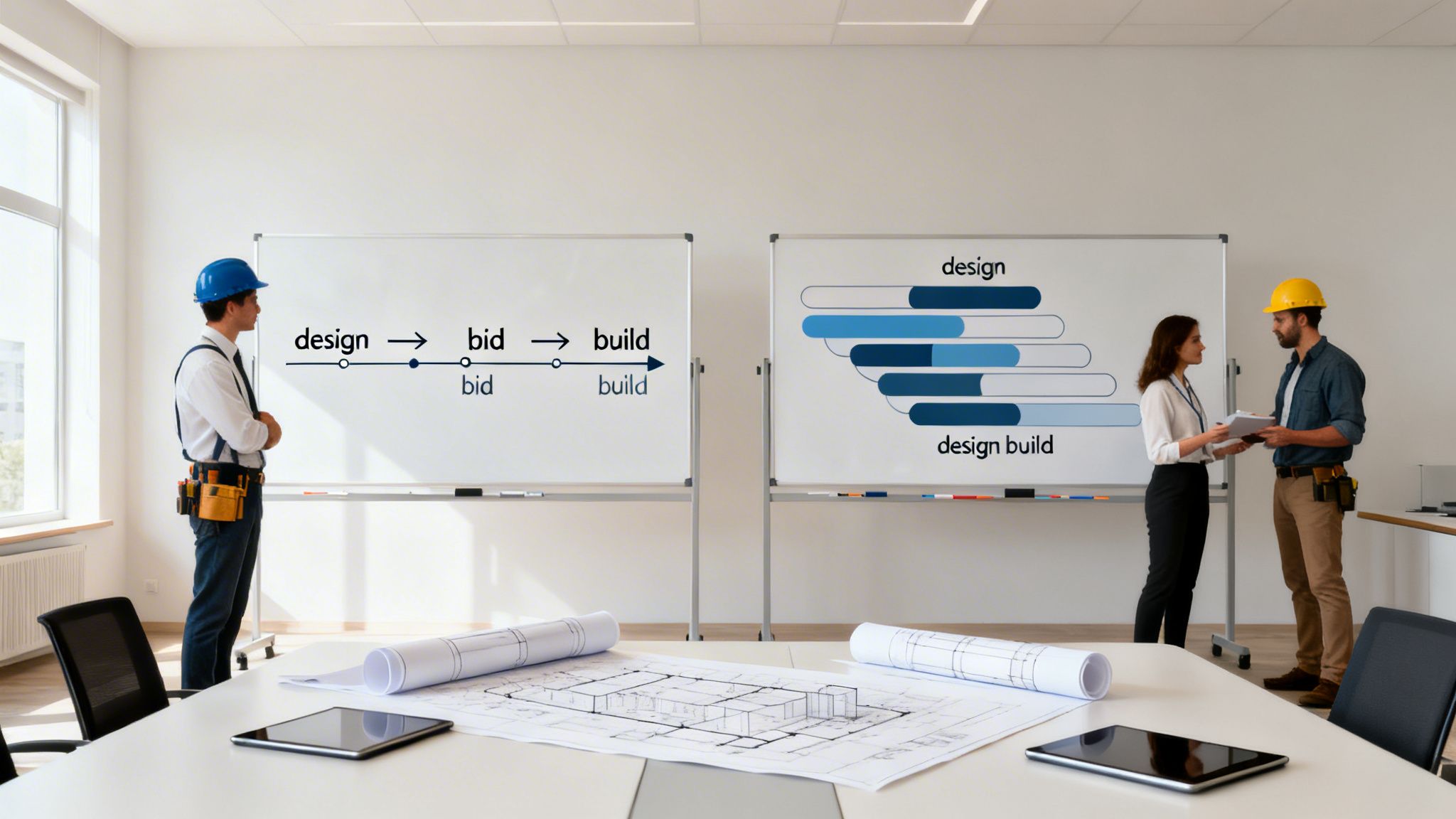
The classic approach is what we call design-bid-build. It’s a very linear, sequential process. Think of it as a relay race, where one professional must completely finish their part before handing the project off to the next.
Your journey starts by hiring an architect or designer to create a full set of construction plans. This design phase often happens separately from the builder who will eventually have to make it a reality. Once the plans are finalized, you take them to market, asking several general contractors to bid on the job. You then select a contractor—often based on the lowest price—and only then does construction finally begin.
This sequence creates distinct, and sometimes challenging, handoffs. Your architect's job is mostly done right when your builder’s is just getting started.
The General Contractor Workflow in Action
So, what does this feel like for a property owner? Imagine you’re planning a commercial tenant improvement for a new retail shop in Kent. Following the traditional model, you hire a Seattle architect who designs a stunning layout.
With these finished plans, you go out for bids. A contractor looking at the job might realize a key material has a long backorder, or that a planned system is incompatible with the building. Because the builder had no input during design, these problems are only discovered now. This can force you back to the drawing board for redesigns and almost guarantees delays before work even starts.
In the traditional model, you become the central hub of communication. You are responsible for mediating any conflicts between the design plans and on-site realities—a role that can be time-consuming and stressful for busy property managers and homeowners.
The Design-Build Workflow: A Collaborative Approach
The design-build model swaps the relay race for a unified team sport. From the very beginning, your designer and builder are working together under a single contract, creating a seamless and integrated workflow. The process is fluid and overlapping, not a rigid sequence of steps.
Let’s apply this to a residential remodeling project in Tacoma. With design-build, our construction experts are in the room with the designer from the first conversation. When the designer suggests a custom island or removing a wall for your kitchen remodel, our team is right there to give instant feedback on structural needs, material costs, and the overall budget. This collaboration prevents surprises and ensures the final design is both beautiful and achievable.
This integrated approach completely changes the accountability structure:
- No more finger-pointing. If there’s an issue, it’s on the single design-build firm to resolve it. The team works together to find a solution.
- Change orders are drastically reduced. Because the builder provides feasibility checks during design, potential issues are caught on paper, not after construction has started.
- Budget certainty is a priority from day one. The design is developed with real-time construction cost data. This means the budget is realistic from the start.
Understanding how project management in residential construction is structured can highlight the practical advantages of having one team. For Wheeler Painting, maintaining clear processes is everything. A detailed construction quality control checklist is central to our success, ensuring high standards are met no matter which model you choose.
Analyzing Project Costs and Budget Management
When it comes to any home addition, commercial renovation, or facility maintenance project, the budget is where the rubber meets the road. How you manage costs shapes the entire experience. The choice between a design-build firm and a general contractor is one of the most significant financial decisions you'll make, and our goal is to help you feel confident in it.
How Design-Build Delivers Budget Certainty
The real financial power of the design-build model is cost predictability. From day one, the builder is at the table with the designer. As ideas take shape, the builder provides immediate, real-world cost feedback on different materials, methods, and design choices.
This early collaboration is your best defense against expensive redesigns. Instead of an architect handing off a finished plan that ends up being over budget, the integrated team finds creative solutions that honor your vision without breaking the bank.
With the design-build approach, potential budget conflicts are resolved on paper, where changes are simple. This is far better than discovering a problem in the field, where the only solution is often an expensive change order.
This is a huge advantage for business owners and facility managers in places like Seattle and Tacoma, who depend on reliable financial forecasting for tenant improvements and other commercial projects.
The Financial Risks of the Traditional Model
The traditional general contractor model (design-bid-build) has a tempting hook: competitive bidding. Once an architect completes the plans, you can send them to several contractors and pick the lowest price.
But that initial low bid can be misleading. The biggest financial trap in this model is that the contractor has no say in the design they are bidding on. They are pricing plans that may have hidden conflicts or impractical details. When those issues surface during construction—and they often do—it can trigger change orders, delays, and surprise costs.
Accurate estimates are critical, but they're only as good as the information provided. Modern construction estimating software helps, but even the best tools can't account for design flaws they don't know about.
A Data-Backed Look at Cost Savings
The cost advantage of design-build isn't just a feeling; the numbers back it up. Research has consistently shown that this integrated method leads to real savings. One comprehensive analysis found that, on average, design-build projects cost 6.1% less than their traditional design-bid-build counterparts. This is almost entirely due to the builder’s early involvement, which catches expensive issues before they happen. You can see the specifics in this federal research on project delivery cost comparisons.
Even more telling, that same research revealed that design-build projects have 5.2% less cost growth after construction begins. For a Puget Sound homeowner planning a remodel or a business owner building out a retail space, that statistic is huge. It translates to a lower risk of facing those dreaded, budget-busting surprises, giving you peace of mind that your initial cost estimate is far more likely to be your final cost.
How Each Model Impacts Your Project's Schedule
When it comes to any construction project, the timeline is everything. For a business owner in Seattle, every day of delay is a day you're not open. For a family in Tacoma, it's another day you're not able to enjoy your newly remodeled home. The path you choose—design-build or the traditional general contractor route—will have a massive impact on that schedule.
Think of the general contractor model as a relay race. The architect must finish their part (the design) completely before passing the project to the builder. This handoff and the step-by-step process naturally build pauses and potential delays into your project from the start.
The Design-Build Advantage: Overlapping Your Schedule for Faster Completion
Design-build throws out the relay race playbook and operates more like a unified team. Since the design and construction experts are on the same team from day one, their work can happen in parallel. This is where you see significant time savings.
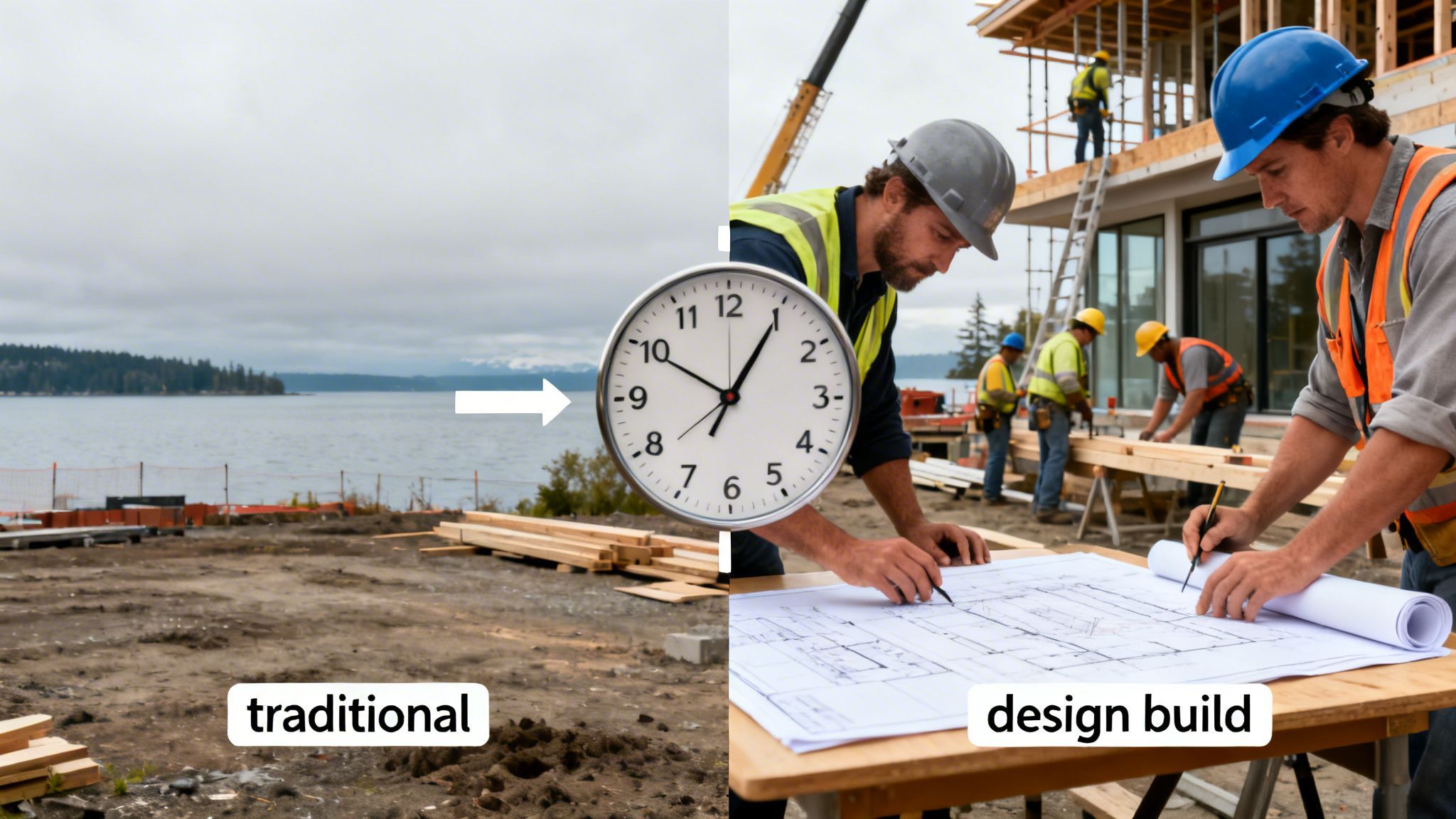
For example, while the final details of the interior finishes are being decided, the team can already be working on site prep, foundation, and framing. We can get a head start on ordering materials with long lead times, like custom cabinets or specialty tile. This integrated approach can shave weeks, and sometimes even months, off a project's total duration.
One of the biggest reasons our local clients love the design-build process is the predictable schedule. By getting rid of the stop-and-start friction of the old model, you get a much smoother and faster journey from the first sketch to the final walkthrough.
More Than Just a Feeling: The Data on Faster Project Delivery
This isn't just a hunch; the speed advantage is backed by solid industry research. A comprehensive study found that the design-build method delivers 12% faster construction speed and an incredible 33.5% faster overall delivery speed compared to the traditional approach. You can dig deeper into how this integrated approach drives project efficiency.
This kind of acceleration is possible because everyone is collaborating from the very beginning. For a property owner, that speed means getting into your space sooner, spending less on project management, and seeing a faster return on your investment.
How This Plays Out on Real Puget Sound Projects
Let's ground this in some familiar local scenarios:
- A Commercial Tenant Improvement in Kent: A retailer needs their new shop open for the holiday season. With design-build, we can fast-track permits and order custom fixtures while the final floor plan is being polished, hitting that critical opening date.
- A Home Remodel in Tacoma: A homeowner needs their kitchen back to normal after a setback. The design-build model lets us begin demolition and structural work almost immediately, drastically cutting down on the time the family is displaced.
- An Office Expansion in Seattle: A company needs to get a new floor ready for a team of new hires. The overlapping phases of design-build create a reliable schedule, which is essential for business planning and minimizing disruption to current operations.
If getting your project done quickly and on a predictable timeline is a top priority, the design-build model offers a clear, proven advantage. For projects all over the Puget Sound, that reliability is a complete game-changer.
Choosing Your Ideal Construction Partner in the Puget Sound
Knowing the difference between the design-build vs. general contractor models is a great start. But the real key to a successful project is picking the right local partner to execute the plan. Your project’s outcome comes down to the experience, flexibility, and communication of the team you hire.
Here at Wheeler Painting, our decades of work as a full-service general contractor across the Puget Sound give us a unique perspective. We have the operational know-how to fit seamlessly into either system, always focusing on what makes the most sense for you and your project.
As Your Partner in a Design-Build Project
When you opt for the design-build route, you’re looking for a single, accountable leader. That's a role we step into with confidence. We manage every detail, from the first brainstorming sessions and cost estimates to the final construction and finishing touches, like interior painting or flooring.
This all-in-one approach is especially effective for projects where collaboration is key:
- Commercial Tenant Improvements: We understand that downtime is lost revenue. We coordinate every detail to get your Seattle retail or office space ready for business, quickly and with minimal fuss.
- Residential Remodeling: For a large kitchen overhaul or a home addition in Tacoma, our integrated team makes sure the design isn't just beautiful but also practical to build and within your budget.
- Custom Decks and Patios: We blend creative vision with solid construction to build outdoor spaces that look great and last for years in our Pacific Northwest climate.
As Your Builder in a Traditional General Contractor Role
If you've already hired an architect and have a full set of plans, our role shifts. We become the dedicated residential contractor or commercial contractor tasked with bringing those plans to life. Our work across Kent, Seattle, and Tacoma shows our skill in translating complex blueprints into high-quality, finished spaces.
In this traditional model, communication is everything. We work closely with your design team to tackle any on-site issues immediately, keeping the project on track. As a "smaller" firm specializing in small to mid-size projects, we provide the focused attention that building owners, property managers, and facility managers are looking for.
Whether you need a single point of contact for the whole project or a skilled builder to execute existing plans, our promise is the same: to make your project straightforward and successful. We are your local expert for everything from siding replacement and custom cabinets to facility maintenance and floor repairs.
Our goal is simple: to build lasting relationships with our clients here in the Puget Sound. We do that by delivering solid, high-quality work and clear communication, project after project. For more on what to look for in a partner, take a look at our guide on how to choose a general contractor.
Common Questions About Construction Models
When you're deciding on a construction partner, it's natural to have questions. Here in the Puget Sound, homeowners and business owners often ask us about the practical differences between hiring a design-build firm versus a general contractor. Here are some of the most common questions, with our straightforward answers.
Which is Better for Smaller Projects?
For more contained projects—like interior painting, deck staining, or siding replacement—hiring a flexible residential contractor near me like Wheeler Painting is usually the simplest route. We can easily manage the entire job and handle any minor design details that come up without needing the formal structure of a full design-build agreement.
The design-build model really shines on larger, more involved projects like a full home addition, a major office space renovation, or a new retail build-out where the design and construction need to be perfectly in sync from day one.
Is There a Difference in Quality Between the Two?
Honestly, the quality of any project comes down to the craftsmanship of the team you hire, not the contract model. That said, the design-build setup has a built-in advantage for ensuring high quality.
When your designer and builder are part of the same team, everyone shares the same goal: a successful project. That single point of accountability eliminates the blame game, encourages creative problem-solving, and often leads to a better finished product.
In the traditional general contractor approach, quality relies on how well your architect and your builder—two separate companies—can communicate. No matter which path you take for your Seattle or Tacoma property, our team at Wheeler Painting brings the same unwavering commitment to craftsmanship to every job, from a simple drywall repair to a complex commercial renovation.
Can Wheeler Painting Recommend an Architect for Me?
Of course. After working as a contractor in Kent, Seattle, and Tacoma for decades, we’ve built strong relationships with some of the best architects and designers in the area. We know who does great work and is reliable.
If you feel the traditional design-bid-build path is the right fit for you, we’re happy to make introductions. Our main goal is to help you assemble a team that you trust and whose style matches your own, ensuring a fantastic result for your project.
Ready to figure out the best approach for your residential or commercial project? The team at Wheeler Painting has the local experience to guide you. Contact us today for a consultation, and let’s start planning together.






 “Like” us on Facebook!