
Epoxy Deck Coating: Durable Protection for Washington Decks
A lot of decks in the Puget Sound region don’t fail all at once. They wear down in small, familiar ways. The boards stay damp longer than they should. Dark patches show up near rail posts. The walking surface starts to feel rough, tired, or a little soft in the spots that never seem to dry out. On commercial properties, the problem looks different but comes from the same place. Water gets into the surface, traffic grinds the finish down, and maintenance becomes a repeat job instead of a long-term fix.
That’s why epoxy deck coating gets so much attention from property owners who are tired of short-lived solutions. In a wet climate like Seattle, Kent, Tacoma, and the communities in between, the right coating isn’t just about appearance. It’s about keeping moisture out, reducing surface wear, and giving the deck a finish that can handle the environment.
Protecting Your Deck from the Puget Sound Weather
You see it all the time around Puget Sound. A deck looks fine at a glance in June, then by fall the coating is peeling near the stairs, the shaded corners stay slick, and the traffic path is worn down to bare material. The structure may still be serviceable, but the surface has already started letting water in.
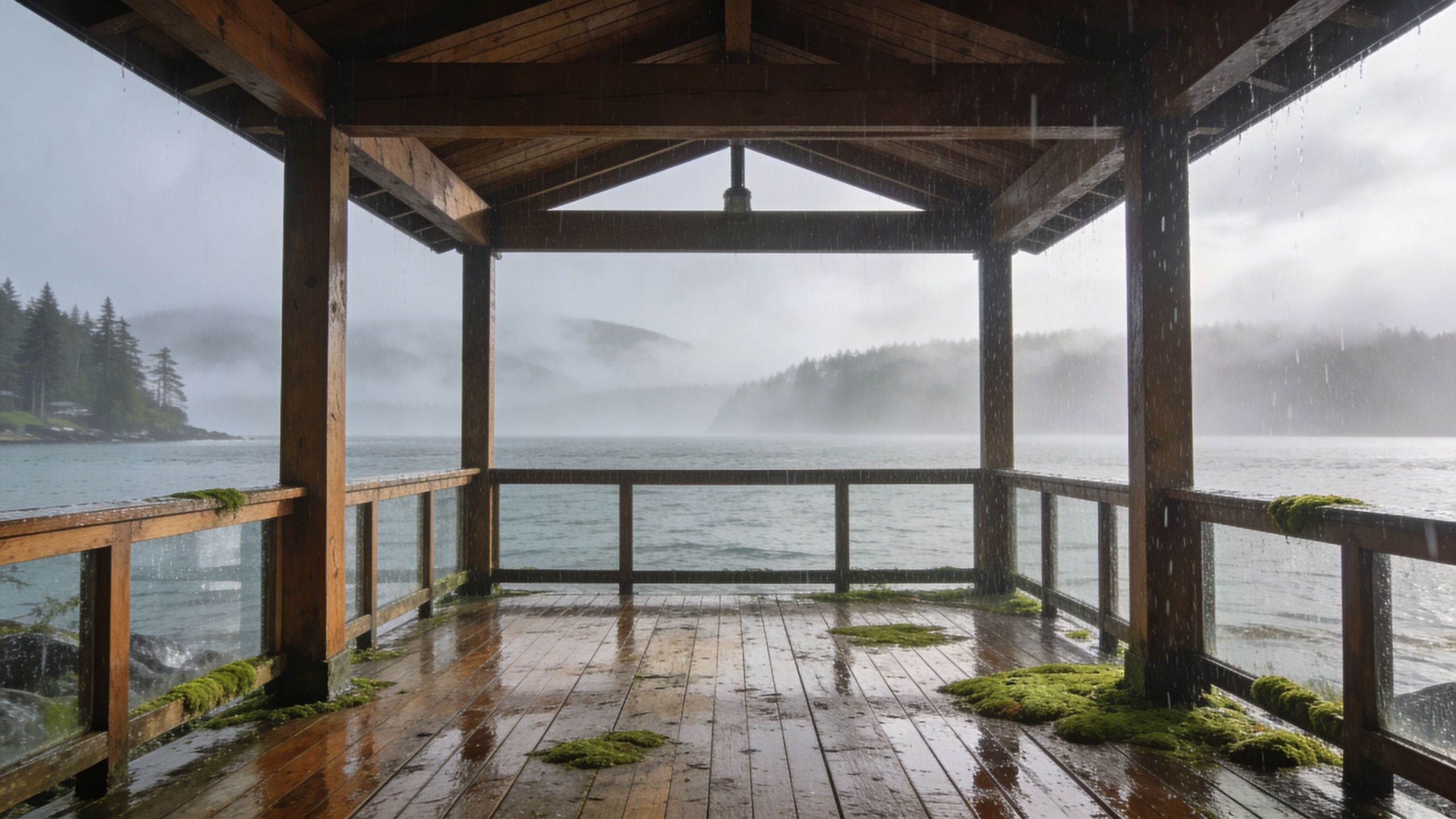
That cycle is common here because our weather keeps testing the same weak spots. Residential wood decks hold moisture around fasteners, rail bases, and board gaps. Commercial concrete walkways and balconies have a different build, but they face the same pressure. Water sits on the surface, foot traffic grinds contaminants into the finish, and short dry spells rarely give failing coatings much of a recovery window.
Locally, this means your deck needs a finish that is tougher than what looks good on day one.
Why weather beats ordinary deck finishes here
In Western Washington, surface failure usually comes from repeated exposure rather than one major storm. I tell property owners to watch for the conditions that keep a deck wet longer than expected and wear a coating down faster than the label suggests.
- Long damp periods: Rain, fog, shade, and cool air slow drying and keep moisture at the surface.
- Organic buildup: Moss, mildew, pollen, and dirt trap water against wood and concrete.
- Seasonal movement: Wood swells and shrinks. Concrete can develop hairline cracking and moisture-related stress.
- Daily wear: Foot traffic, furniture, planters, deliveries, and routine cleaning wear out weak films fast.
The practical question is not whether a coating can survive a nice week in August. The question is how it handles nine months of moisture, dirt, temperature swings, and regular use.
Property owners who are already looking at moisture control often benefit from understanding waterproofing in construction, because deck protection works best as part of the full water-management plan for the building.
A good coating helps. Surface prep matters just as much. On wood, trapped moisture, rot, or unstable boards can ruin a coating job no matter what product goes on top. On concrete, contamination, laitance, and hidden moisture vapor can cause bond failure if they are not addressed first. That is why product choice has to match the substrate and the site conditions, especially in the Puget Sound climate.
The same coating logic applies in harsher moisture environments. This overview of superior vessel protection shows how coating systems are selected when water exposure is constant and failure has real consequences.
What Exactly Is an Epoxy Deck Coating
An epoxy deck coating is a two-part system made from resin and hardener. Once those parts are mixed at the right ratio, they cure into a bonded film that is much harder and thicker than ordinary deck paint.
On the right surface, that film does more than add color. It creates a wear layer that helps resist water, abrasion, and chemical exposure, which is why epoxy shows up on garage floors, commercial walkways, mechanical rooms, and some deck assemblies that need more protection than a stain or sealer can provide.
In Puget Sound, that distinction matters.
A deck in this region may stay damp for long stretches, collect organic buildup, and see regular foot traffic even outside the dry season. For residential owners, the question is often whether epoxy makes sense on a wood deck, a plywood traffic coating assembly, or a concrete patio or balcony. For commercial properties, it usually comes down to whether the system can bond well, hold up to use, and stay serviceable under wet conditions.
How epoxy behaves on a deck surface
Once cured, epoxy forms a dense, tightly bonded coating over the substrate. On concrete, that can produce a hard, continuous surface with much better wear resistance than standard paint. On traffic-bearing deck systems, epoxy often serves as part of a larger build that can include primers, aggregate, intermediate coats, and a UV-stable topcoat.
That last point is where owners get tripped up. “Epoxy deck coating” is not one universal product. It is a category of materials used in different ways depending on whether the surface is wood, plywood, or concrete, and whether the goal is waterproofing, abrasion resistance, easier cleaning, or all three.
For a closer look at how these systems differ from standard coatings on hard surfaces, this guide on what epoxy floor coating is gives helpful background.
The main epoxy types you’ll hear about
The type of epoxy affects odor, cure speed, application limits, and long-term performance.
100% solids epoxy
These are thicker, higher-build products often used where film strength and wear resistance matter. Product specifications published by ArmorGarage’s epoxy floor specifications show that some professional-grade systems are formulated with zero VOC content and can deliver strong adhesion, impact resistance, and low abrasion loss. In deck work, that can be useful on concrete or protected traffic surfaces where a thicker build is part of the system.Water-based epoxy
These products usually have lower odor and can be easier to work with on occupied properties. Industry analysts cited earlier reported that water-based epoxy holds a large share of the market and continues to grow, which lines up with what contractors see in the field. Owners often ask for lower-odor options, especially in multifamily and commercial settings. The trade-off is that the right choice still depends on the substrate, moisture conditions, and expected wear.Solvent-based epoxy
These systems are still used, but they are less common where odor control, VOC restrictions, or occupied spaces are part of the job.
What epoxy is, and what it is not
Epoxy is strong, but it is not a cure-all. On exterior decks in Western Washington, epoxy usually performs best as part of a full coating system, not as a stand-alone promise. Many assemblies need a compatible primer and a UV-resistant topcoat because epoxy by itself can amber or chalk in sunlight.
Wood decks need extra caution. Natural wood moves with moisture and temperature swings, and rigid coatings do not always tolerate that movement well. Some wood or plywood deck assemblies can be coated successfully, but only if the structure is sound, the moisture content is acceptable, and the coating system is designed for that use. Concrete is often a better fit because it is more dimensionally stable, though it brings its own issues with moisture vapor and surface contamination.
Material choice always follows exposure. The same principle shows up in marine work, where constant water contact pushes owners to compare resin types carefully. This article on understanding boat epoxy options is a good example of how environment and use drive the selection.
The practical takeaway is simple. Epoxy deck coating means a high-performance resin system that can protect the right deck very well, but only when the product, the substrate, and the Puget Sound conditions are matched correctly.
Epoxy Coatings Compared to Traditional Deck Finishes
A deck owner usually isn’t choosing between “good” and “bad.” The choice is between finishes that solve different problems.
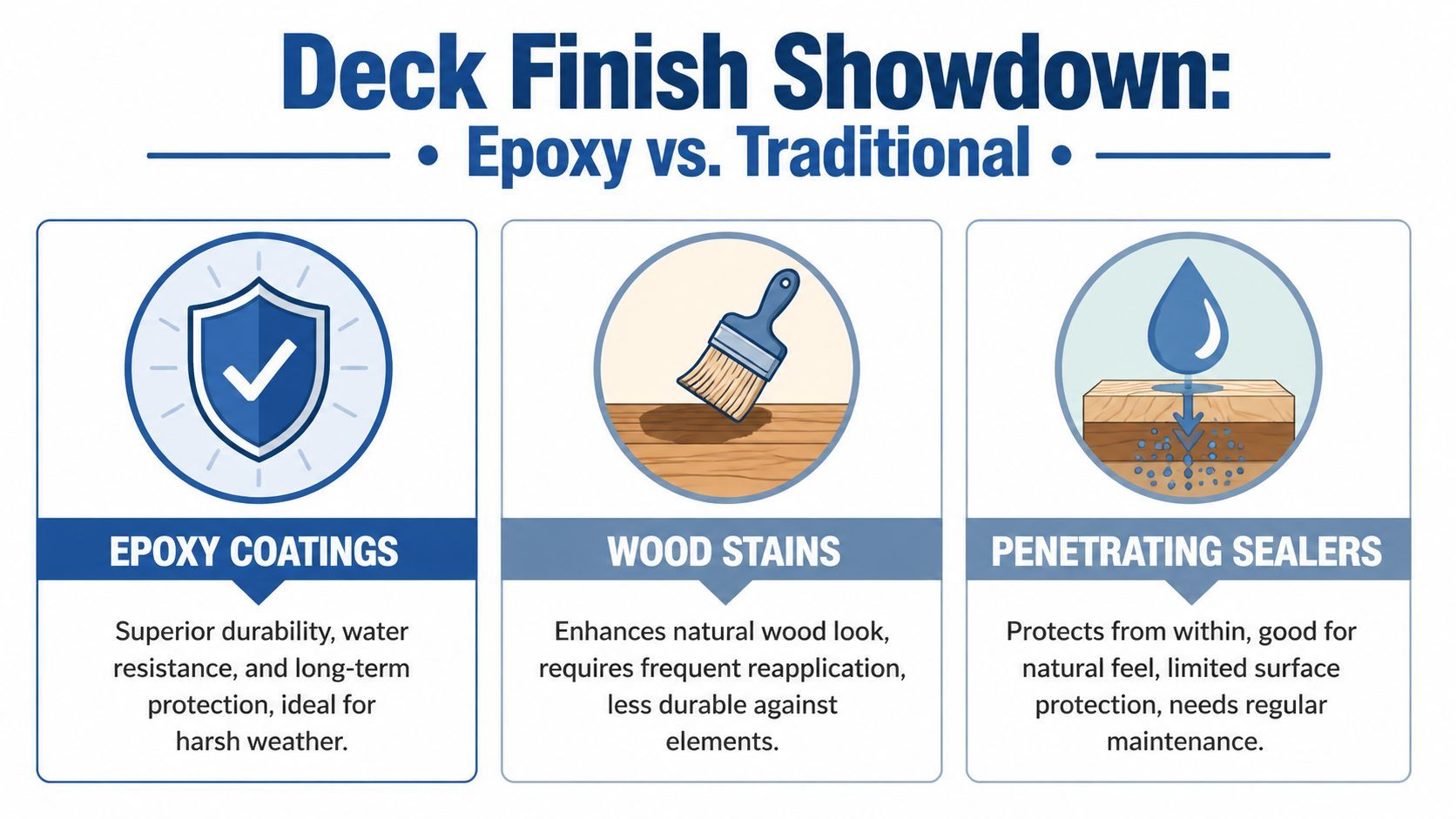
If you want to keep a natural wood look and don’t mind regular upkeep, a stain may be the right answer. If you want a breathable treatment that penetrates wood fibers, a sealer may fit. If you want a more substantial protective surface on the right substrate, epoxy moves into a different class.
Where epoxy stands apart
In Western Washington, owners usually care about five things more than anything else:
- How well the finish handles water.
- How it stands up to foot traffic and furniture.
- Whether sunlight breaks it down.
- Whether the surface encourages mildew and grime.
- How often it needs attention.
Traditional stains do a good job of preserving the look of wood, but they don’t build much surface thickness. Penetrating sealers can help reduce water absorption, but they don’t create a wear layer. Standard deck paints can improve appearance quickly, yet they often struggle when the underlying surface stays damp or moves too much.
Epoxy can outperform those options when the substrate and system are a good match. On concrete decks, balconies, walkways, and similar surfaces, it provides a more substantial barrier and stronger wear surface. That’s one reason epoxy is central to the parking deck coatings market, which is valued at USD 2.49 billion in 2025 and projected to reach USD 4.00 billion by 2033 at a 6.1% CAGR according to Data Bridge Market Research on parking deck coatings. The same source notes water-based variants hold 45.70% market share in 2026, which shows how important lower-emission systems have become in this category.
Deck Coating Performance in Western Washington
| Coating Type | Waterproofing | Durability (Foot Traffic) | UV Resistance | Lifespan (Typical) | Best For |
|---|---|---|---|---|---|
| Epoxy Coating | Strong surface barrier when properly installed | High on suitable substrates | Needs protective topcoat for exterior use | Varies by exposure, substrate, and installation quality | Concrete decks, balconies, commercial walking surfaces, select specialty systems |
| Wood Stain | Moderate water repellency | Lower surface wear protection | Usually better for preserving wood appearance than building a thick film | Requires regular maintenance | Residential wood decks where natural grain matters |
| Penetrating Sealer | Good absorption-based moisture resistance | Limited surface wear protection | Depends on product and sun exposure | Requires routine reapplication | Owners wanting a natural feel with less film build |
The trade-offs owners should understand
Epoxy isn’t automatically the best answer for every deck.
- For natural wood appearance: Stain usually wins.
- For rigid surface protection on concrete: Epoxy is often stronger.
- For wood that moves a lot: A rigid coating can become a liability if the system isn’t designed for that movement.
- For long-term exterior appearance: Topcoat choice matters as much as the epoxy itself.
Owners who are deciding between a film-forming coating and a more traditional finish often benefit from reading about paint or stain first, because the wrong expectation causes a lot of disappointment. Some people want protection but still expect to see raw wood character. Others want a clean, uniform, easier-to-clean surface and don’t mind a more coated look.
A deck finish should match the deck’s job. A lakefront wood deck, an apartment balcony, and a loading-area walkway don’t need the same system.
The Professional Epoxy Application Process An Overview
Most epoxy failures start before the coating is opened. The weak point is usually preparation, not the material itself.
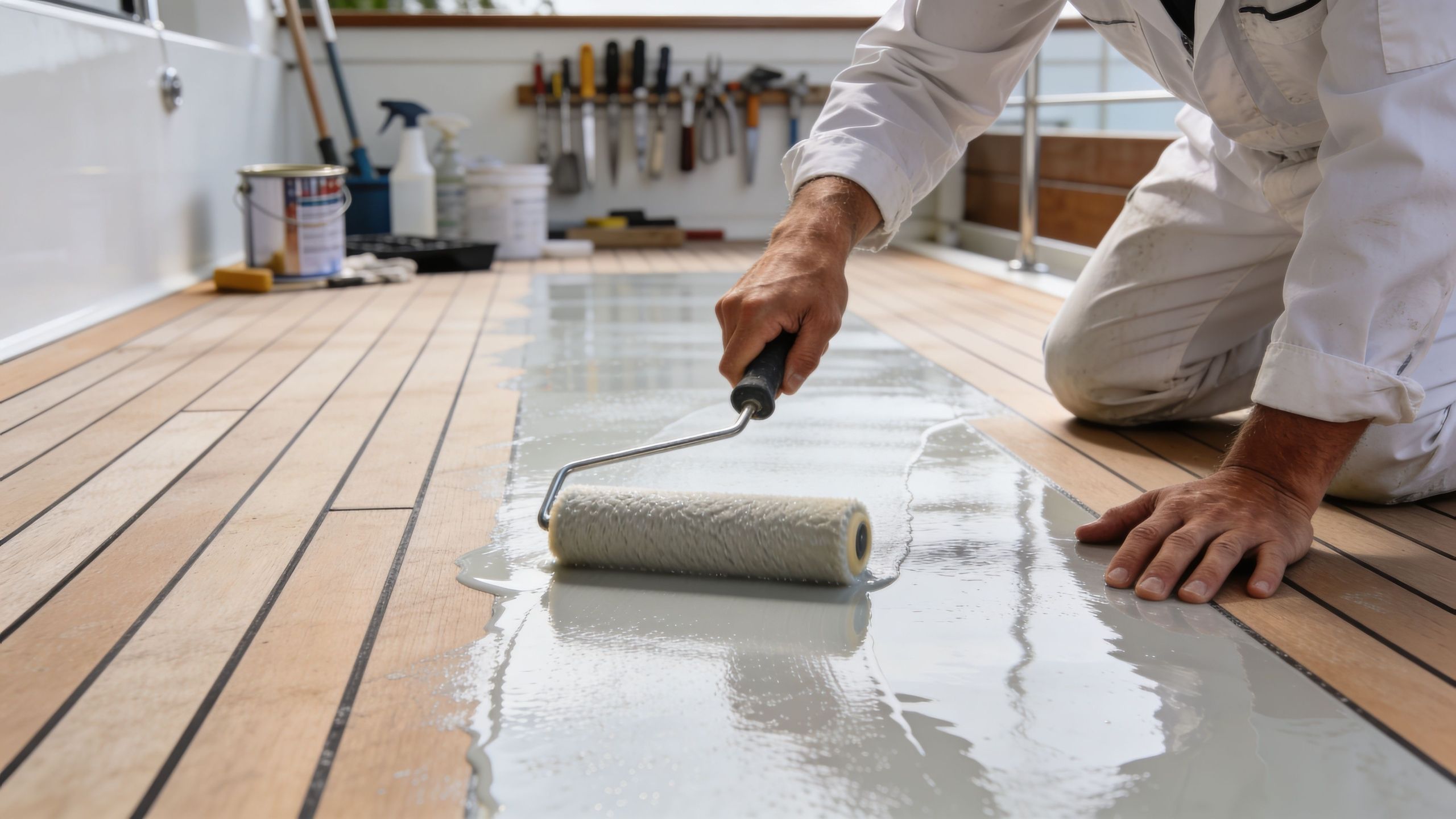
A professional crew doesn’t treat epoxy deck coating like ordinary repainting. The work begins with substrate evaluation, moisture concerns, existing coating compatibility, repair needs, and how the deck drains.
Inspection and preparation come first
Before coating starts, the deck has to be checked for issues that no coating can solve on its own. That includes rot, loose boards, failing concrete, active cracks, trapped moisture, and bad slope. If the substrate is wrong, the finish won’t save it.
Preparation often includes:
- Cleaning the surface thoroughly: Dirt, chalking, mildew, oils, and old failing coatings have to go.
- Removing weak material: Loose paint, delaminated layers, and contaminants break bond strength.
- Repairing defects: Cracks, spalls, soft spots, and damaged transitions need attention first.
- Creating the right profile: Concrete may need grinding or mechanical preparation. Wood may require sanding and selective repair.
Even cleaning methods need judgment. Composite and specialty surfaces can be damaged by aggressive washing, which is why a practical piece like how to power wash Trex decks is a good reminder that prep has to fit the material.
Mixing, placement, and timing matter
Epoxy is unforgiving about ratios and working time. Once mixed, the clock starts.
Verified product data for professional 100% solids systems shows coverage rates often run 200 to 300 square feet per gallon for primer and topcoat applications, while certain trowel or squeegee methods and roller methods change actual spread rates. The same product data notes cure times are highly temperature dependent. A system ready for light traffic in 24 hours at 75°F can take up to 96 hours at 50°F according to Life Specialty Coatings technical information. In the Puget Sound region, that scheduling difference is not minor. It affects occupancy planning, weather windows, and how long a deck stays out of service.
Field note: Cool weather doesn’t just slow curing. It changes jobsite planning, staging, and when people can safely get back onto the surface.
A short look at application in action helps show why technique matters:
The finish coat is only part of the system
A professional installation usually involves more than one layer. Depending on the system, there may be a primer, build coat, broadcast texture for slip resistance, and a protective topcoat. Each layer has a job.
Some layers improve adhesion. Some build film thickness. Some create texture. Some protect the epoxy from wear or sun exposure. If any layer is skipped without a good reason, the whole system can become the weak point.
Special Considerations for Puget Sound Decks
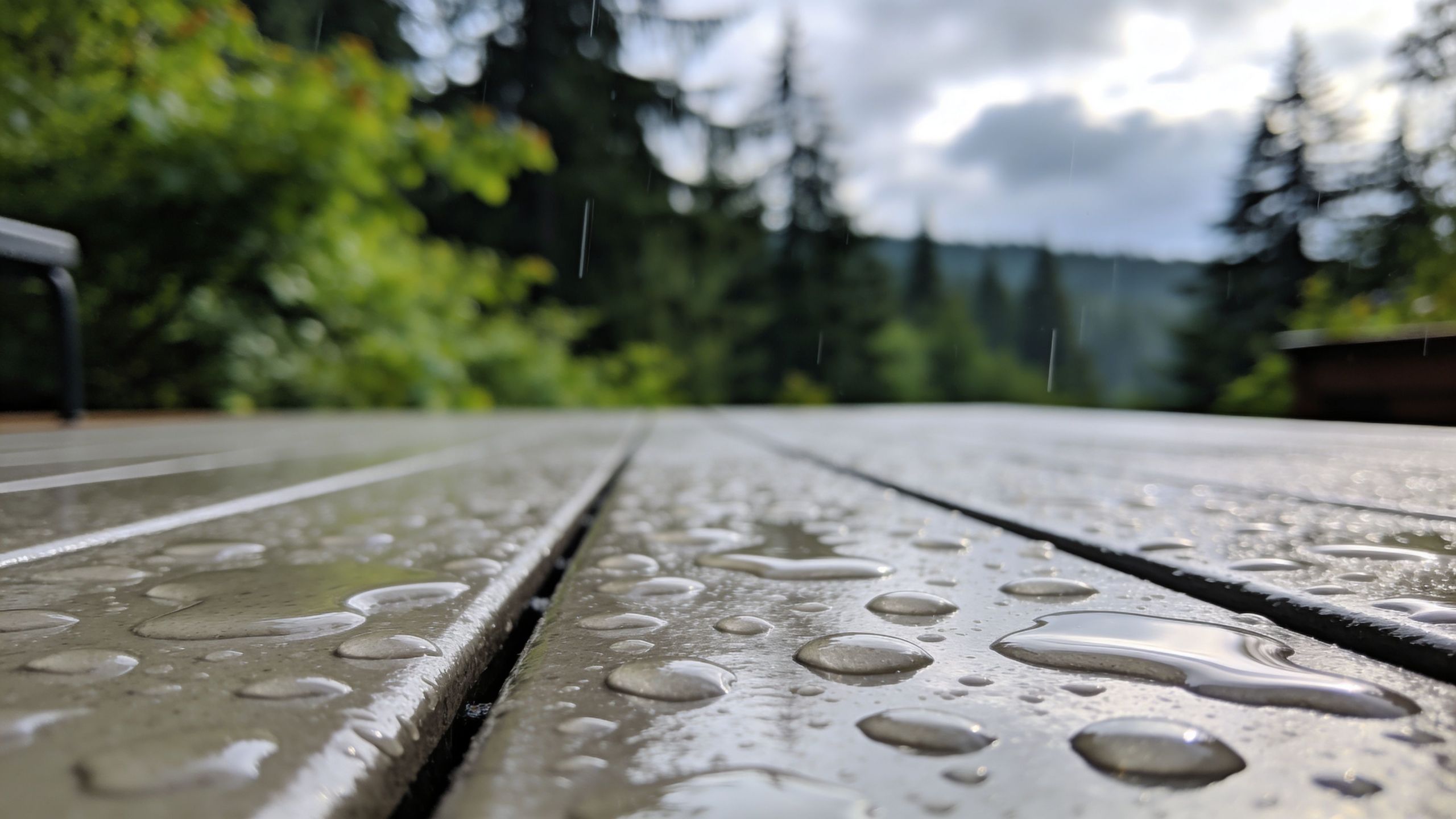
A deck that looks fine in July can stay damp for days by October. In the Puget Sound area, that long wet season changes what works and what fails. Coating choices here need to account for steady moisture, cool temperatures, shade, moss, and the stop-and-start drying cycle that hits both backyard decks and commercial walking surfaces.
Why wet regional conditions change the coating decision
In Western Washington, the main problem is rarely one big weather event. It is repeated moisture exposure. Water gets into small cracks, open grain, fastener penetrations, and weak coating edges. Then the surface stays cool and shaded long enough that it never fully dries before the next round of rain.
That pattern is hard on decks.
A properly selected coating system can limit water intrusion and make the surface easier to wash down, especially on concrete walk decks, exterior corridors, podium areas, and entries. Owners usually notice the appearance first. The bigger benefit is that a continuous film leaves fewer places for water and dirt to sit.
That said, epoxy is not automatically the right answer just because the climate is wet. Drainage still has to work. Low spots still need to be corrected. If water ponds on the surface, even a good coating system ends up under more stress than it should.
Wood decks need more caution than concrete decks
Many homeowners ask about epoxy after getting tired of re-staining a wood deck every few years. I understand the appeal, but wood creates real limits for rigid coatings.
Wood swells when it takes on moisture and shrinks as it dries. It also flexes under foot traffic and moves at joints, seams, and board ends. Standard epoxy handles bond and wear well, but it does not stretch much. On an older residential deck, that mismatch often leads to cracking, edge failure, or peeling around board movement.
That is why wood decks need an honest inspection before anyone talks about coatings. I look at moisture exposure, board condition, fastener movement, joint spacing, cupping, and how much shade the deck gets. If the framing and surface boards are moving too much, a flexible exterior system or a traditional finish is usually the safer recommendation.
A few practical filters help:
- Weathered or unstable boards usually do not hold a rigid film for long.
- Seasonal joint movement can split the coating or break the bond line.
- Visible wood grain goals do not match an epoxy build.
- Covered or more controlled deck areas may allow specialty systems, but only after careful prep and realistic expectations.
For many Puget Sound wood decks, restraint is part of good advice. The right call is the one that fits the substrate, not the one that sounds toughest on paper.
Concrete decks are usually the better epoxy candidate
Concrete is generally a stronger fit for epoxy, especially on balconies, breezeways, podium decks, exterior stairs, service areas, and commercial entries. Those surfaces are more dimensionally stable than wood, and they benefit from epoxy’s adhesion, wear resistance, and easy-to-clean finish.
This matters on commercial properties in our area. Wet shoes, grit, planters, de-icing residue, and regular foot traffic wear down unprotected concrete fast. A properly built coating system helps protect the surface while giving owners a cleaner, more uniform walking area.
Common good candidates include:
- Apartment and condo balconies
- Exterior corridors and breezeways
- Retail and office entry platforms
- Utility and service walkways
- Some parking-adjacent concrete surfaces
Even on concrete, the details decide the outcome. Cracks need to be evaluated, not just covered. Expansion and control joints need the right treatment. Slip resistance matters more here than it does in drier climates, because a smooth exterior finish can become risky during long wet stretches. Sun exposure matters too, especially on decks that get direct afternoon light after months of cloud cover. A system that works well in Tacoma or Seattle often includes texture and a protective topcoat chosen for exterior use, not just a basic epoxy layer.
Expected Lifespan Cost and Maintenance
Property owners usually ask three direct questions. How long will it last, what will it cost, and what do I need to do after it’s installed.
The honest answer is that lifespan and cost vary too much by substrate, prep needs, repair scope, texture requirements, and topcoat selection to give one universal number without seeing the deck. A simple concrete balcony in good shape is not priced or maintained like a weathered exterior platform with repairs, drainage issues, and coating removal.
What affects service life most
The coating itself matters, but these factors usually matter more:
- Surface preparation quality: Poor prep shortens life fast.
- Substrate condition: Coating over weak material doesn’t produce a durable result.
- Sun exposure: Exterior UV breaks down unprotected epoxy.
- Traffic and use: Chairs, planters, carts, grit, and cleaning methods all affect wear.
- Water management: Ponding water and bad drainage stress any coating system.
One important long-term consideration: Standard epoxy coatings are not UV-stable and require a polyurethane or polyaspartic topcoat to help prevent yellowing and chalking in exterior use, as explained in this guide to deck coating options and topcoat requirements. If someone prices an exterior epoxy deck coating without talking seriously about UV protection, that’s a warning sign.
Maintenance is simple, but it isn’t optional
Epoxy is lower maintenance than many traditional finishes when it’s installed correctly, but it’s not maintenance-free.
A practical care plan usually includes:
- Regular cleaning: Remove grit, wet debris, leaves, and dirt before they grind into the finish.
- Fast response to damage: Address chips, cuts, or bond loss before water gets underneath.
- Drainage checks: Keep scuppers, drains, and edges clear so water doesn’t sit.
- Protective habits: Use care with heavy furniture, sharp metal edges, and dragged equipment.
A deck coating lasts longer when owners treat it like a protective system, not a permanent surface that can be ignored.
When recoating becomes the smart move
Owners don’t need to wait for full failure. A review is usually worth scheduling when you notice:
- surface chalking or fading,
- worn traffic paths,
- localized peeling,
- cracking around details,
- persistent staining that no longer cleans up well,
- or a topcoat that has clearly thinned in exposed areas.
On commercial properties, early maintenance is often cheaper and less disruptive than waiting for larger breakdown. On residential decks, catching wear early helps prevent moisture from turning a coating issue into a substrate repair issue.
Why Choose Wheeler Painting for Your Deck Project
Epoxy deck coating only performs as well as the planning behind it. That’s why local experience matters so much. A contractor working in Seattle, Kent, Tacoma, and the surrounding communities has to understand more than product labels. They need to know how damp weather affects scheduling, how different substrates behave after a long rainy season, and when a deck should be repaired, coated, or handled with a different system entirely.
Wheeler Painting & Restoration Services has served the Puget Sound and Western Washington region since 1991, with residential and commercial experience that fits both homeowners and facility managers. That range matters. A residential wood deck, a commercial walkway, and a tenant improvement surface each need a different approach, even when people use the same general term for the job.
For property owners looking for a dependable residential contractor near me, or managers searching for commercial painting services near me and practical specialty coating support, the value is having one accountable team that can evaluate the substrate, explain the trade-offs clearly, and carry the project through with discipline. That’s especially useful for smaller to mid-size tenant improvement work, facility maintenance, and deck-related protection where communication and follow-through matter just as much as the finish itself.
Frequently Asked Questions About Epoxy Deck Coatings
Is an epoxy deck coating slippery when wet
It can be if the system is installed as a smooth finish without texture. That’s why professionals often build in slip resistance with broadcast aggregate or a textured topcoat. The right texture depends on whether the deck is residential, commercial, barefoot traffic, or heavy-use pedestrian traffic.
Can epoxy be applied to any wood deck
No. That’s one of the biggest misconceptions. Wood movement, moisture content, board condition, and joint behavior all matter. Some wood decks are poor candidates for rigid epoxy systems, and a responsible contractor should say so.
Why do DIY epoxy deck projects fail so often
Most failures come from bad preparation, incorrect mixing, moisture issues, wrong weather conditions, or choosing a system that doesn’t fit the substrate. Epoxy is less forgiving than ordinary paint. Small mistakes during prep or application often turn into peeling, bubbling, or uneven cure.
How soon can the deck be used again
That depends on the system and temperature. Verified technical guidance shows some professional 100% solids systems can be ready for light traffic in about a day at warmer temperatures, while cooler conditions can extend that timeline significantly. In Western Washington, cure planning should always be based on actual site conditions, not best-case assumptions.
Does exterior epoxy need another coating over it
Yes, in many cases. Exterior epoxy usually needs a UV-stable topcoat to help protect against yellowing and chalking. That topcoat is part of the long-term system, not an optional extra.
If your deck, balcony, walkway, or exterior concrete surface needs a coating system that makes sense for Western Washington weather, Wheeler Painting & Restoration Services can help you evaluate the substrate, explain the trade-offs, and recommend a practical path forward. Whether you’re a homeowner planning an upgrade or a property manager coordinating maintenance or tenant improvement work, reach out to schedule a conversation about the right deck protection for your Seattle, Kent, or Tacoma area property.







 “Like” us on Facebook!